จำนวน Repository ( 5 )

การออกแบบเครื่องแต่งกายสุภาพสตรีรูปแบบฮิปปี้โดยได้รับแรงบันดาลใจจากผ้าพื้นเมืองชนเผ่าลีซอ อาเภอปาย จังหวัดแม่ฮ่องสอน
This project aims to study the costume designers hippie style was inspired by a native tribe Lisu in Mae Hong Son province . Get ideas from hippie clothes. The study was led by the appearance of the hippies in the 70s applied. Such a combination of cloth into garments by tribal technique of cloth Lisu tribe is to cut the fabric. Cloth Lisu tribe is a unique fabric is made with a variety of colors. Fold the fabric diagonally line by line. The need to fold into a rectangular or triangular piece by piece then bring the two sides together fold then bossed by hand one by one. And integrated into a fabric. Colorful The distinctive characteristics that are unique in design. The instrument used in this study. An analysis of patterns of cloth Lisu tribes. By the analysis of two 1. Patterns 2. Colors include a focus on the physical aspect. And image analysis the overall portfolio. To be creative costumes. The study found that Pattern of cloth Lisu tribe is overlapping geometry as a pattern. With the use of warm colors and cool contrast to the dominant pattern. Thus the study took the data to the application in the design model focusing on bringing hippie motifs applied in costume.
การพัฒนารูปแบบเครื่องนุ่งห่ม จากผ้าทอพื้นเมือง จังหวัดพิษณุโลก
The research entitled “Development of Designed Clothing from Native Woven Fabrics of Phitsanulok” aims to 1) investigate the information of Phitsanulok’s native woven fabric patterns 2) develop designed clothing from native woven fabrics of Phitsanulok and 3) measure the consumer satisfaction for the clothing from native woven fabrics of Phitsanulok. The sample of this research comprised 398 working age women selected by using the accidental sampling technique form working age woman resided in Mueang district of Phitsanulok province. The questionnaire and clothing prototypes were used as a tool for the consumer satisfaction data collecting. The descriptive used for statistical analysis in the study were the frequency percentage arithmetic mean and standard deviation.
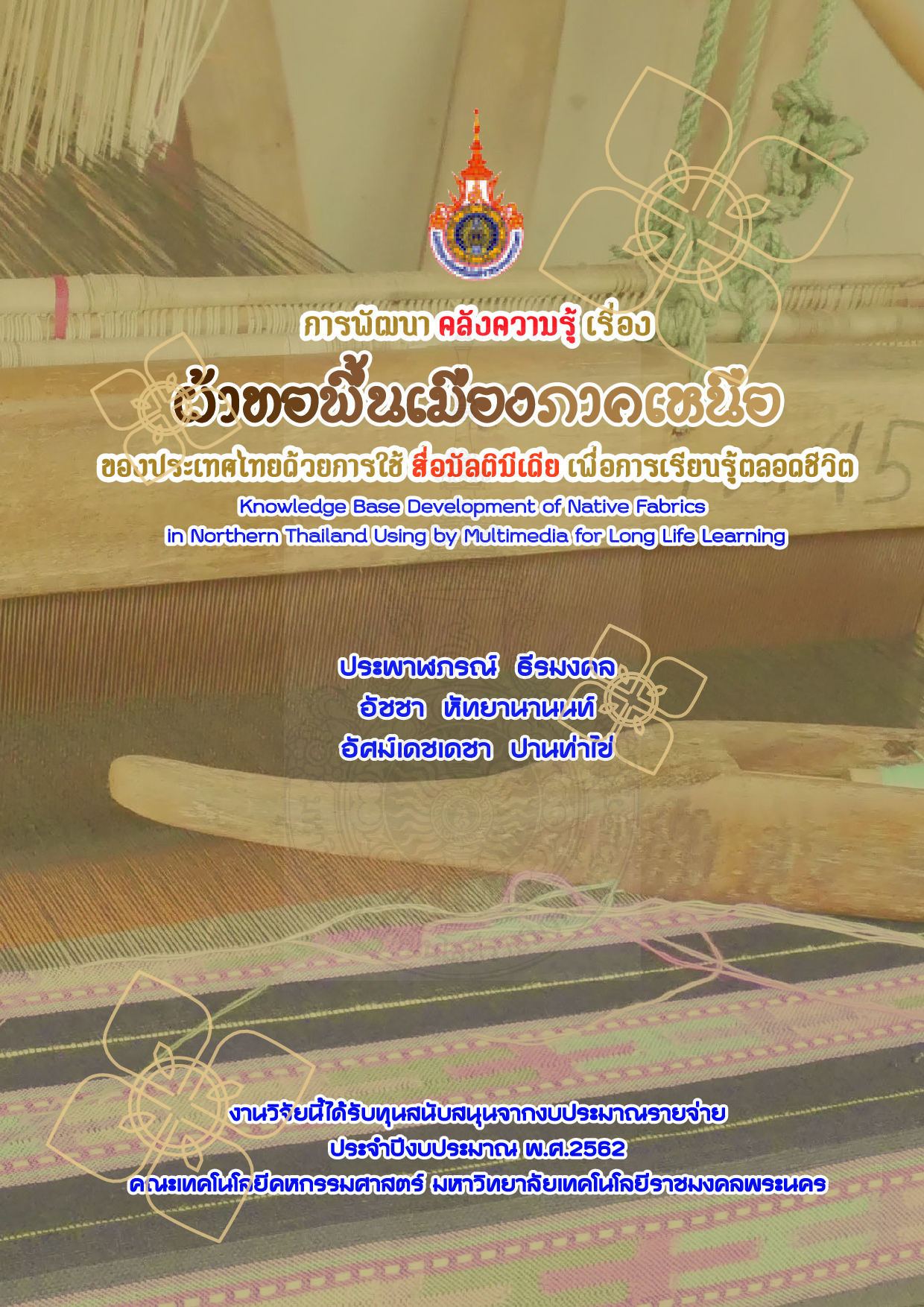
การพัฒนาคลังความรู้เรื่องผ้าทอพื้นเมืองภาคเหนือของ ประเทศไทยด้วย การใช้สื่อมัลติมีเดียเพื่อการเรียนรู้ตลอดชีวิต
This research is the development of the knowledge base on local textiles of northern Thailand by using multimedia for lifelong learning. The aim is to study compile and gather information of local cloths in northern Thailand. Develop a knowledge base by using multimedia on the local textiles of northern Thailand for lifelong learning and transferring knowledge and disseminating the knowledge base on northern Thai fabric by using multimedia for lifelong learning to the community. The research team proceeded to gather primary knowledge from the roots of the researchers who are interested in the local woven fabric. Therefore proceeding further knowledge in the upper reaches from literature reviews Including from field trips for data collection through in-depth interviews with important people Interviewing people who have knowledge about social context community local weaving characteristics weaving characteristics name of pattern type of fabric weaving technique of local textiles in northern Thailand in 9 provinces as well as studying primary data from textbooks textbooks and technical documents and in the internet. Thus the research shown that into 3 parts which are 1. Ethnic groups of Northern Thailand 2. Local woven fabric in northern Thailand and 3. Woven process and pattern. After that the knowledge library was developed by using multimedia on the local textiles of Northern Thailand for lifelong learning. This research can summarize the results in the form of a written description showing that the northern region of Thailand in the past was the Lanna Kingdom area. In the area of Xishuangbanna Before moving to the north of Thailand including the Tai Lue Tai Kheen Thai people Tai Yai people Meng (Mon) Lua people villages scattered throughout the highlands of the Lanna region such as Karen (Pak Kahen M) Mien (Yao) Hmong (Meo) Akha (Akha) Lahu (Mso) Lisu. In addition there are some groups in the Lanna fringe such as Khmu Labri (Tong Lueang). Each ethnic group has its own unique style especially Common skirt Has the same basis with the resin head the resin body and the resin tip but each part is not woven differently Have different colors Some ethnicities have a section called Lep which is the part that the weaver often weaves to keep the thread as for knowledge transfer. The research created a book Local woven cloth consists of videos from local knowledge sources and digital documents and to make the transfer of knowledge more complete Therefore held a forum and exhibition on the topic primary fabric of Lanna Kingdom as a medium for those interested in Local woven fabrics in the Lanna Kingdom of Thailand attended. Exchange ideas from various sources of knowledge from the research. While also receiving multimedia for lifelong learning from the inquiry regarding the satisfaction of the participants. The Keynote speakers are interesting and event condition caused the interest in the knowledge content that used to organize the exhibition. Overall the work is most satisfied.
การออกแบบและพัฒนาลวดลายผ้าไหมแพรวาเพื่อประยุกต์ใช้งานผ้าไทยด้วยนวัตกรรมเครื่องทอผ้าแจ็คการ์ด
This project was to design and development of Satin Silk for applying innovative Thai fabric with Jacquard (JACQUARD). This purposed to study and develop of satin silk pattern with Jacquard (JACQUARD) to be effective. There are 4 steps as follows:1) Study the traditional satin silk production process by database study pattern color and pattern including the satin silk woven process that was related during of time to complicate satin silk woven process 2) Apply the data and design the satin silk pattern on the computer program (CROSS STITICH) 3) Transfer the knowledge extend the folk wisdom and publicize the usage of satin silk woven method that applied by Jacquard (JACQUARD to the group of satin silk community enterprise at Ban Phon Phon subdistrict Kham Muang Kalasin District Kalasin province to promote and preserve satin silk indigenous fabric 4) produced the serpent striped of satin silk woven that called two color of satin silk that had consisted the main pattern separated striped pattern and fringed bouquet pattern. The study found that satin silk woven by Jacquard (JACQUARD) can reduce problems in various areas. There were 1) Reduce the manual labor raised the heddle that usually used 3 persons including the weaver to raise it while the Jacquard (JACQUARD) could controlled the heddle by only one person 2) Reduce the time to weave less 3-5 times when compared to the length of fabric with a width equal. 3) Reduce the woven process problem could be continuously and could be changed woven pattern quickly without to go up the heddle or collected by applying Thai fabric with the innovative Jacquard (JACQUARD). It made to reduce some work could be woven special satin silk pattern and conserve traditional pattern to result in satisfaction of the consumer group to gain popularity expand the market add new consumer groups and brought the fabric to top in costume and apparel accessories textile product.
การพัฒนาผลิตภัณฑ์ผ้าทอพื้นเมือง กลุ่มทอผ้าตำบลไผ่หูช้าง อำเภอบางเลน จังหวัดนครปฐม
The objective of the study were to produce 5 prototype products made of native fabric Paihoochang Banglen district Nakhon Pathom Province which were facial tissue boxes hanging hand towels bolster cushions bags and tablecloths and to study the opinion’s customer toward prototype products about styles sizes utilizations and attractiveness on different products. Choosing by the random sampling there are 200 evaluators who were interested in prototype products. The prototypes products were presented in 4 department stores of Nakhon Pathom. The statistic analysis was done by using the computer program. The research found that the most of the evaluator were 31-40 years of age females single and graduated in Bachelor degree level. Their occupations were running private business with over 20001 baht income per month. The purpose for buying products was the presents or souvenirs. The motivation for buying products was the utilizations. The result of customer satisfaction affected phototype products from native fabric weaving showed that the average highest satisfaction in styles of product was the hanging hand towels A which was decorated by jacket style. The satisfaction of sizes of product showed the average highest was the hanging hand towels A which was decorated by jacket style and B which were decorated in scarf style. The satisfaction of utilizations of product showed the average highest was the hanging hand towels A which was decorated by jacket style. The satisfaction of attractiveness of product showed the average highest was the facial tissue boxes A which was decorated by jacket style. The 4 issues satisfaction of products found that all prototypes was the average high the hanging hand towels A which was decorated by jacket style was the average highest .