จำนวน Repository ( 2 )

Wind turbine simulator based on constant Volts/Hertz control three phase induction motor drives
This article presents the application of the constant Volts per Hertz control to control a three phase induction motor has torque and speed characteristics similar to wind turbine. Due to this method is not complicated and does not require the parameters of motor. As a result the accuracy of control is independent of variation of the parameters of motor. Furthermore the equation for compensate the difference between the moment of inertia of wind turbine and motor which is consistent with the mentioned control method is proposed. In order to make the dynamic responses of the wind turbine simulator similar to the wind turbine and to overcome the problems of noise amplification from differentiation that leads to instability of the system. The simulation results in Matlab/Simulink program show that the proposed wind turbine simulator can imitate the wind turbine accurately both in dynamic and steady state conditions
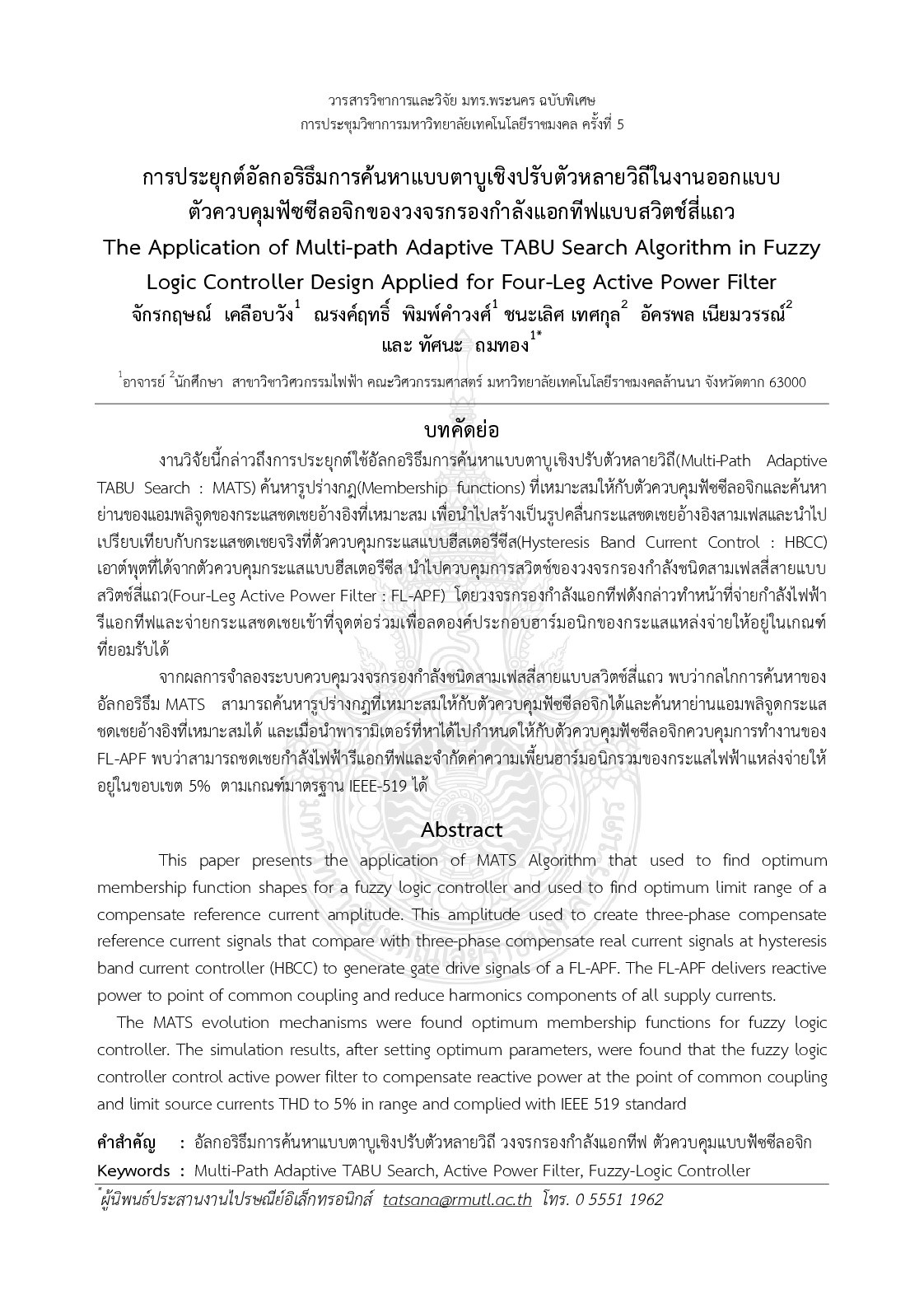
The application of multi-path adaptive TABU search algorithm in fuzzy logic controller design applied for four-leg active power filter
This paper presents the application of MATS Algorithm that used to find optimum membership function shapes for a fuzzy logic controller and used to find optimum limit range of a compensate reference current amplitude. This amplitude used to create three-phase compensate reference current signals that compare with three-phase compensate real current signals at hysteresis band current controller (HBCC) to generate gate drive signals of a FL-APF. The FL-APF delivers reactive power to point of common coupling and reduce harmonics components of all supply currents. The MATS evolution mechanisms were found optimum membership functions for fuzzy logic controller. The simulation results after setting optimum parameters were found that the fuzzy logic controller control active power filter to compensate reactive power at the point of common coupling and limit source currents THD to 5% in range and complied with IEEE 519 standard