จำนวน Repository ( 8 )

รูปแบบการจัดการนวัตกรรมของอุทยานประวัติศาสตร์เมืองมรดกโลก เพื่อส่งเสริมการท่องเที่ยวเชิงสร้างสรรค์เขตภาคเหนือตอนล่าง
This study aims to study the current situation towards to innovation management model of world heritage city museum on historical park for creative tourism in the lower part of Northern part of Thailand. 1) Formulate and check the innovation management model of world heritage city museum on historical park for creative tourism in the lower part of Northern part of Thailand with the mixed-method research by focus on Delphi- Technique. The samples are public sectors which are related to world heritage city museum on historical park and also the government sector of world heritage city museum on historical park. The data are collected by questionnaires and employed by indepth interview method. In the quantitative part this study uses multiple classification analysis: MCA to analyze the data. The samples are 18 tourists in the Sulkhothai and Kampaeng Phet historical park. The questionnaires are distributed three times to 400 tourists. The descriptive statistics is median mode average standard deviation. Absolute value of the difference between mode and median and inter-quartile range are used for considering the congruence check and confirm the data. The results find that: 1. The congruence which is obtained from Delphi technique has affected to innovation management model of world heritage city museum on historical park for creative tourism in the lower part of Northern part of Thailand as followings: As for strategic factors 1.1) Structure Management 1.2) Participation with public sector and local community 1.3) Domestic management of museum 1.4) Public management of museum 1.5) Public relation factor 2) As for quality service factor (SERVQUAL) 2.1) Practical service factor 2.2) Reliability 2.3) Responses factor 2.4) Confident factor 2.5) Concerning of employee 2.6) Concerning of historical park 3) Successful factors (HISTOQUAL) 3.1) Friendly and polite staffs 3.2) Readiness to spend time with tourists 3.3) Functional area for tourist 3.4) Convenient and practical time for tourists 3.5) Content in the event 3.6) Solid content in the event which is explainable to tourist 3.7) New and modern technologies 3.8) Manual guide for professional tourism 3.9) Practical and easy instructions 3.10) Attractive museum structural and building 3.11) Practical and welldetailed information for tourists 3.12) Cleanliness of both inside and outside the museum area 2. The synthesized finding from the return questionnaires from specialist shows that the criteria for set up the congruence of the data from statistic which has the possible median which could occur from the range between 4.00-5.00. Also interquartile range is less than or equal 1.00 (IR < 1.00) and the differences between median and mode is not more than 1. 3. The Multiple Classification Analysis : MCA finds that the factors which influencing successful factor innovation management model of world heritage city museum on historical park for creative tourism in the lower part of Northern part of Thailand is strategic factor which is composed of domestic management level factor has the beta value = .450 public management level has the beta value = .384 and the least beta value is participation with public sector and local community which has the beta value = .184 consecutively. Also the quality factor is affected to successful factor in the beta value of .731 From the results this study reveals the practical model for innovation management model of world heritage city museum on historical park for creative tourism in the lower part of Northern part of Thailand. The model is SERVHISTOQUAL-Satisfaction- Service Quality Model which is confirmed by 18 specialists and 400 tourists which is could be divided in 3 parts as followings: 1) Manufactures 2) Management sector 3) Consumer sector. In addition it includes the practical manual guide instruction for creative tourism in Sukhothai and Kamphaeng Phet historical park.
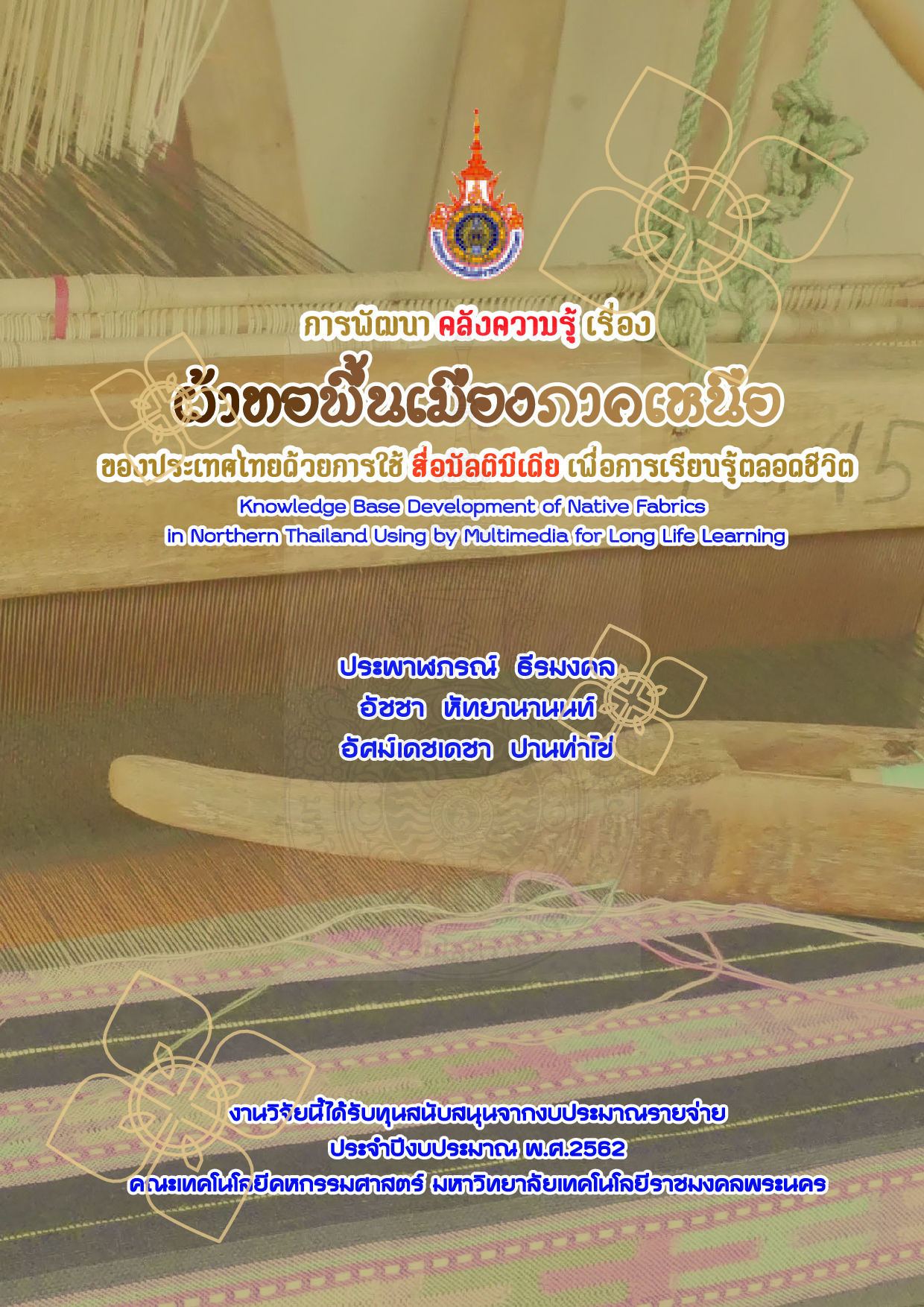
การพัฒนาคลังความรู้เรื่องผ้าทอพื้นเมืองภาคเหนือของ ประเทศไทยด้วย การใช้สื่อมัลติมีเดียเพื่อการเรียนรู้ตลอดชีวิต
This research is the development of the knowledge base on local textiles of northern Thailand by using multimedia for lifelong learning. The aim is to study compile and gather information of local cloths in northern Thailand. Develop a knowledge base by using multimedia on the local textiles of northern Thailand for lifelong learning and transferring knowledge and disseminating the knowledge base on northern Thai fabric by using multimedia for lifelong learning to the community. The research team proceeded to gather primary knowledge from the roots of the researchers who are interested in the local woven fabric. Therefore proceeding further knowledge in the upper reaches from literature reviews Including from field trips for data collection through in-depth interviews with important people Interviewing people who have knowledge about social context community local weaving characteristics weaving characteristics name of pattern type of fabric weaving technique of local textiles in northern Thailand in 9 provinces as well as studying primary data from textbooks textbooks and technical documents and in the internet. Thus the research shown that into 3 parts which are 1. Ethnic groups of Northern Thailand 2. Local woven fabric in northern Thailand and 3. Woven process and pattern. After that the knowledge library was developed by using multimedia on the local textiles of Northern Thailand for lifelong learning. This research can summarize the results in the form of a written description showing that the northern region of Thailand in the past was the Lanna Kingdom area. In the area of Xishuangbanna Before moving to the north of Thailand including the Tai Lue Tai Kheen Thai people Tai Yai people Meng (Mon) Lua people villages scattered throughout the highlands of the Lanna region such as Karen (Pak Kahen M) Mien (Yao) Hmong (Meo) Akha (Akha) Lahu (Mso) Lisu. In addition there are some groups in the Lanna fringe such as Khmu Labri (Tong Lueang). Each ethnic group has its own unique style especially Common skirt Has the same basis with the resin head the resin body and the resin tip but each part is not woven differently Have different colors Some ethnicities have a section called Lep which is the part that the weaver often weaves to keep the thread as for knowledge transfer. The research created a book Local woven cloth consists of videos from local knowledge sources and digital documents and to make the transfer of knowledge more complete Therefore held a forum and exhibition on the topic primary fabric of Lanna Kingdom as a medium for those interested in Local woven fabrics in the Lanna Kingdom of Thailand attended. Exchange ideas from various sources of knowledge from the research. While also receiving multimedia for lifelong learning from the inquiry regarding the satisfaction of the participants. The Keynote speakers are interesting and event condition caused the interest in the knowledge content that used to organize the exhibition. Overall the work is most satisfied.
การสื่อสารและการมีส่วนร่วมในชุมชนต่อปัญหาหมอกควันภาคเหนือของเยาวชนในจังหวัดเชียงใหม่
The purposes of this study were to investigate 1.Smog problems exposure to mass media 2. Community Participation to Northern Smog Pollution of Youth in Chiang Mai 3. The relationship between smog problems exposure to mass media and Community Participation to Northern Smog Pollution of Youth in Chiang Mai. This way a survey study. The sample included 400 people in Chiang Mai area. The questionnaires were administered and the statistical package program was used to analyze the data through frequency percentage means standard deviations and Pearson’s Correlation. The results revealed that Smog problems exposure was most exposure was most exposed via internet media because Youth like this. Community Participation to Northern Smog Pollution of Youth in Chiang Mai was at medium level. The relationship between smog problems to mass media and Community Participation to Northern Smog Pollution of Youth in Chiang Mai. There was significant at 0.05 difference between smog problems exposure to mass media and Community Participation to Northern Smog Pollution of Youth in Chiang Mai.
ศึกษาวิถีวัฒนธรรม อนุรักษ์และพัฒนาผ้าชนเผ่าสู่เชิงพาณิชย์ กรณีศึกษา ผ้าทอกะเหรี่ยงจังหวัดภาคเหนือ
The purpose of this research was to study the ways of Karieng tribal culture conserve and develop Karieng’s fabric and transfer technology to the target groups. The research instruments consisted of the interview the product prototype the opinion evaluation the performance evaluation the training evaluation. The sample groups used for this study comprised Karieng of Tambon Sridongyen Amphur Chaiprakan in Chaingmai province Karieng of Tambon Pangmoo Amphur Muang in Maehongson province Karieng of Tambonkhanaechue Amphur Maeramad in Tak province. Groups of 100 people were interested in these products and 25 trainees of Karieng of Tambon Sridongyen Amphur Chaiprakan in Chaingmai. Statistics used were percentage average and standard deviation. The results revealed that 3 Karieng groups were the same culture ways in the religion languages the life ways costumes occupation culture tradition residents and family systems. They were different from Karieng of Tambon Pangmoo Amphur Muang in Maehongson who wore a brass collar were called long neck Karieng but some people weren’t wearing them in this day. Groups of Karieng Tumbon Khanechue Amphur Maeramad in Tak province will use the urban lifestyle and costumes. Groups of Karieng Tumbon Sridongyen Amphur Chaiprakan in Chiangmai will use in sufficient style farmers and employees. All of them were similar to wear Karieng’s fabric in ceremonies. The researchers concluded that the development of tribe’s fabric were applied the costumes style from the origins. We used two methods: the striped fabric and decorative materials were made in ten patterns. The evaluation of Karieng’s fabric product found that the sixth clothes pattern were the best suitable in decoration the pattern and design averaged 4.45. and the transfer technology evaluation trainees groups were Karieng of Tumbon Sridongyen Amphur Chaiprakan in Chaingmai province wanted to know and practice to develop the modern garment pattern base on the conservative of wisdom and creation the economic communities. The assessment result found that the female trainees who were farmer’s occupation primary education income less than 4000 baht were over 40 years. Before training they knew the Karieng garment design in moderate level. Sewing and decoration of Karieng garment were in high level. After training they knew more three things. They brought the knowledge to use in high level. The trainees want to train the next time in the highest.
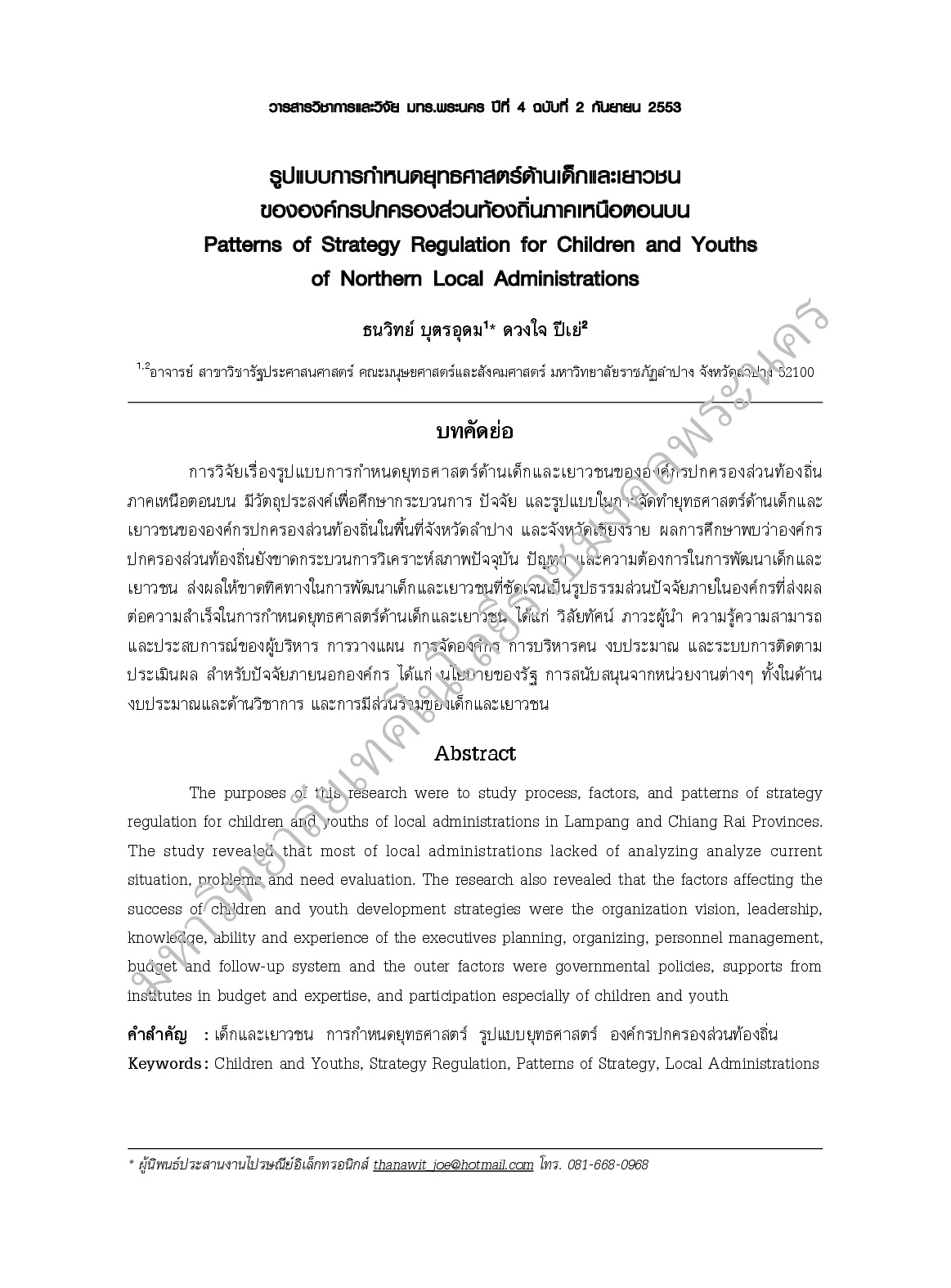
รูปแบบการกำหนดยุทธศาสตร์ด้านเด็กและเยาวชนขององค์กรปกครองส่วนท้องถิ่นภาคเหนือตอนบน
The purposes of this research were to study process factors and patterns of strategy regulation for children and youths of local administrations in Lampang and Chiang Rai Provinces. The study revealed that most of local administrations lacked of analyzing analyze current situation problems and need evaluation. The research also revealed that the factors affecting the success of children and youth development strategies were the organization vision leadership knowledge ability and experience of the executives planning organizing personnel management budget and follow-up system and the outer factors were governmental policies supports from institutes in budget and expertise and participation especially of children and youth