จำนวน Repository ( 4 )
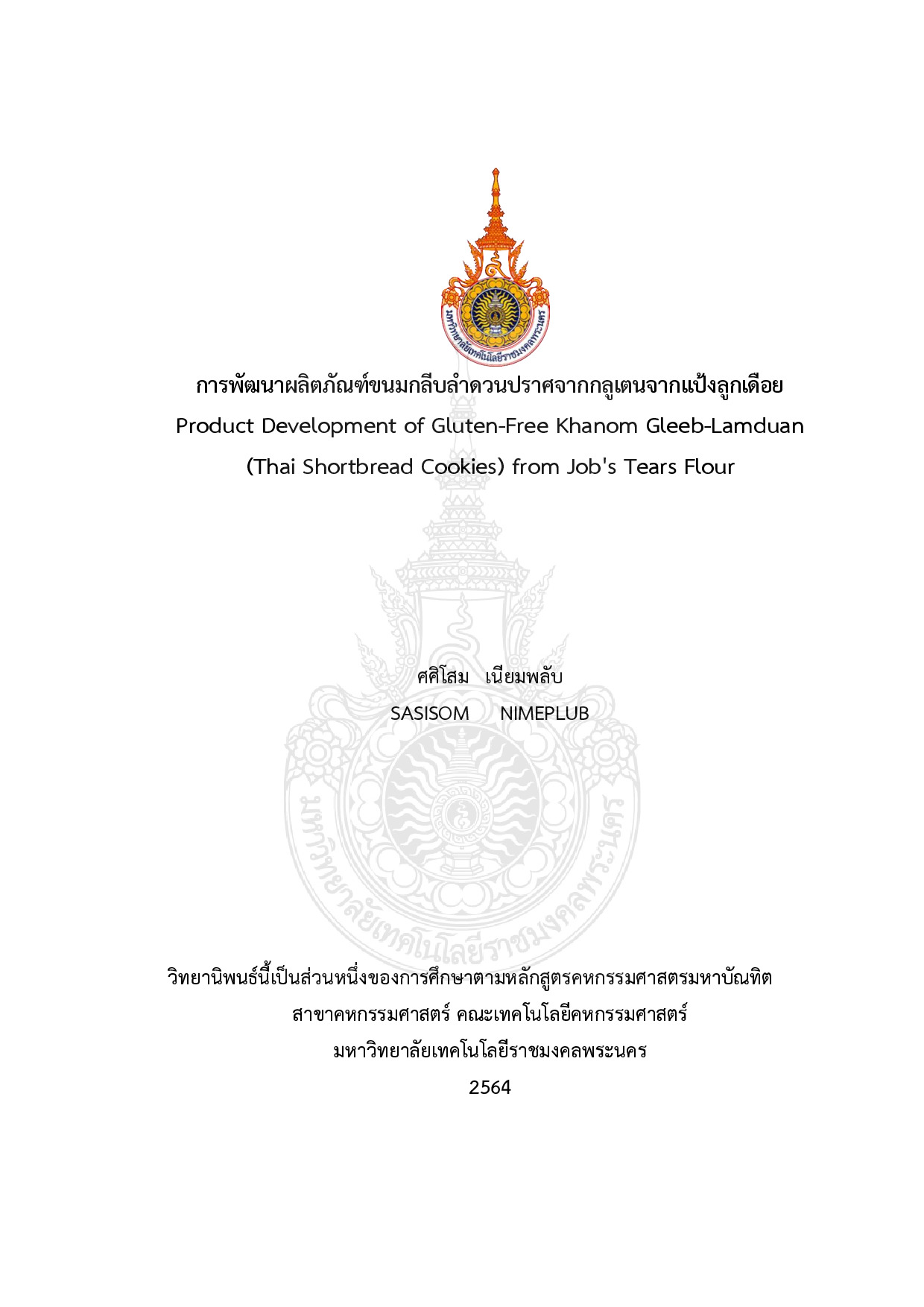
การพัฒนาผลิตภัณฑ์ขนมกลีบลำดวนปราศจากกลูเตนจากแป้งลูกเดือย
The purposes of this study were 1) to study the basic recipe of Khanom Gleeb- Lamduan. 2) To study the types of Job’s Tears flour used as a substitute for wheat flour in the recipe of Khanom Gleeb-Lamduan. 3) To study the quantity of supplemented xanthan gum was studied in the recipe of Khanom Gleeb-Lamduan from Job’s Tears flour to improve texture. 4) To study the chemical composition of Khanom Gleeb-Lamduan from Job’s Tears flour. The results of the sensory quality evaluation with a 9-point Hedonic scale favorability score by 30 taste panelists found that the basic formula of Khanom Gleeb-Lamduan that was selected contained 55% of the ingredients including wheat flour soybean oil and icing sugar 27.50% and 17.50% respectively. The results of a study on the type of Job’s Tears flour suitable for substitute for wheat flour for the development of gluten-free Khanom Gleeb- Lamduan recipe. It was found that Khanom Gleeb-Lamduan made from dried milled job’s Tears flour had a higher score on the tasters favor than that made from commercial milled Job’s Tears flour and boiled Job’s Tears flour (p≤0.05). Tasters rated their preference for Khanom Gleeb-Lamduan from Jobs Tears flour with added xanthan gum to improve texture characteristics in the amount of 1% of millet flour preferring it over Khanom Gleeb-Lamduan with Jobs Tears flour added at the rate. 0.5% and at a rate of 2%. Khanom Gleeb-Lamduan had average liking scores in terms of appearance color smell taste texture (crusty) and overall liking was 7.33 7.40 7.86 7.53 7.76 and 8.10 respectively which were in moderate to high liking level. The approximate chemical composition of 100 g of Khanom Gleeb-Lamduan from JobsbTears flour contains 6.75 g of protein 27.46 g of fat 2.64 g of moisture 62.21 g of carbohydrates 0.94 g of ash and 522.98 kcal of energy which is similar to that of the basic recipe of Khanom Gleeb-Lamduan using wheat flour but it has a higher ash content than the basic formula. This is because Jobs Tears contains high amounts of many minerals. Khanom Gleeb-Lamduan from Jobs Tears flour is therefore a healthy snack for general consumers. In particular consumers with gluten intolerance can also eat it.

การพัฒนาผลิตภัณฑ์เส้นก๋วยเตี๋ยวจากแป้งลูกเดือยทดแทนแป้งข้าวเจ้าบางส่วน
The aims of research were to study (1) a basic formula of rice noodles’ production. (2) the production of jobs tears flour and rice flour in rice noodles’ production. (3) the quantities of using jobs tears substituting for rice flour in noodles’ production. And (4) consumers’ acceptance of rice noodles product from jobs tears flour. The results showed that the first formula was chosen to be the basic formula. This formulation containing 10% rice flour 3% tapioca flour 26% water and 0.5% vegetable oil. The results of physical qualification between jobs tears flour and rice flour showed that the lightness (L) of jobs tears flour lower than the lightness (L) of rice flour (p≤0.05). And the value (a*) showed redness and the value (b*) showed yellowness higher than rice flour (p≤0.05). Humidity and water activity (aw) of general rice flour is not different from jobs tears flour considered by sensory test with ratio of jobs tears flour to rice flour of 20:80. This ratio got more preference the ratio 40:60 and 60:40 (p≤0.05). According to the consumer test (100 consumers) the Noodles by Partially Substituting Rice Flour with Jobs tears Flour was accepted as the novel and delicious product by 98% consumers. Moreover and 92% of consumers decided to buy the product containing 250 g in the plastic bag with the price of 25 Baht.
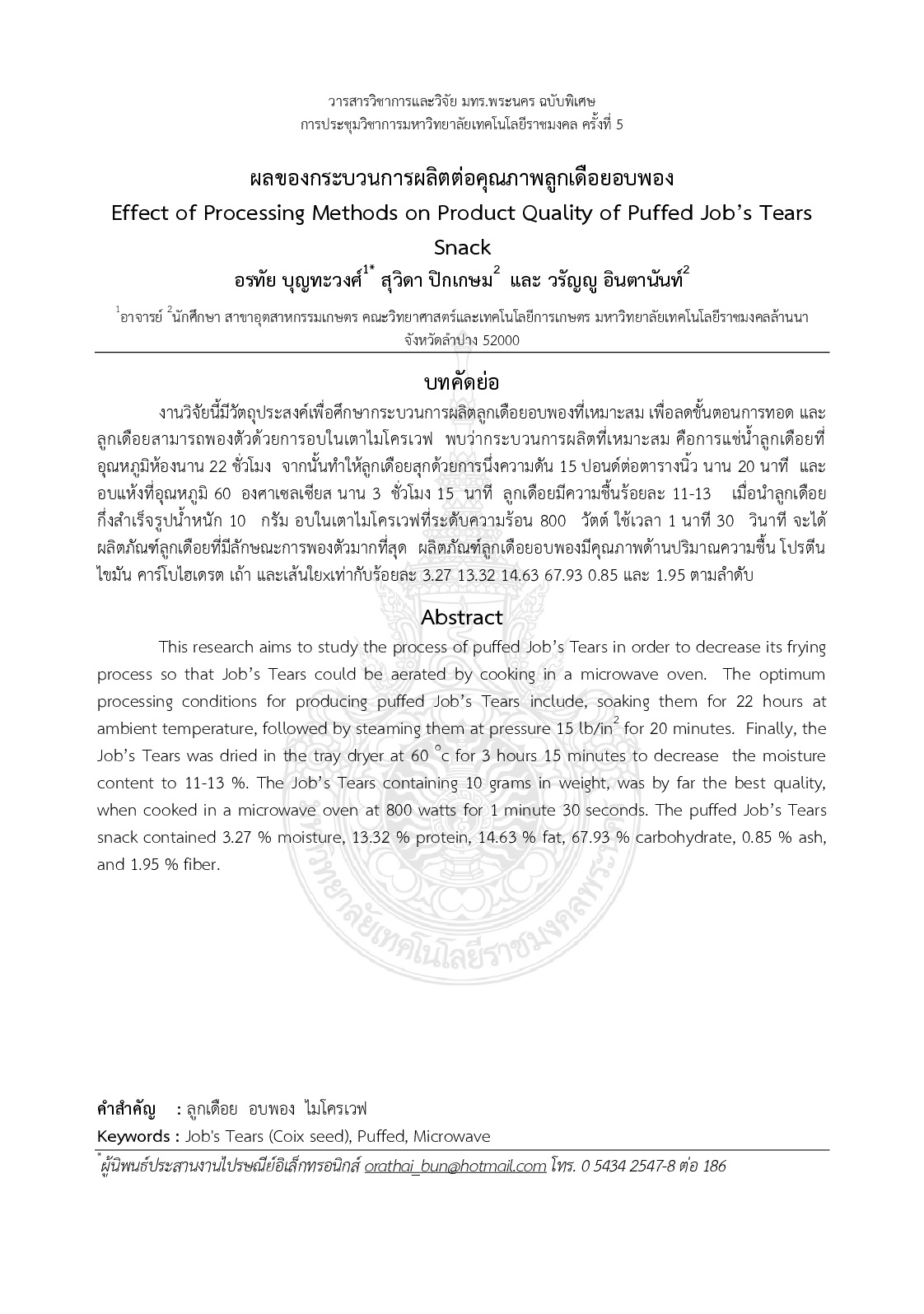
Effect of processing methods on product quality of puffed job’s tears snack
This research aims to study the process of puffed Job’s Tears in order to decrease its frying process so that Job’s Tears could be aerated by cooking in a microwave oven. The optimum processing conditions for producing puffed Job’s Tears include soaking them for 22 hours at ambient temperature followed by steaming them at pressure 15 lb/in2 for 20 minutes. Finally the Job’s Tears was dried in the tray dryer at 60 oc for 3 hours 15 minutes to decrease the moisture content to 11-13 %. The Job’s Tears containing 10 grams in weight was by far the best quality when cooked in a microwave oven at 800 watts for 1 minute 30 seconds. The puffed Job’s Tears snack contained 3.27 % moisture 13.32 % protein 14.63 % fat 67.93 % carbohydrate 0.85 % ash and 1.95 % fiber.
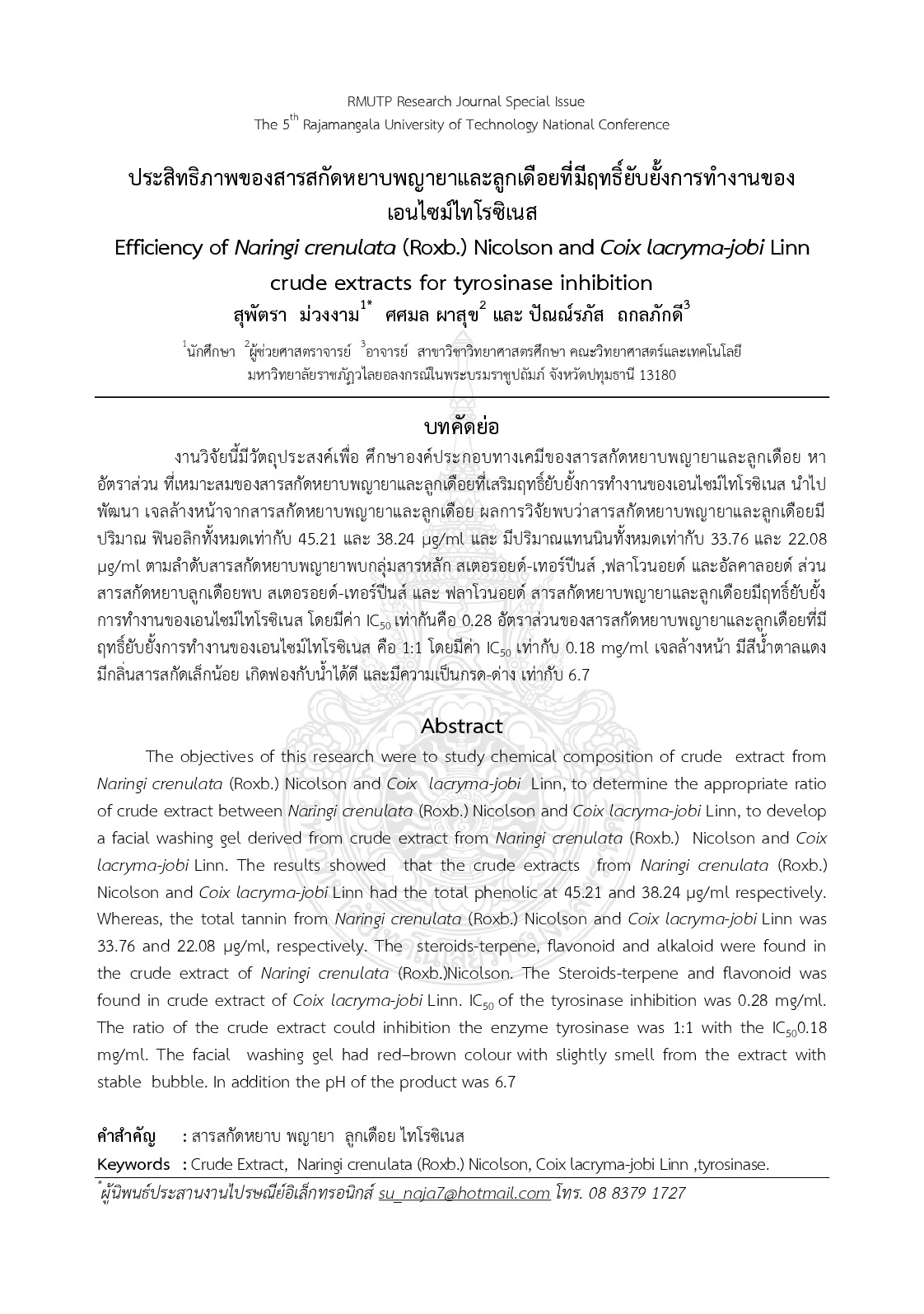
Efficiency of naringi crenulata (roxb.) nicolson and coix iacryma-jobi linn crude extracts for tyrosinase inhibition
The objectives of this research were to study chemical composition of crude extract from Naringi crenulata (Roxb.) Nicolson and Coix lacryma-jobi Linn to determine the appropriate ratio of crude extract between Naringi crenulata (Roxb.) Nicolson and Coix lacryma-jobi Linn to develop a facial washing gel derived from crude extract from Naringi crenulata (Roxb.) Nicolson and Coix lacryma-jobi Linn. The results showed that the crude extracts from Naringi crenulata (Roxb.) Nicolson and Coix lacryma-jobi Linn had the total phenolic at 45.21 and 38.24 g/ml respectively. Whereas the total tannin from Naringi crenulata (Roxb.) Nicolson and Coix lacryma-jobi Linn was 33.76 and 22.08 g/ml respectively. The steroids-terpene flavonoid and alkaloid were found in the crude extract of Naringi crenulata (Roxb.)Nicolson. The Steroids-terpene and flavonoid was found in crude extract of Coix lacryma-jobi Linn. IC50 of the tyrosinase inhibition was 0.28 mg/ml. The ratio of the crude extract could inhibition the enzyme tyrosinase was 1:1 with the IC500.18 mg/ml. The facial washing gel had red–brown colour with slightly smell from the extract with stable bubble. In addition the pH of the product was 6.7