จำนวน Repository ( 3 )
ศึกษาสมบัติทางกายภาพของวัสดุเหลือใช้ทางการเกษตรเพื่องานหัตถอุตสาหกรรม ชุมชนบ้านถ้ำเสือ จังหวัดเพชรบุรี
This research 1) to study and analyze the relationship between the context of industrial handicraftsproperties of agricultural waste in community areas and 2) to agricultural waste to find physical properties and the industrial handicrafts for Bantumsua community Phetchaburi province. From primary data it was found the relationship of the community with the context of industrial crafts is a culture of agricultural wisdom from the collection of participatory research data. Found method and test the properties of paper pulp from agricultural waste where banana leaves = A bamboo leaves = B and pineapple leaves = C.Use the formula for quantifying the triangular grid the Trixie Blend Diagram to uses caustic sodium hydroxide 10-15% of dry weight. There are 7 test items 1 formula thin and thickness (a) according to the experimental standard referring to the community product standards plant fiber paper. For testing as follows: 1) standard average weight from the test of paper size 45x85 cm operation number list of the experimental formula test section 1.1) standard weight the overall average is equal to 220 grams/sqm. 1.2) part 2 tear strength which is strong = 3(10a) at 1962 mN the second strength = 1(8a) at 1907 mN and third = 6(13a) at 1467 mN. 1.3) Part 3 the overall moisture content of the paper the experiment found the humidity level is within the normal level at ± 10% which is complete and can be developed into a products or package. 2) Summary of physical properties the color characteristics of the paper according to provide color tones gray-brown and different beautiful suitable for the screen-printing and using large size rubber stamp. Process forming can produce use by semi-automatic heat setting at 140°C at time of 70 seconds per piece is suitable for further expansion to create industrial handicrafts for the community.
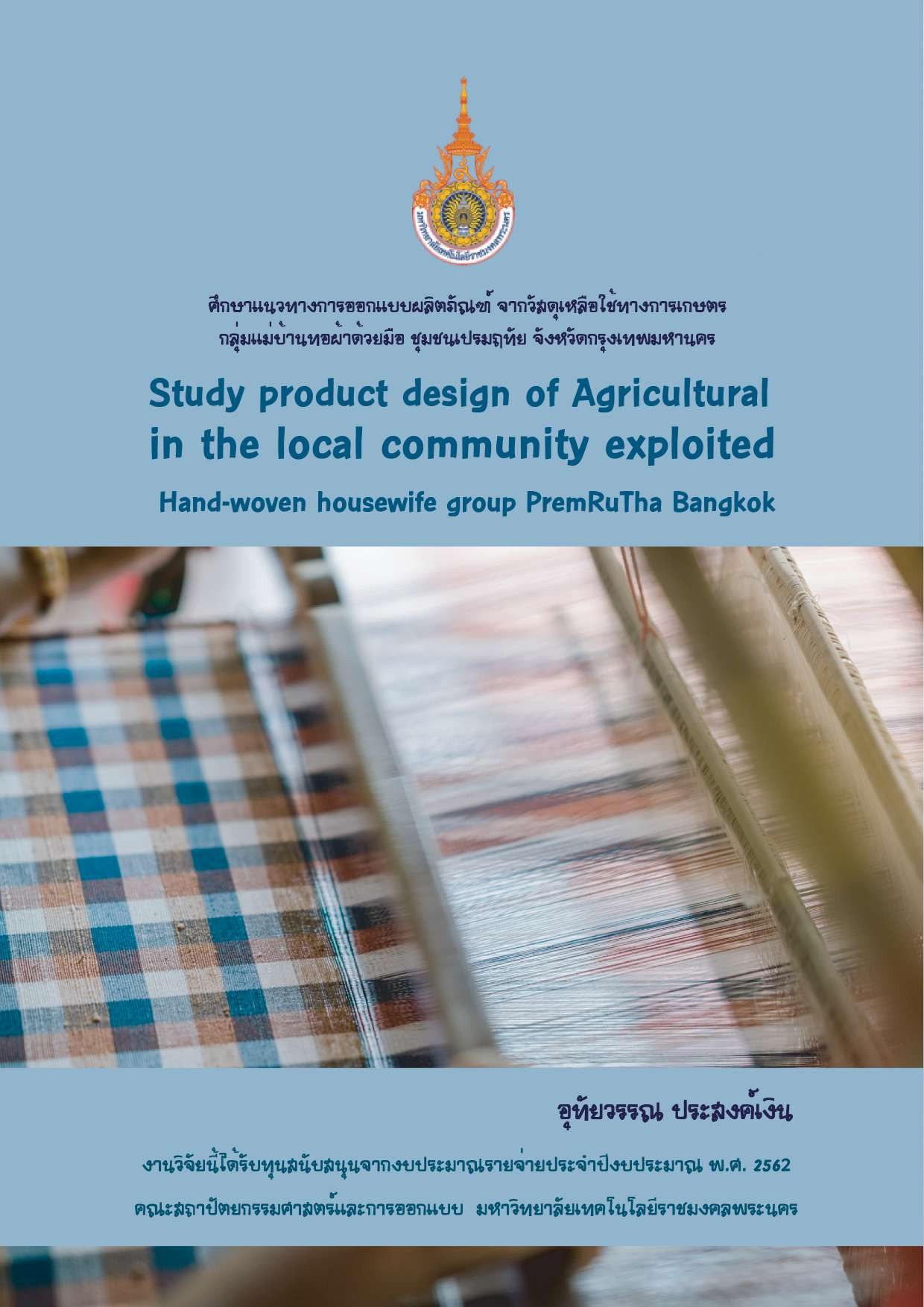
ศึกษาแนวทางการออกแบบผลิตภัณฑ์ จากวัสดุเหลือใช้ทางการเกษตร กลุ่มแม่บ้านทอผ้าด้วยมือชุมชนเปรมฤทัย จังหวัดกรุงเทพมหานคร
This research is Study the product design guidelines from agricultural waste materials. Weaving Housewife Group Premruethai Community Bangkok And in order to use waste materials to develop to add value With the following steps. (1) Surveying types amount of agricultural waste materials. (2) Study the physical structure and chemical properties of plant fibers. (3) Study the methods of preparing suitable fibers for textile materials. (4) Develop and study the suitable mixture ratio of blended fiber yarn. (5) Manufacture of hand-woven fabrics from agricultural waste materials. (6) Design and prototype of products from hand-woven fabrics from fibers agricultural waste And study from testing methods comparing the opinions of users / users and evaluators Assessed in the test Bring the results to analyze find conclusions analyze and suggest the research results to study. And analyze find conclusions study product design guidelines from agricultural waste materials Weaving Housewife Group Premruethai Community Bangkok Expect It was found that different methods of fiber content were obtained. And found that the amount of fiber varies according to the size of the material Analysis results of all chemical composition of fibers Found that the moisture content of 1.82% Water content 1.00% ashes 0.7 % and the fiber has the same amount of 0.97 mg kg at a normal level that can be found in general plants And meet the standard criteria Physical property test results of fibers The shape according to the cross-section of the fiber Looks like an oval almost round shape with a noticeable lumen. For the strength it was found that the fibers had an average elongation at break of 7.54% the toughness equal to 57.32% the fiber size was 16.45 deniers and the strength was 26.85 grams. Yarn production results The most suitable hand-woven (plant fiber and cotton) is 60% plant fiber mixed with 40% cotton. The yarn has an average toughness or strength of 4.86 newtons and the yarn is equal to 2.8 Ne and the result of Testing fabric peach mixed fiber fabric with handicraft pattern Found that the weaving of the fabric on the surface of the fabric and / or some grain on the fabric. And there is no hair and grain on the fabric medium Woven fabric has a lack of testing value from the number of abrasion cycles in the range of 1780 - 2100 and the color fastness to washing is in the level of 4-5 (the color has slightly changed And there is no color leakage) By the test streaking of yarn streaks (Plant fiber yarn) has the strength to withstand the pulling force in the range 577.30 - 610.22 newton the tear strength is in the range 37.26 - 53.89 newton and the size change after washing is in the range - 3.77 to - 6.59 should be developed into various home decoration products such as tableware sets curtains shoes bags etc. The assessor has the opinion that the use The beauty of various products Satisfied (1) Beauty pattern (2) color (3) Durability (4) Suitable proportion (5) Career promotion to local communities The assessors have the highest level of satisfaction respectively.

การพัฒนาวัสดุอาหารจากวัสดุเหลือทิ้งทางการเกษตรเพื่อการประหยัดพลังงานและลดการถ่ายเทความร้อนเข้าสู่อาคาร
The objective of this research is to study the implementing the agricultural residue to the design of outdoor paving block for lowering the building temperature. The base layer admixture (layer no.1) is selected from cement type1: quarry dust: rice husk: rice straw: water ratios equal to 1: 3: 0: 0: 0.3 1: 1: 0: 1: 0.5 1: 1. 0.25: 0.75: 0.5 1: 1: 0.5: 0.5: 0.5 1: 1: 0.75: 0.25: 0.5 and 1: 1: 1: 0: 0.5 by weight. The surface layer admixture (layer no.2) is white silica cement: yellow stone chip no.4: water equals to 1: 4: 0.3 by weight. The exterior floor-covering blocks were tested following density testing water absorption testing compressive testing and surface temperature testing compare with laterite sandstone paving concrete block marble and granite. Resulting the best ratio of cement type1: quarry dust: rice husk: rice straw: water is 1: 1: 0.75: 0.25: 0.5 that has properties at 28 days following 1939.43 kg/m of density 14.97 % of water absorption 284.69 ksc of compressive strength and lower than other paving blocks around 3 – 13 degrees Celsius of surface temperature