จำนวน Repository ( 3 )
ศักยภาพของมะดูกพืชสมุนไพรพื้นบ้านของไทยในการรักษาโรคเพื่อพัฒนาองค์ความรู้ของภูมิปัญญาท้องถิ่นไปสู่การใช้ประโยชน์อย่างยั่งยืน
The research project on The potential of Siphonodon celastrineus Griff traditional medicinal plants of Thailand for treatment from local wisdom knowledge lead to the development of sustainable use with the objective of studying the botanical phytochemical and biological activity of the Siphonodon celastrineus to create confidence in the use of S. celastrineus in herbal medicine by using the bark leaves and fruit of the S. celastrineus to extract with 3 types of solvents. Each of hexane ethyl acetate and methanol respectively from low to high polarity. All nine extracts will be extracted. Preliminary examinations for phytochemistry Antioxidant activity by DPPH radical scavenging assay and quantitative determination of phenolic compounds by Folin-Ciocalteu method and antimicrobial activity were tested. The research found that. 1. The extract of the results of the methanol layer of the S.celastrineus shows a reduction in the amount of 11-diphenol-2-picrylhydrazyl (DPPH) had the highest EC50 equal to 31 mg/ml. The amount of phenol compounds found that the extracts from the methanol extract of S. celastrineus contain the amount of phenol. The highest concentration of 95.23 mg GAE / g dw 2. Extract from the bark of the S. celastrineus with methanol showed the best inhibition of the growth of Vibrio paraheamolyticus with the MIC value of 15.60 mg/ml. The extracts of the S. celastrineus leaf extracts with hexane showed the best inhibition of the growth of Vibrio cholerae with the MIC value equal to 31.25 mg/ml and leaf extracts with ethyl acetate showed the best inhibitory effect on the growth of Vibrio cholerae with a MIC value of 31.25 mg/ml and the extract of the fruit with ethyl acetate to inhibit the growth of Vibrio paraheamolyticus most with MIC equal to 15.60 mg/ml.
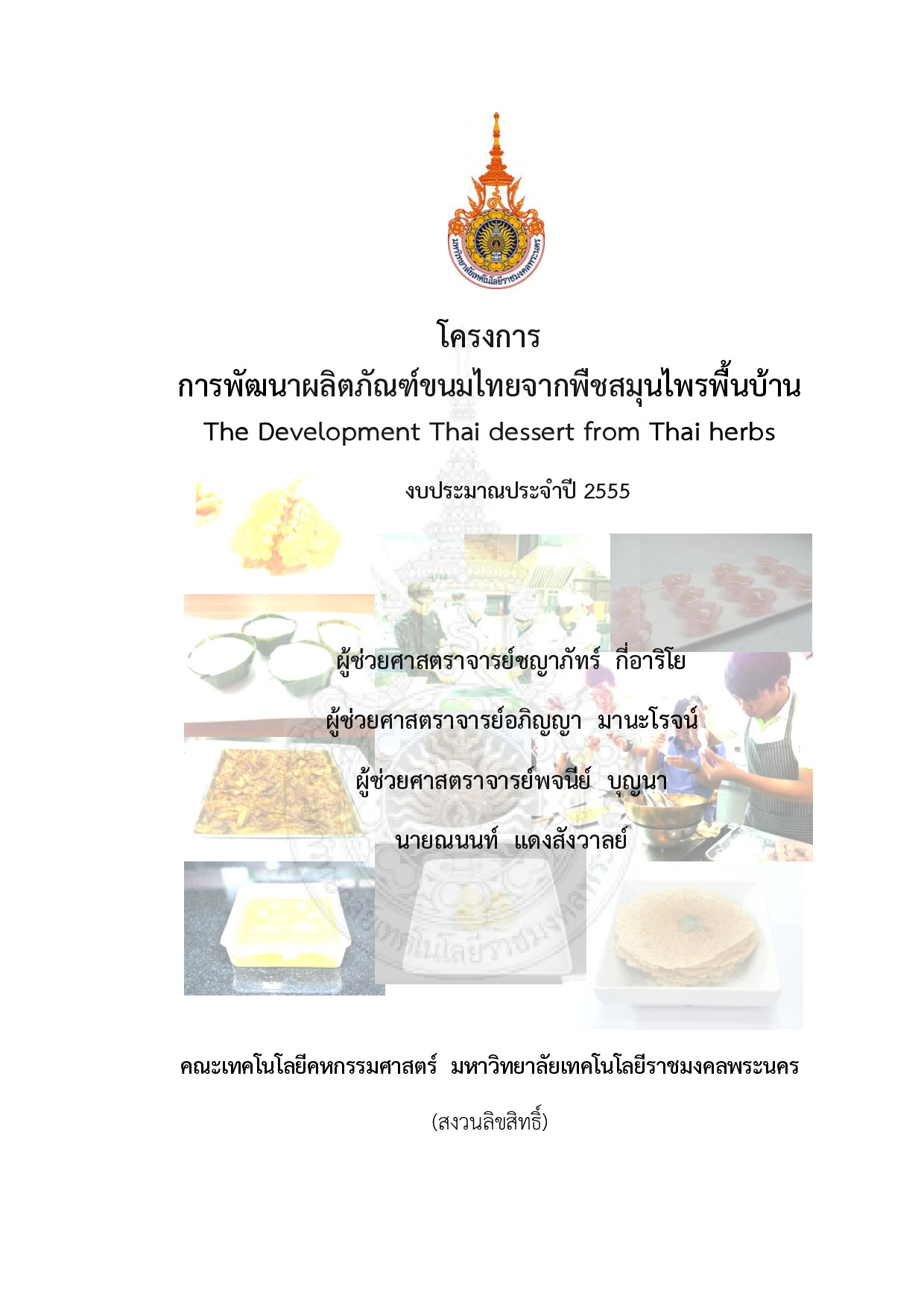
การพัฒนาผลิตภัณฑ์ขนมไทยจากพืชสมุนไพรพื้นบ้าน
The studies of original recipes of Thai desserts were modified and developed by local Thai herb. There are eight kinds of Thai dessert were selected such as Ta – Ko Mao-Kang (Thai baked custard) Shung–Ha-Ya (Thai streamed custard) Toa-Pap Krob-Kim Ka-Nom-Tom Ka-Nom-Tein-Kaew and Kaow-Tung-Sa-Wey which were developed by dried sweet bael fruit Curcuma powder Mashed lemongrass and Mashed ginger. A result was found that Ta – ko substitution water chestnut from dried sweet bael fruit (marmelos) in level of bael fruit was 100 125 and 150 % by weight of water chestnut. The food expertises like substitution dried sweet bael fruit with 125 % in moderate level. The majority of consumer 85% accepted Ta –ko with 125% of dried sweet bael fruit. Mao-kang was added dried sweet bael fruit in levels of bael fruit was 10 20 and 30% by total weight. The food expertises like added sweet bael fruit with 20% in moderate level. The majority of consumer 95% accepted Maokang with 20 % of dried sweet bael fruit. Shung–ha-ya was added curcuma powder in levels of curcuma powder was 0.5 0.75 and 1% by total weight. The food expertises like added curcuma powder with 0.5% in moderate level. The majority of consumer 81% accepted shung–ha-ya with 0.5% of curcuma powder. Ka-nom-Toa-pap was added curcuma powder in levels of curcuma powder was 1 2 and 3% by total weight. The food expertises like added curcuma powder with 2% in moderate level. The majority of consumer 84% accepted ka-nom-Toa-papwith 2% of curcuma powder. Krob-kim was added mashed lemongrass in levels of mashed lemongrass was 6 8 and 10% by total weight. The food expertises like added mashed lemongrass with 10% in moderate level. The majority of consumer 94% accepted Krob-kim with 10% of mashed lemongrass. Ka-nom-Tom was added mashed lemongrass in levels of mashed lemongrass was 10 15 and 20% by total weight. The food expertises like added mashed lemongrass with 15% in moderate level. The majority of consumer 87% accepted Ka-nom-Tom with 15% of mashed lemongrass. Ka-nom-tein-kaew and kaow-tung-sa-wey was added mashed ginger in levels of mashed ginger was 4 8 and 12% by total weight. The food expertises like added mashed ginger 4% in two products. They like in moderate level. The majority of consumer 79 % accepted Ka-nom-tein-kaew and 93% accepted kaowtung-sa-wey with 4% mashed ginger.

The potential development of Ficus hispida Linn use to traditional herbs and cancer prevention for generate knowledge and heritage of local wisdom
The study used the bark leaves and fruit of Ficus hispida Linn to separation by Maceration and sequential extraction method with hexane ethyl acetate and methanol to crude extracts. Crude extracts were assessed for their antioxidant activities tested using DPPH radical scavenging assay total phenolic contents tested using the Folin–Ciocalteu method cytotoxic activity against oral cavity cancer (KB) human small cell lung cancer (NCI-H187) and breast cancer (MCF-7) cancer cell lines tested using the resazurin microplate assay (REMA). The results showed that 1. Crude methanol extracts from the fruit exhibited free radical scavenging effect on the DPPH assay with IC50 value of 27 g/ml with the total phenolic contents value of 102.39 mg GAE/g dw of standard BHT. 2. Crude hexane extracts from the bark showed highest inhibited the growth of Vibrio paraheamolyticus crude ethyl acetate extracts from the bark showed highest inhibited the growth of Streptococcus mutans ATCC 27175 and crude methanol extracts from the leaves showed highest inhibited the growth of Vibrio cholerae most with MIC value of 7.80 g/ml. 3. Crude ethyl acetate and methanol extracts from F. Hispida exhibited inhibitory effect against oral cavity cancer (KB) human small cell lung cancer (NCI-H187) and breast cancer (MCF-7) cancer cell lines. These data support traditional uses of F. Hispida in folk medicine