จำนวน Repository ( 2 )

ความคิดเห็นของสถานประกอบการที่มีต่อทักษะบัณฑิตสาขาวิชาภาษาอังกฤษเพื่อการสื่อสารสากลในศตวรรษที่ 21
The purposes of the research were to 1) study the attributes of the graduates according to standards of learning outcome 2) study the 21st century skills of English for International Communication graduates desired by employers 3) compare the attributes of the graduates according to standards of learning outcome categorized by the individual factors and 4) compare the employers’ requirements to skills of English for International Communication graduates categorized by the individual factors. The population were 55 employers participating in the cooperative education project in the academic year 2017. The research tools were questionnaires and interviews which were analyzed by the SPSS program. The statistical data analysis was performed by frequency percentage mean standard deviation and Fdistribution and the interview data analysis was performed by frequency and content analysis. The results were found as follows. 1. As for the employers information33emoloyets were from private and service businesses (60%) and 14 employets were from government sectors (25.50%).As for the working statuses29 employers were the officers (53.70%) 20 employer were the supervisors (37.00%) and 5 employers weie mangers (9.30%) 2. The overall requirement of hte employers for the attrbutes of the graduates according to standandards of learning outcome was at the high level (=4.48). As for each attribute morals and ethcs were the most desirable (=4.75) the second highest level was interpersonal skils and accountabiliy (4.57) and the last one was the intellectual skills (=4.25) 3. The overall requirement of the ernptoyers for the 21st century skills of the graduates was at the high level (=4.43). As for each attribute the highest level was enthusiasm collaboration and thinking skills respectivrty (=4.634.58 and 4.54) The lowest tevel was the inquiry skills (=4.07). 4.The results of the research hypothesis were; 4.1 There was a significant difference between the employers with different employrment sectors (government and service business sectors) and the requirement of the graduates attributes. There was no significant difference between the employers with different working status and the requirement of the graduates attributes. 4.2 There is no significant difference between the employers with diferent employent sectors and working status and the requirement of the graduates attributes.
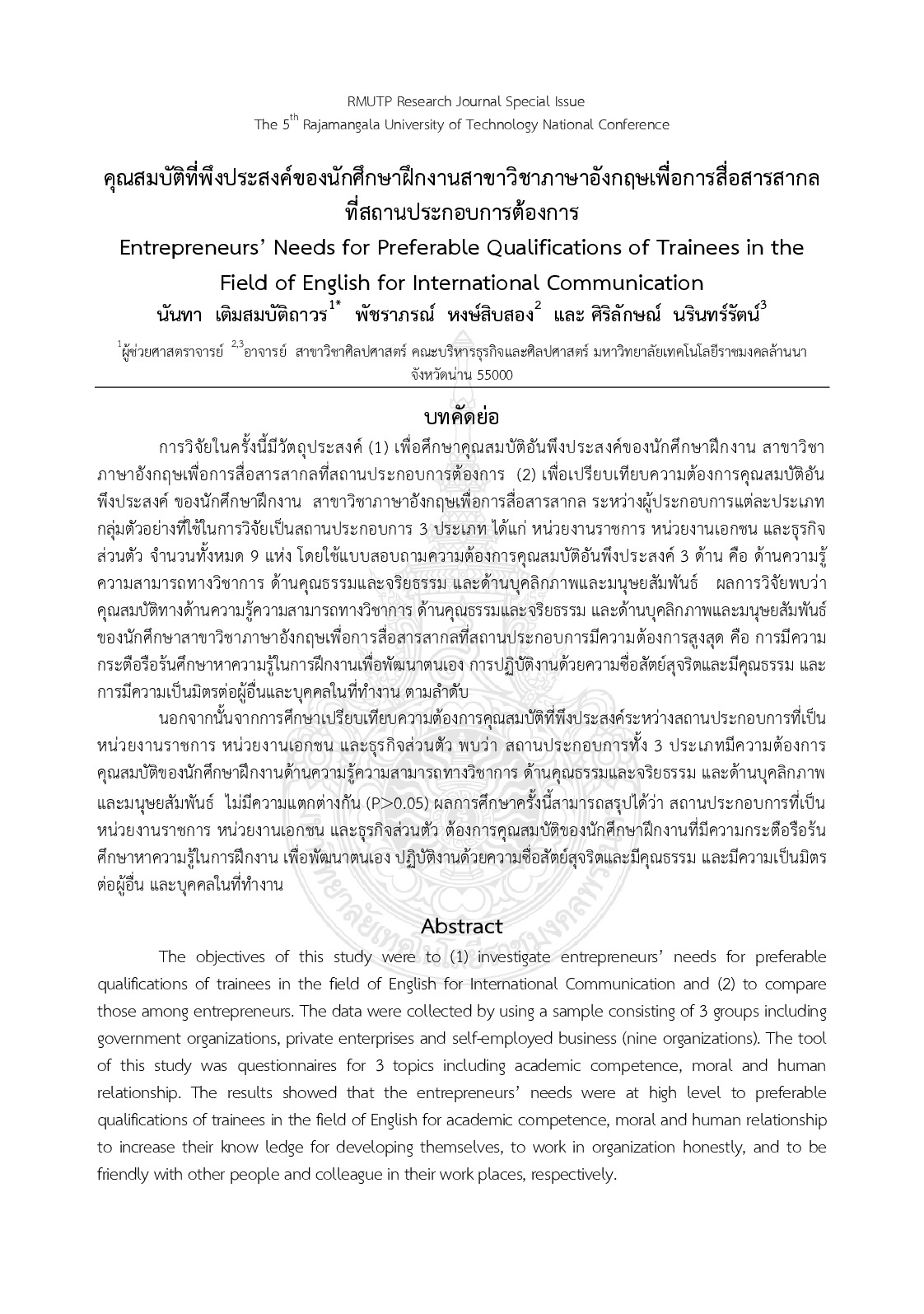
Entrepreneurs’ needs for preferable qualifications of trainees in the field of english for international communication
The objectives of this study were to (1) investigate entrepreneurs’ needs for preferable qualifications of trainees in the field of English for International Communication and (2) to compare those among entrepreneurs. The data were collected by using a sample consisting of 3 groups including government organizations private enterprises and self-employed business (nine organizations). The tool of this study was questionnaires for 3 topics including academic competence moral and human relationship. The results showed that the entrepreneurs’ needs were at high level to preferable qualifications of trainees in the field of English for academic competence moral and human relationship to increase their know ledge for developing themselves to work in organization honestly and to be friendly with other people and colleague in their work places respectively.In addition comparing needs for trainees’ preferable qualifications among government organizations private enterprises and self-employed business showed that there was no significant difference (P? 0.05). This study concludes that the entrepreneurs’ needs for preferable qualifications of trainees in the field of English for 3 groups were to increase their knowledge for developing themselves to work in organizations honestly and to be friendly with other people and colleague in their work places.