จำนวน Repository ( 3 )
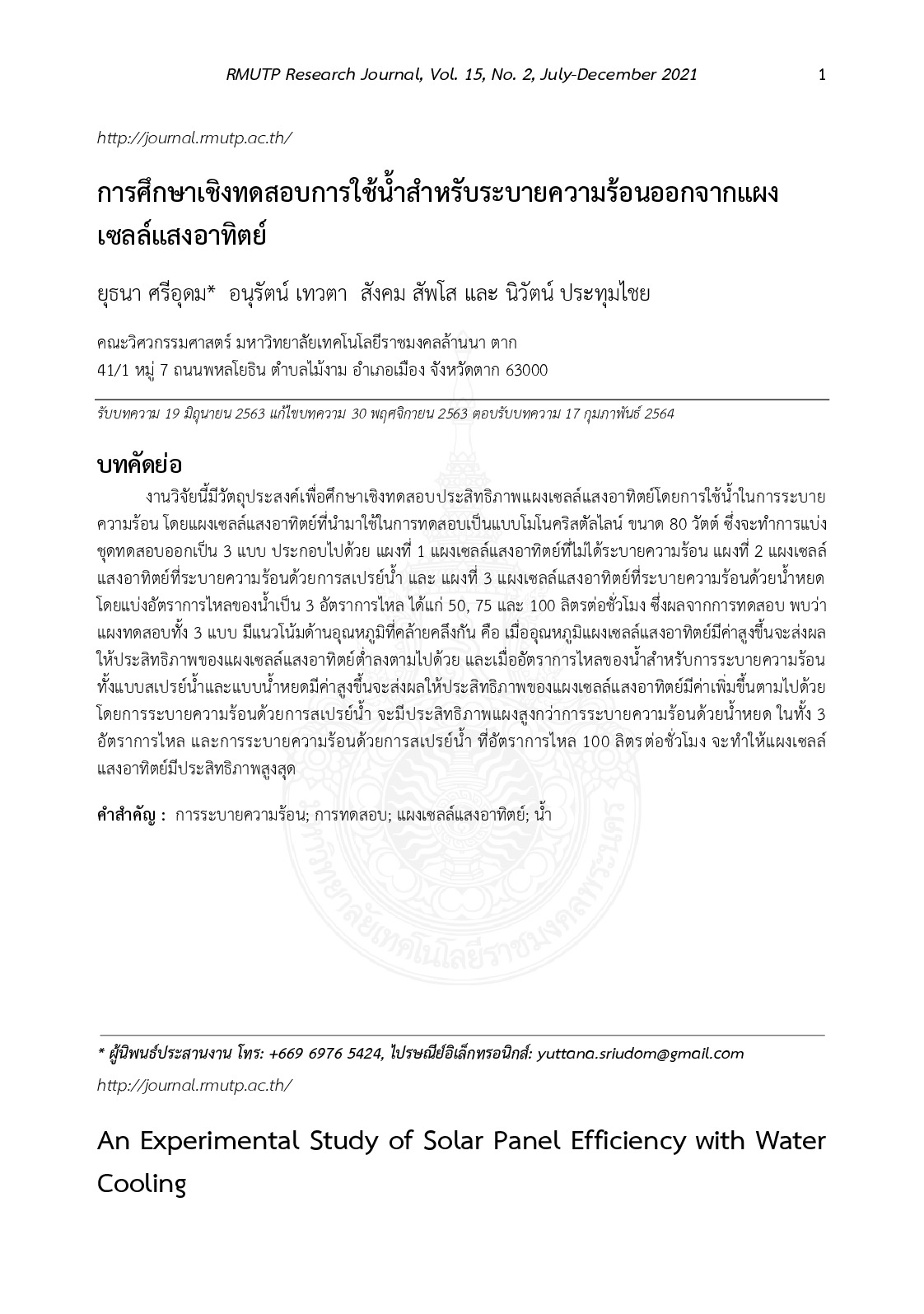
การศึกษาเชิงทดสอบการใช้น้ำสำหรับระบายความร้อนออกจากแผงเซลล์แสงอาทิตย์
This research aimed to experimentally study of solar panel efficiency with water cooling. Three mono-crystalline solar panels with the capacity of 80 W (for each panel) were used for this test. The first panel was a solar panel without water cooling. The second panel was a panel with water spray cooling. The last panel was a solar panel with water drop cooling. The cooling water flow rate was varied to 50 75 and 100 LPH. From the test it was found that the temperatures of all solar panels had the similar trends. The solar panel efficiency decreased when the temperature of solar panel increases. The solar panel efficiency increased when the cooling water flow rate was increased for both of water spray cooling and water drop cooling. For all water cooling flow rates the water spray cooling solar panel performed higher efficiency than water drop cooling solar panel. The highest solar panel efficiency in this test occurred when the water spray cooling flow rate of 100 LPH.

การศึกษาเชิงทดลองการเพิ่มประสิทธิภาพแผงเซลล์แสงอาทิตย์โดยใช้ท่อความร้อนแบบแบน
The purpose of this research was to improve the efficiency of solar cell modules by cooling with heat pipes. The test set consisted of three 80 watt solar modules that were made of mono-crystalline. The first module did not install heat pipes while the second module installed heat pipes using ethanol as the working fluid and the third module installed heat pipes using R-11 as working fluid. Solar radiation intensity electrical energy produced by the solar modules and temperature of the solar modules were recorded. The results showed that the average temperature of the first solar cell module was 52.9oC and the case of not install heat pipes on module. For the units with heat pipes it was found that unit with ethanol heat pipe had an average temperature of 50.7oC and efficiency at 10.2% whereas the unit using R-11 heat pipe had an average temperature at 49.2oC and efficiency at 11.8% From the experiments it was concluded that the installation of heat pipes could increase the efficiency of solar cell mokules.
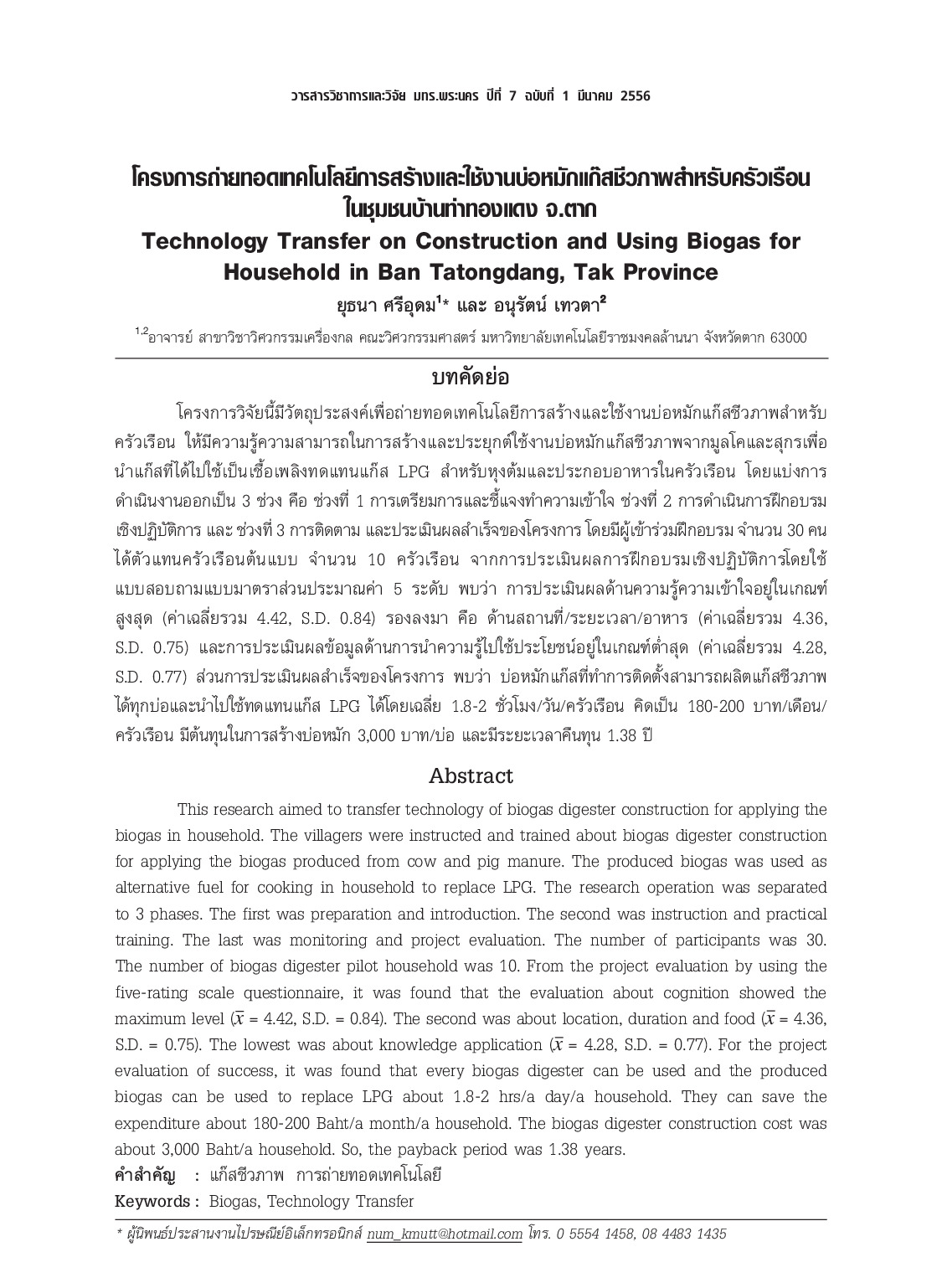
Technology transfer on construction and using biogas for household in ban tatongdang tak province
This research aimed to transfer technology of biogas construction for applying the biogas in household. The villagers were instructed and trained about digester construction for applying the biogas produced from cow and pig manure. The produced biogas was used as alternative fuel for cooking in household to replace LPG. The research operation was separated to 3 phases. the first was preparation and introduction. The second was instruction and practical training. The last was monitoring and project evaluation. The number of participants was 30. The number of biogas digester pilot household was 10. From the project evaluation by using the five-rating scale questionnaire it was found that the evaluation about cognition showed the maximun level (x=4.42 S.D. = 0.84). The second was about location duration and food (X = 4.36 S.D. = 0.75). The lowest was about knowledge application (X= 4.28 S.D. = 0.77). For the project evaluation of success it was found that every biogas digester can be used and the produced biogas can be used to replace LPG about 1.8-2 hrs/a day/a housenold. They can save the expenditure about 180-200 Baht/a month/a household. The biogas digester construction cost was about 3000 Baht/a household. So the payback period was 1.38 years.