จำนวน Repository ( 4 )
แนวทางการเพิ่มประสิทธิภาพในการจัดอาหารกลางวันของศูนย์การศึกษาพิเศษส่วนกลาง จังหวัดกรุงเทพมหานคร
This research aimed to study the personal factors operation and effectiveness of the lunch management project in Central Special Education Center Bangkok. The comparison of the effectiveness of the lunch was based on respondents’ individual factors this study proposed guidelines for optimizing the lunch arrangements. The research group consisted of 215 parents administrators and persons in charge of lunch management of which 164 samples were divided into 140 parents and 24 administrators and responsible persons for the lunch. The research instrument was a survey questionnaire. Data were analyzed statistically by using frequency percentage mean standard deviation and one-way analysis of variance. The results of the study indicated that this sample of parents was predominantly female aged between 31 to 40 years holding a lower bachelors’ degree and having a maximum income of 10000 baht. Overall the operations of the lunch project were performed at a high level. It appeared that the raw materials had the most average followed by administration management. The personnel aspect was the least. Moreover parents’ perception towards the effectiveness of the lunch project were high. Considering each aspect ordered from the highest to the least they respectively included quantity type quality of lunch safety and health administration and favorite luncheon menus. The comparison of the effectiveness of lunch project management and the perception of parents classified by their personal factors revealed that there was a significant difference at 0.05. The found guidelines for increasing the effectiveness of the lunch projects were to provide quality food ingredients the variety of tasty and nutritious dishes and five food groups. Moreover recruited dietitians were required to cook clean disease-free and healthy food by either frying steaming boiling or grilling the food. As a result of fully utilizing nutrients students would stay fit and healthy.

การศึกษาความพึงพอใจต่ออาหารกลางวันของนักเรียนระดับชั้นมัธยมศึกษาตอนต้นโรงเรียนราชินิบน
The objective of this research is: 1) To study of the satisfaction of the Secondary School Lunch Program at Rajinibon School 2) To compare the differences in satisfaction among the Secondary School Lunch Program at Rajinibon School and 3) To study the relationship between the personal factor and the family factor and satisfaction in the daily food consumption of the Secondary School Lunch Program at Rajinibon School. The stratified random sampling consisted of 259 secondary students at Rajinibon School. The tool used was a questionnaire data analysis The frequency percentage mean standard deviation Analysis of variance And Prasit. The study indicated that 1 ) the satisfaction of the Secondary School Lunch Program at Rajinibon School is relatively low 2.48 percent. Overall 2 ) comparative study results of the different student grade levels and their satisfaction of the Secondary School Lunch Program at Rajinibon School produce the value statistically significant at .05. It means that students in different grade levels have varying satisfaction with the overall lunch program. 3 ) Relationship between personal factors And family factors. Levels of entry Education Level The amount of money received at the school. Education of parents Parental occupation Family income And the food characteristics of students with satisfaction for lunch. The taste of the food the container and the place of service personnel. And cleanliness which is statistically significant at .05. But the relationship between personal factors. And family factors. The relationship between the level of education and satisfaction with lunch taste location and cleanliness. No relationship The relationship between the amount received to school And parental occupations with container preference and equipment have not relationship.
ความพึงพอใจของนักเรียนต่อโครงการอาหารกลางวันในโรงเรียนสาธิตมหาวิทยาลัยราชภัฏสวนสุนันทา
The purposes of this research was to study and to compare the students’ satisfaction of the school lunch project in Demonstration School of Suan Sunandha Rajabhat University classified by gender age grade levels and amount of participation in the school lunch project. A sample of this research was 297 students selected by stratified sampling Research instrument was the questionnaire. The data were statistically analyzed in terms of frequency percentage mean standard deviation and t-test for dependent samples. The results of the research indicated that : 1. The satisfaction of most girls from grade levels 1-3 and amount of participation in the project were at high level in all aspects of food services place equipment cost and personel. 2. The satisfaction of students with different genders ages grade levels and amount of participation toward the school lunch project was significantly different at 0.05 level.
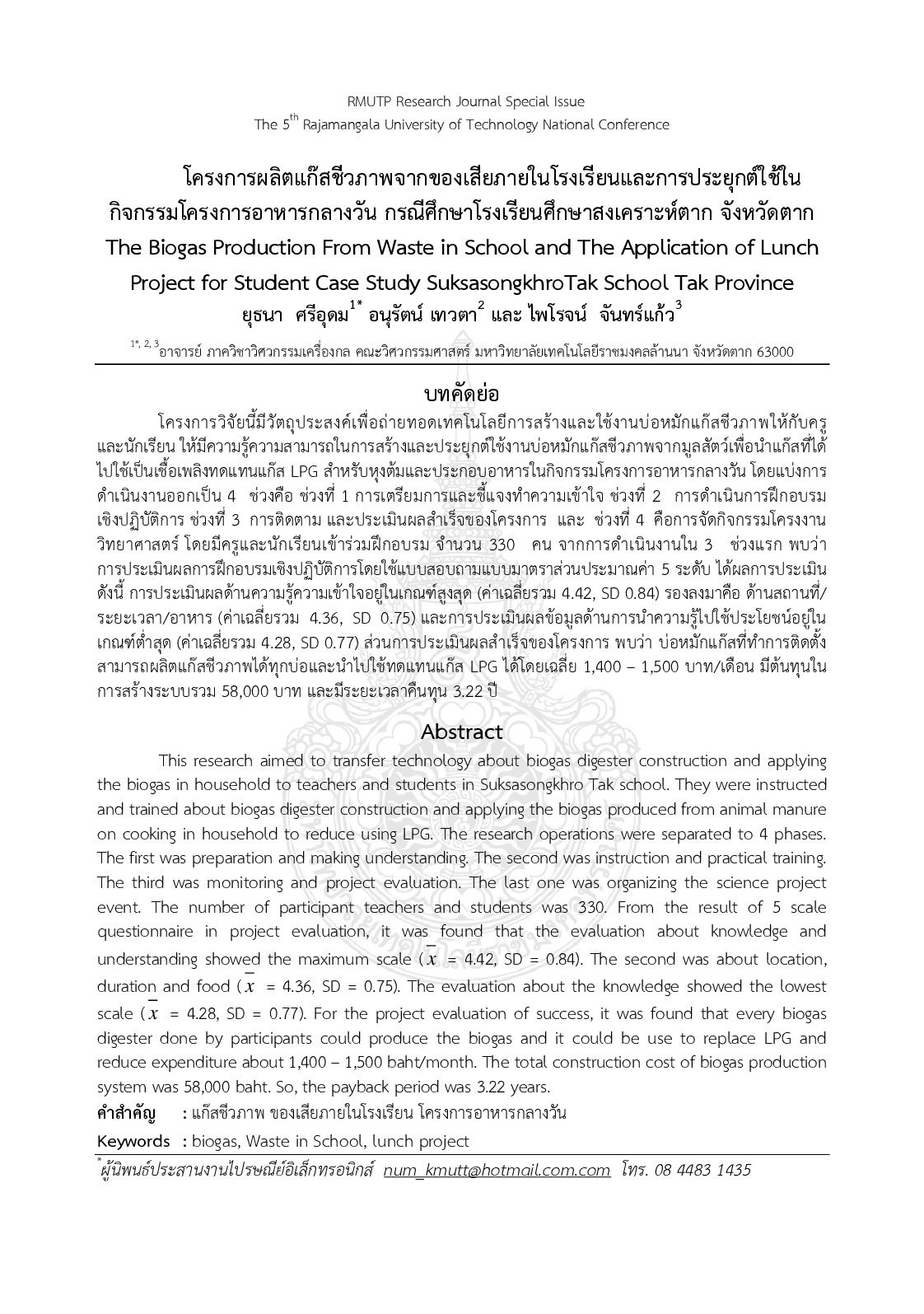
The biogas production from waste in school and the application of lunch project for student case study suksasongkhro tak school tak province
This research aimed to transfer technology about biogas digester construction and applying the biogas in household to teachers and students in Suksasongkhro Tak school. They were instructed and trained about biogas digester construction and applying the biogas produced from animal manure on cooking in household to reduce using LPG. The research operations were separated to 4 phases. The first was preparation and making understanding. The second was instruction and practical training. The third was monitoring and project evaluation. The last one was organizing the science project event. The number of participant teachers and students was 330. From the result of 5 scale questionnaire in project evaluation it was found that the evaluation about knowledge and understanding showed the maximum scale ( = 4.42 SD = 0.84). The second was about location duration and food ( = 4.36 SD = 0.75). The evaluation about the knowledge showed the lowest scale ( = 4.28 SD = 0.77). For the project evaluation of success it was found that every biogas digester done by participants could produce the biogas and it could be use to replace LPG and reduce expenditure about 1400 – 1500 baht/month. The total construction cost of biogas production system was 58000 baht. So the payback period was 3.22 years.