จำนวน Repository ( 2 )

การศึกษาความพึงพอใจต่ออาหารกลางวันของนักเรียนระดับชั้นมัธยมศึกษาตอนต้นโรงเรียนราชินิบน
The objective of this research is: 1) To study of the satisfaction of the Secondary School Lunch Program at Rajinibon School 2) To compare the differences in satisfaction among the Secondary School Lunch Program at Rajinibon School and 3) To study the relationship between the personal factor and the family factor and satisfaction in the daily food consumption of the Secondary School Lunch Program at Rajinibon School. The stratified random sampling consisted of 259 secondary students at Rajinibon School. The tool used was a questionnaire data analysis The frequency percentage mean standard deviation Analysis of variance And Prasit. The study indicated that 1 ) the satisfaction of the Secondary School Lunch Program at Rajinibon School is relatively low 2.48 percent. Overall 2 ) comparative study results of the different student grade levels and their satisfaction of the Secondary School Lunch Program at Rajinibon School produce the value statistically significant at .05. It means that students in different grade levels have varying satisfaction with the overall lunch program. 3 ) Relationship between personal factors And family factors. Levels of entry Education Level The amount of money received at the school. Education of parents Parental occupation Family income And the food characteristics of students with satisfaction for lunch. The taste of the food the container and the place of service personnel. And cleanliness which is statistically significant at .05. But the relationship between personal factors. And family factors. The relationship between the level of education and satisfaction with lunch taste location and cleanliness. No relationship The relationship between the amount received to school And parental occupations with container preference and equipment have not relationship.
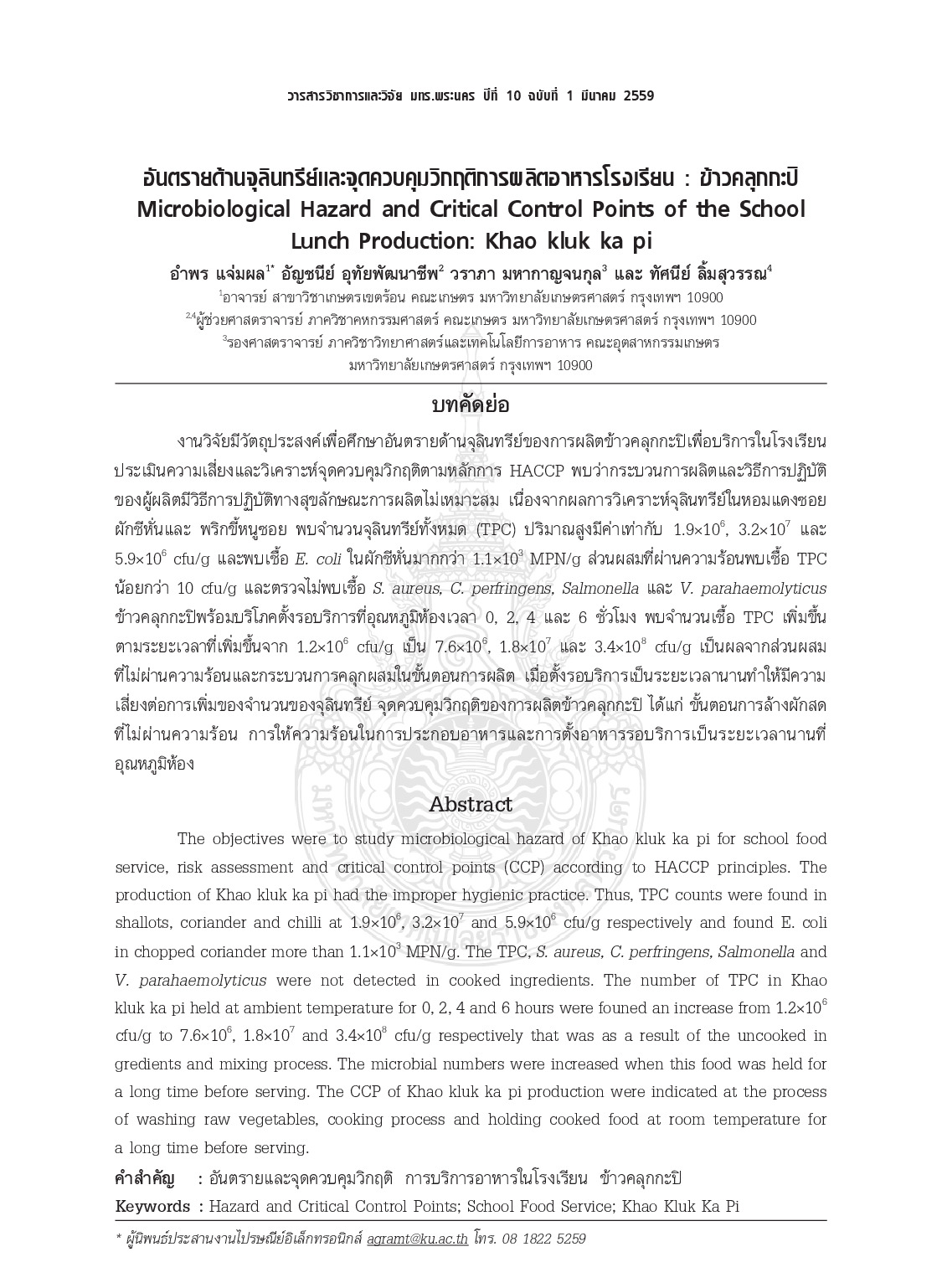
อันตรายด้านจุลินทรีย์และจุดควบคุมวิกฤติการผลิตอาหารโรงเรียน : ข้าวคลุกกะปิ
The objectives were to study microbiological hazard of Khao kluk ka pi for school food service risk assessment and critical control points (CCP) according to HACCP principles.The production of Khao kluk ka pi had the improper hygienic practice. Thus TPC counts were found in shallots coriander and chilli at 1.9×10⁶ 3.2×10⁷ and 5.9×10⁶ cfu/g respectively and found E. coli in chopped coriander more than 1100 MPN/g. The TPC S. aureus C. perfringens Salmonella and V. parahaemolyticus were not detected in cooked ingredients. The number of TPC in Khao kluk ka pi held at ambient temperature for 0 2 4 and 6 hours were founed an increase from 1.2×10⁶ cfu/g to 7.6×10⁶ 1.8×10⁷ and 3.4×10⁸ cfu/g respectively that was as a result of the uncooked ingredients and mixing process. The microbial numbers were increased when this food was held for a long time before serving. The CCP of Khao kluk ka pi production were indicated at the process of washing raw vegetables cooking process and holding cooked food at room temperature for a long time before serving.