จำนวน Repository ( 6 )

การตรวจสอบความเป็นสารปอซโซลานของเถ้าแกลบผสมเถ้าลอยโดยวิธีการบ่มเร่งกำลัง
This paper presents the investigation of pozzolanic reaction of rice husk ash blended with fly ash by accelerated curing. The compressive strength of cement paste containing rice husk ash blended with fly ash at 30% by weight of cementitious material (PBA-30) was studied. The temperature curing at 60 70 and 80oC were parameter of test in order to determine the suitable temperature and curing period on strength development of cement paste. The ratio of rice husk ash to fly ash was 1:1 by weight and the ratio of water-to-binder (w/b) was 0.38. The test results found that the accelerated curing of PBA-30 at temperature of 60oC for 5 10 and 45 hours had comparable compressive strength to PBA-30 with normal curing at the age of 37 and 28 days respectively. As a result of accelerated curing the calcium silicate (CS) which effect on strength development of cement paste was increased. According to the X-ray diffraction analysis the calcium silicate content in cement paste was comparable. Therefore it can be use accelerated curing to investigate the poozolanic reaction of rice husk ash blended with fly ash within 48 hours.
การรับแรงกระแทกของคอนกรีตผสมดินขาวและเถ้าลอย
This research to study the possibility of material pozzolan as binder by replacment cement by fly ash (FA) and meta kaolin (MK) some for testing compressive strength flexural strength and impact strength of concrete vary the ratio of water to binder (w / b) of 0.40 and 0.45 and the amount of fly ash to replace cement some 15 % 30 % MK and 35% for 10% 15% and 20% by weight of cement. The sample consisted of a cylinder diameter of 10 x 20 cm beam sizes 10 x 10 x 40 cm and 4 x 4 x 16 cm from the test results showed that the concrete samples at 28 days and w/ b of 0.40 to greater than 0.45 all mixed. the compressive strength by replacing cement with FA increase up to 30 % compression of 382 ksc higher than the 20 percent replace by MK were equal to 354 ksc and 32.48 ksc compared to replace cement with FA 15 % is equal to 31 ksc 30% were equal to 30 ksc and 45% were equal to 23.85 ksc while the MK was replaced by 10% were equal to 40.10 ksc higher than to 15% and 20% respectively. The control sample was replaced with MK by 10% is equal to 111 joules maximum replaced by fly ash more than 30% were equal to 110 joules and MK were 15% fly ash 15 and 45 percent respectively.
Effect of bottom ash as fine aggregate on strength of concrete
This research was aimed to study the effect of bottom ash (BA) as fine aggregate in fly ash concrete and cement-only concrete on strength of water-cured and uncured concrete. The water to binder ratios were 0.35 and 0.55 to represent high strength and normal strength concrete respectively. The weight percentages of replacement of cement by fly ash were 0 and 30%. The replacement ratios of bottom ash as fine aggregate were 0 10 and 30% by volume of fine aggregate. The results indicated that the slump and setting time of concrete increased with the increase of bottom ash content. In contrast the compressive and tensile strength decreased with the increase of bottom ash content. From the curing sensitivity index it was showed that the fly ash concrete required longer curing period than cement-only concrete. In case of high strength concrete the use of bottom ash in fly ash concrete can reduce curing sensitivity of concrete
Effect of binders on shrinkage cracking behavior of concrete
This research was aimed to study the effect of binders on cracking behavior of high strength concrete under restrained shrinkage condition. The cracking behaviors of concrete that study were cracking age in uniaxially restrained shrinkage test shrinkage rate free shrinkage crack propagation and strength of concrete. The binders used in this study were fly ash and limestone powder. The weight percentage of replacement of cement by fly ash and limestone powder were 30 and 10% respectively. The water to binder ratios was 0.35. The results indicated that the influence parameters of shrinkage cracking were type of binder amount of free shrinkage shrinkage rate and tensile creep of concrete. The use of fly ash and limestone powder could reduce free shrinkage and shrinkage rate of concrete and result in the longer cracking age than cement-only concrete. The tensile creep of cement-only concrete was higher than that of limestone powder concrete and fly ash concrete respectively
Effect of rice husk ash blended with fly Ash on mechanical properties of concrete
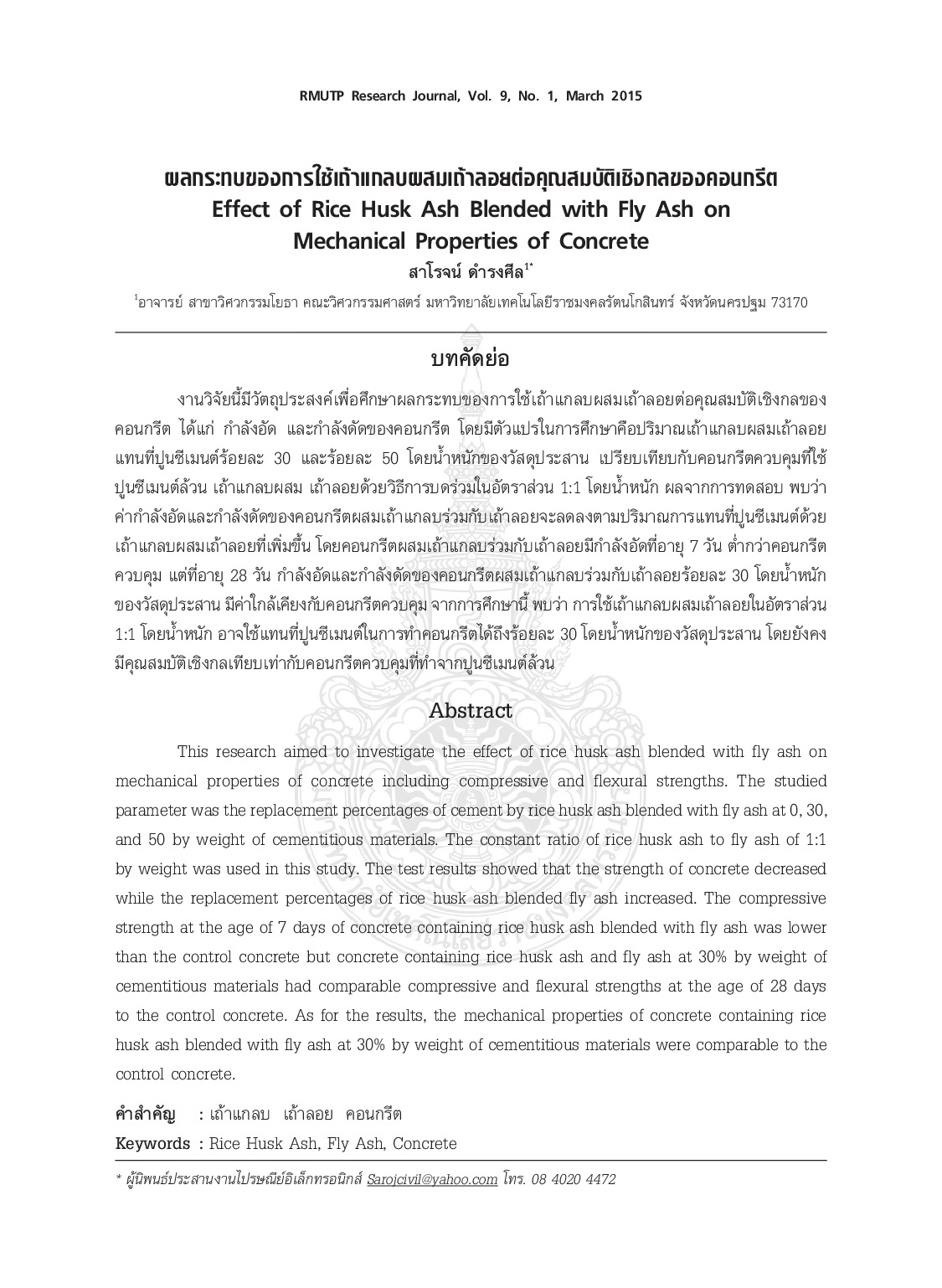
This research aimed to investigate the effect of rice husk ash blended with fly ash on mechanical properties of concrete including compressive and flexural strengths. The studied parameter was the replacement percentages of cement by rice husk ash blended with fly ash at 0 30 and 50 by weight of cementitious materials. The constant ratio of rice husk ash to fly ash of 1:1 by weight was used in this study. The test results showed that the strength of concrete decreased while the replacement percentages of rice husk ash blended fly ash increased. The compressive strength at the age of 7 days of concrete containing rice husk ash blended with fly ash was lower than the control concrete but concrete containing rice husk ash and fly ash at 30% by weight of cementitious materials had comparable compressive and flexural strengths at the age of 28 days to the control concrete. As for the results the mechanical properties of concrete containing rice husk ash blended with fly ash at 30% by weight of cementitious materials were comparable to the control concrete.