จำนวน Repository ( 5 )

การย่อยสลายภายใต้สภาวะไร้อากาศของสารอินทรีย์ประเภทเศษอาหารเข้มข้นในกระบวนการผลิตแก๊สชีวภาพ
The purposes of this research were to investigate anaerobic digestion of concentrated food waste in biogas production system at mesophilic temperature (37 C). The effect of grinding and pH controlled at 6.20 and 7.00 on methane production were also studied. It was found that the ability of mix bacteria which had initial concentration of 2100 mg/l for digesting concentrated food waste with grinding was higher than that without grinding because of the increase in surface area (about 1.37 time). In this system the optimum condition for bacteria growth was found at pH 7.00. Under optimal condition the digestion efficiency in term of chemical oxygen demand (COD) removal was 18.81% higher corresponding to an increase in methane production rate (19.10%) than other conditions
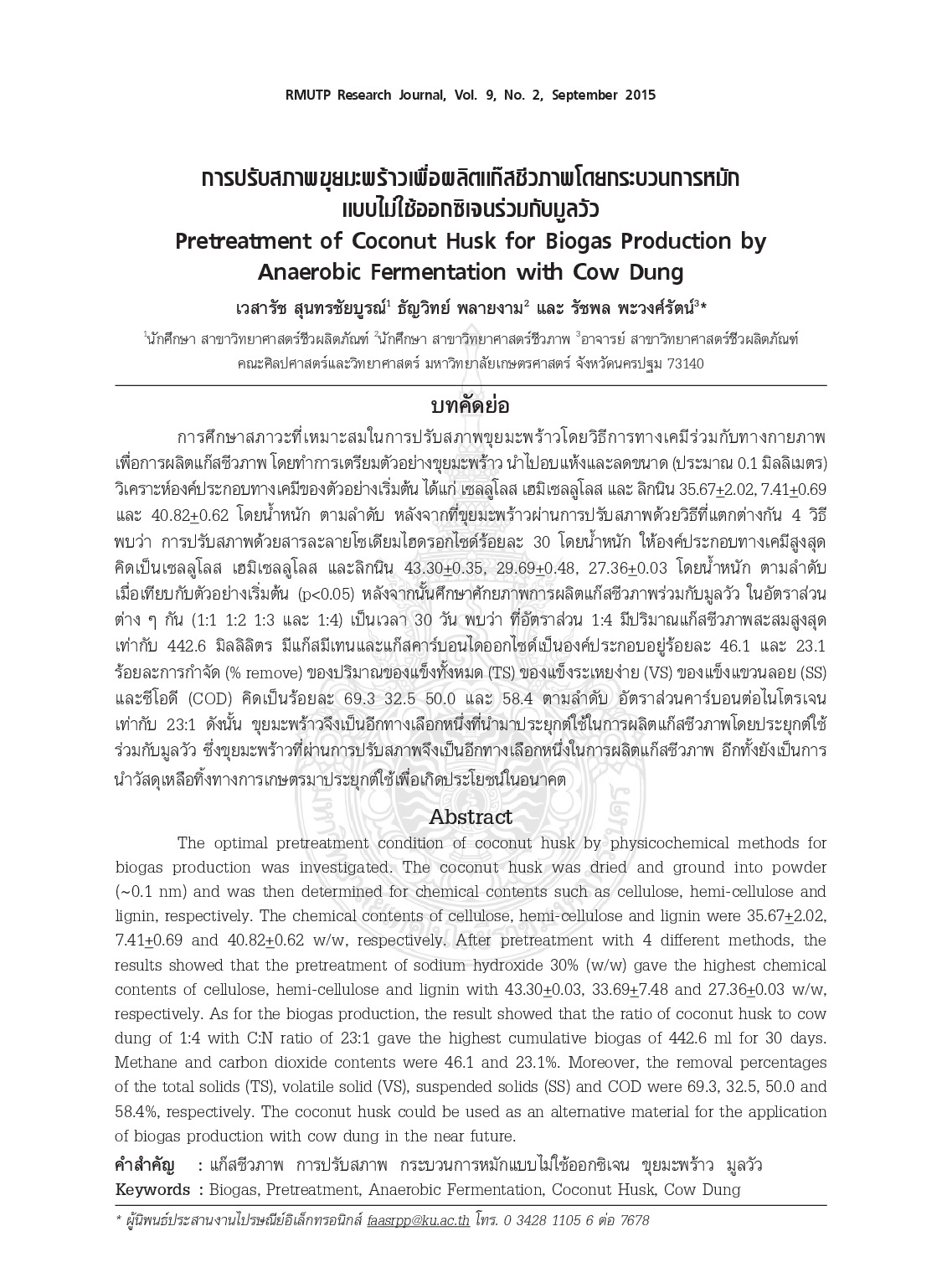
การปรับสภาพขุยมะพร้าวเพื่อผลิตแก๊สชีวภาพโดยกระบวนการหมักแบบไม่ใช้ออกซิเจนร่วมกับมูลวัว
The optimal pretreatment condition of coconut husk by physicochemical methods for biogas production was investigated. The coconut husk was dried and ground into powder (~0.1 nm) and was then determined for chemical contents such as cellulose hemi-cellulose and lignin respectively. The chemical contents of cellulose hemi-cellulose and lignin were 35.67±2.02 7.41±0.69 and 40.82±0.62 w/w respectively. After pretreatment with 4 different methods the results showed that the pretreatment of sodium hydroxide 30 % (w/w) gave the highest chemical contents of cellulose hemi-cellulose and lignin with 43.30±0.03 33.69±7.48 and 27.36±0.03 w/w respectively. As for the biogas production the result showed that the ratio of coconut husk to cow dung of 1:4 with C:N ratio of 23:1 gave the highest cumulative biogas of 442.6 ml for 30 days. Methane and carbon dioxide contents were 46.1 and 23.1 %. Moreover the removal percentages of the total solids (TS) volatile solid (VS) suspended solids (SS) and COD were 69.3 32.5 50.0 and 58.4 % respectively. The coconut husk could be used as an alternative material for the application of biogas production with cow dung in the near future.
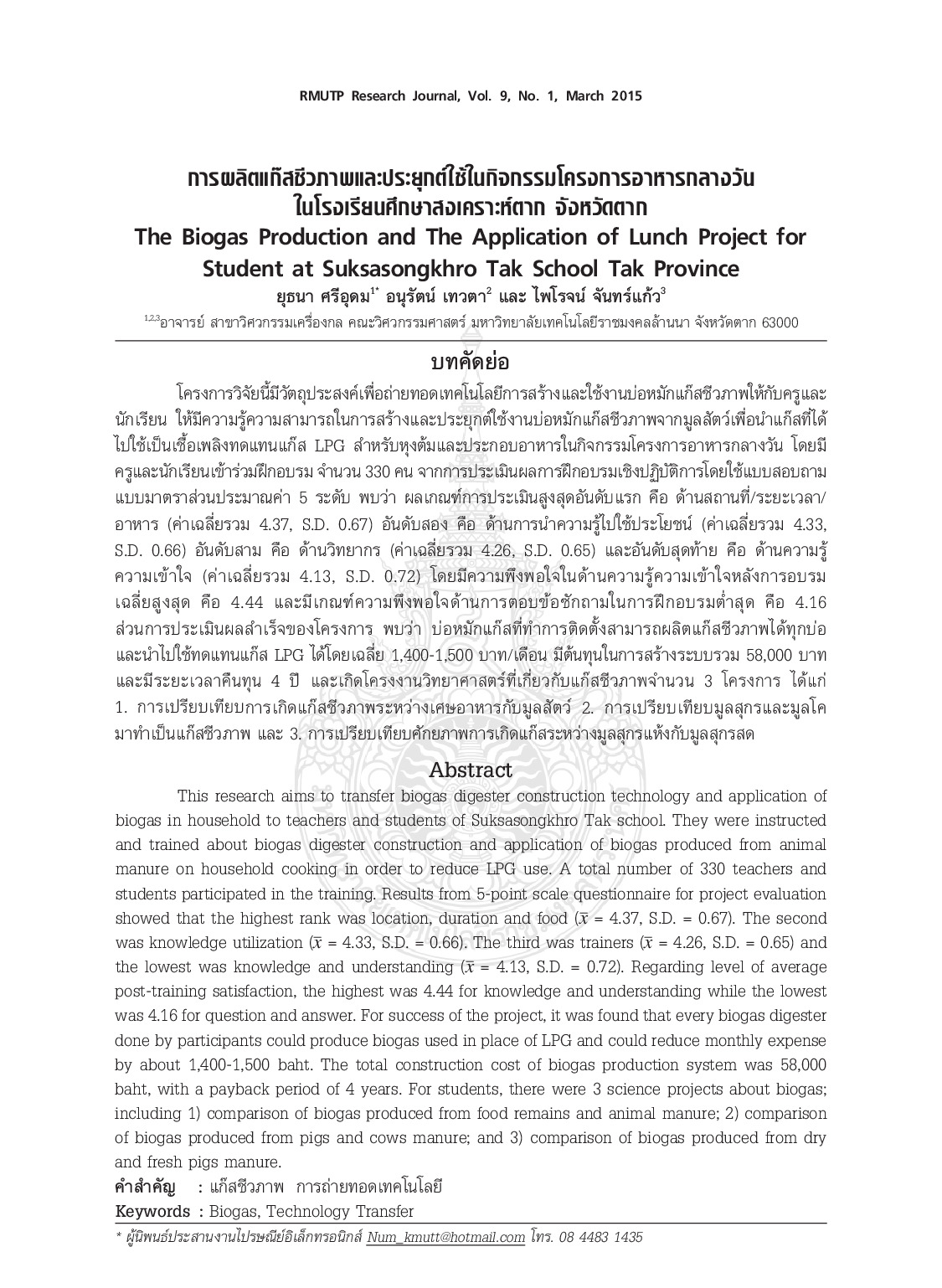
The biogas production and the application of lunch project for student at suksasongkhro tak school tak province
This research aims to transfer biogas digester construction technology and application of biogas in household to teachers and students of Suksasongkhro Tak school. They were instructed and trained about biogas digester construction and application of biogas produced from animal manure on household cooking in order to reduce LPG use. A total number of 330 teachers and students participated in the training. Results from 5-point scale questionnaire for project evaluation showed that the highest rank was location duration and food ( = 4.37 SD = 0.67). The second was knowledge utilization ( = 4.33 SD = 0.66). The third was trainers ( = 4.26 SD = 0.65) and the lowest was knowledge and understanding ( = 4.13 SD = 0.72). Regarding level of average post-training satisfaction the highest was 4.44 for knowledge and understanding while the lowest was 4.16 for question and answer. For success of the project it was found that every biogas digester done by participants could produce biogas used in place of LPG and could reduce monthly expense by about 1400 – 1500 baht. The total construction cost of biogas production system was 58000 baht with a payback period of 4 years. For students there were 3 science projects about biogas; including 1) comparison of biogas produced from food remains and animal manure; 2) comparison of biogas produced from pigs and cows manure; and 3) comparison of biogas produced from dry and fresh pigs manure.
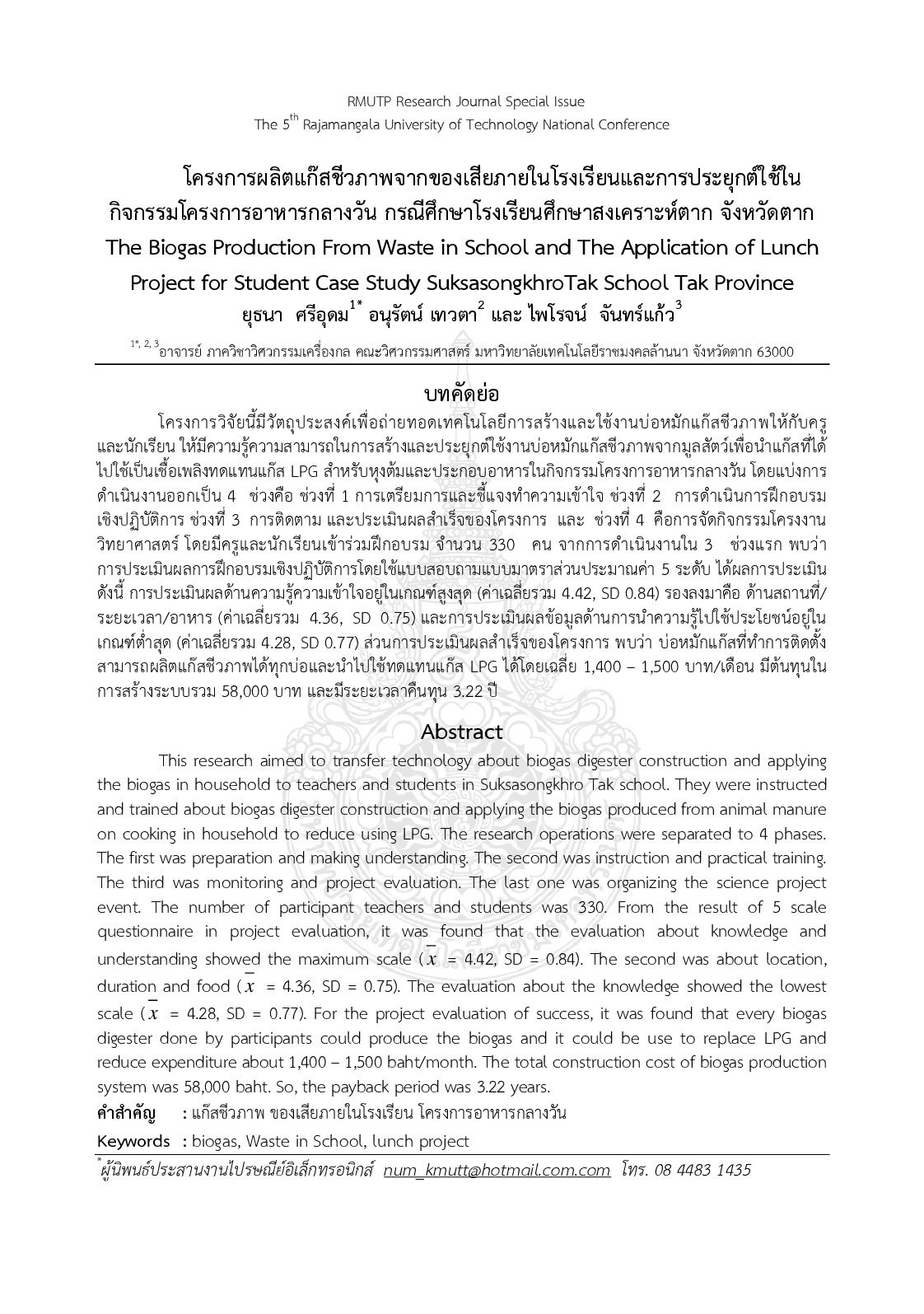
The biogas production from waste in school and the application of lunch project for student case study suksasongkhro tak school tak province
This research aimed to transfer technology about biogas digester construction and applying the biogas in household to teachers and students in Suksasongkhro Tak school. They were instructed and trained about biogas digester construction and applying the biogas produced from animal manure on cooking in household to reduce using LPG. The research operations were separated to 4 phases. The first was preparation and making understanding. The second was instruction and practical training. The third was monitoring and project evaluation. The last one was organizing the science project event. The number of participant teachers and students was 330. From the result of 5 scale questionnaire in project evaluation it was found that the evaluation about knowledge and understanding showed the maximum scale ( = 4.42 SD = 0.84). The second was about location duration and food ( = 4.36 SD = 0.75). The evaluation about the knowledge showed the lowest scale ( = 4.28 SD = 0.77). For the project evaluation of success it was found that every biogas digester done by participants could produce the biogas and it could be use to replace LPG and reduce expenditure about 1400 – 1500 baht/month. The total construction cost of biogas production system was 58000 baht. So the payback period was 3.22 years.
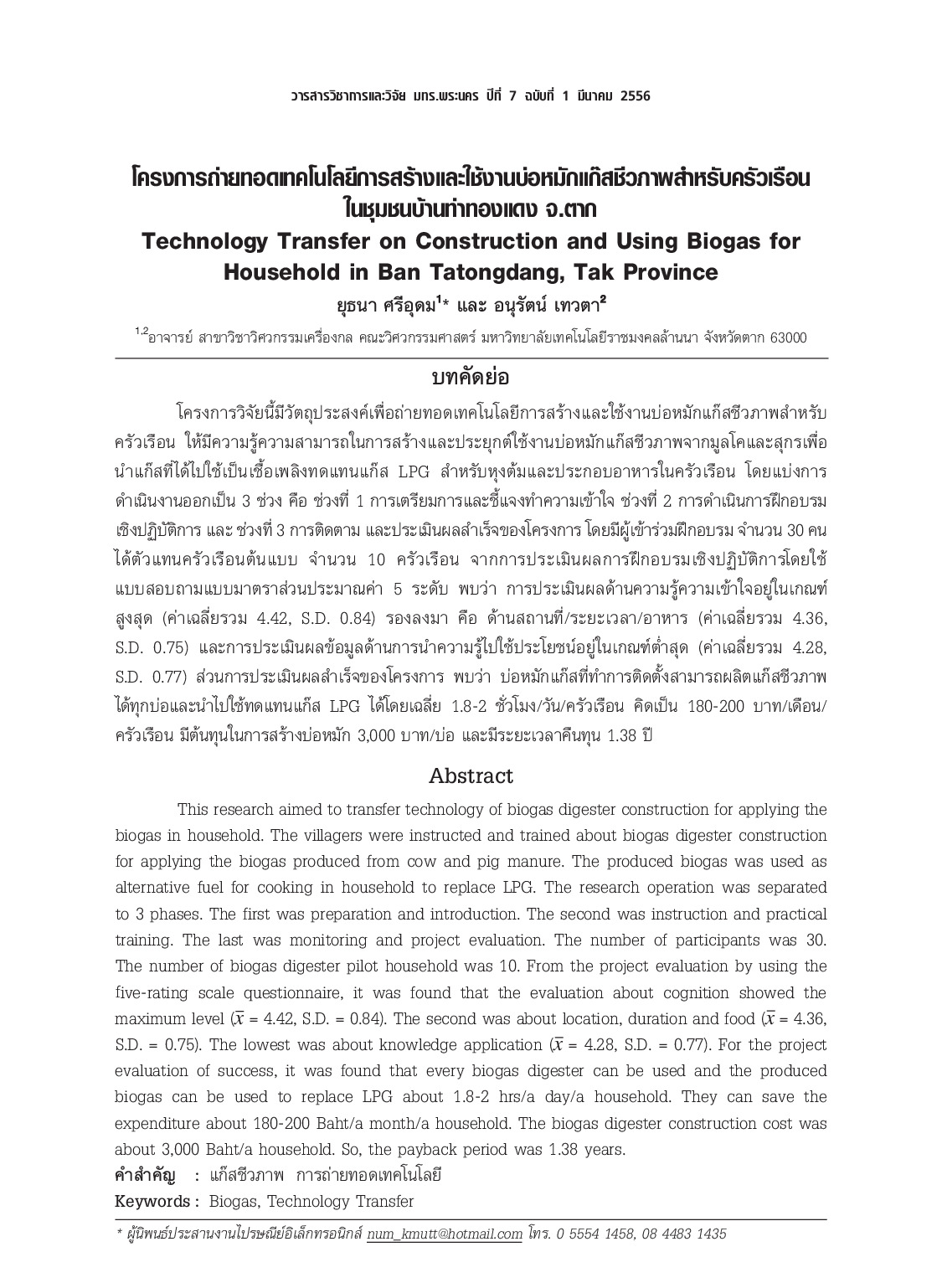
Technology transfer on construction and using biogas for household in ban tatongdang tak province
This research aimed to transfer technology of biogas construction for applying the biogas in household. The villagers were instructed and trained about digester construction for applying the biogas produced from cow and pig manure. The produced biogas was used as alternative fuel for cooking in household to replace LPG. The research operation was separated to 3 phases. the first was preparation and introduction. The second was instruction and practical training. The last was monitoring and project evaluation. The number of participants was 30. The number of biogas digester pilot household was 10. From the project evaluation by using the five-rating scale questionnaire it was found that the evaluation about cognition showed the maximun level (x=4.42 S.D. = 0.84). The second was about location duration and food (X = 4.36 S.D. = 0.75). The lowest was about knowledge application (X= 4.28 S.D. = 0.77). For the project evaluation of success it was found that every biogas digester can be used and the produced biogas can be used to replace LPG about 1.8-2 hrs/a day/a housenold. They can save the expenditure about 180-200 Baht/a month/a household. The biogas digester construction cost was about 3000 Baht/a household. So the payback period was 1.38 years.