จำนวน Repository ( 3 )

การพัฒนาผลิตภัณฑ์ขนมสำปันนีโดยใช้แป้งข้าวลืมผัวทดแทน แป้งมันสำปะหลังบางส่วน
This research study the purposes of the research are to : 1) To study the recipe and process of making Sampanee dessert. 2) To study the preparation of leumpua rice flour for the partially substituted of flour in Sampanee dessert. 3) To study the use of leumpua rice flour for the partially substituted of flour in Sampanee dessert. and 4) To study the storage time of the quality of Sampanee dessert replacement products with leumpua rice flour. A study of Sampanee dessert by using leumpua rice flour to partially substituted of flour. Found that the most appropriate formulation. Formula 1 consists of 2 5 0 grams of tapioca flour 2 0 0 grams of sugar and 3 6 0 grams of coconut milk. The average score was acceptable in all aspects such as color flavor texture overall taste and appearance. The average score was 7.90 8.00 8.30 8.40 8.20 and 8.10 respectively. Due to the texture and smoothness of the two formulas then the leumpua rice is forgotten by the process of flour. The use of modern tools will shorten the process time. It also helps to make the flour more effective. Is a resolution And dry without moisture which is the source of molds. Bring leumpua rice flour to partially substituted of flour in the Sampanee dessert. It was found that Sampanee desserts using leumpua rice flour to replace the flour in some parts. At the replacement rate of 15 percent or formula 1 was the most accepted in terms of color flavor texture overall taste and appearance. The average scores were 7.00 7.60 7.70 7.10 7.73 and 7.40 respectively. Because the desserts is the least change. Consumption Study Results In Sampanee dessert Partially Substituted Flour with Leumpua Rice. It was found that the acceptance of 95% of the products gave an average score of 7.74 at the high level of liking. And according to Thai dessert community product standard. Sampannee Partially Substituted Flour with Leumpua Rice Can be eaten when stored at room temperature. The shelf life should not exceed 1 week.
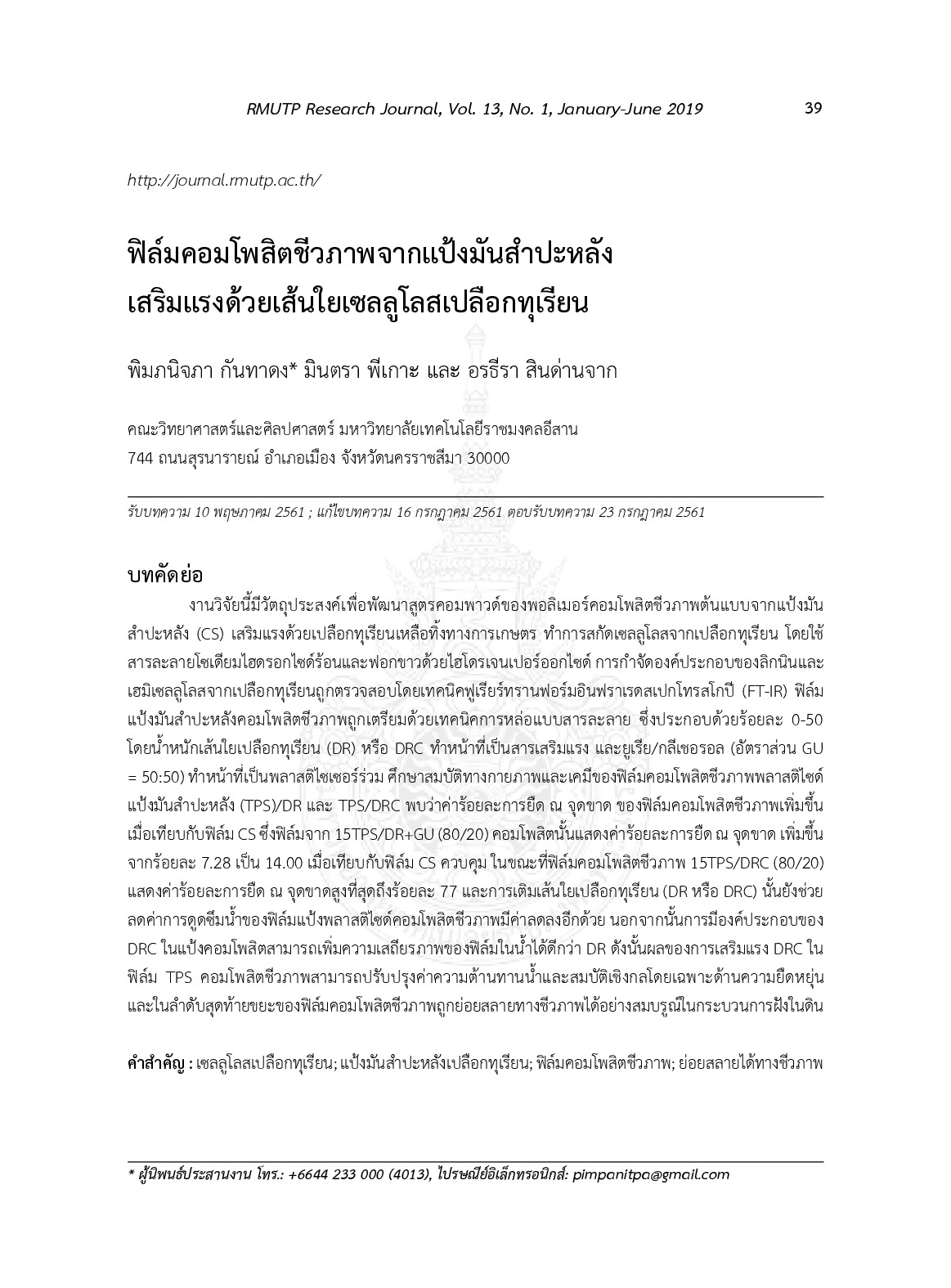
ฟิล์มคอมโพสิตชีวภาพจากแป้งมันสำปะหลังเสริมแรงด้วยเส้นใยเซลลูโลสเปลือกทุเรียน
This research aimed to develop compound of prototypes polymer bio-composites from cassava starch (CS) reinforced with agriculture residue the rind of durian fruit. Cellulose extracted from durian rind using hot sodium hydroxide and bleaching treatment with hydrogen peroxide. The removal of lignin and hemicellulose components from durian rind were investigated by fourier transform infrared spectroscopy (FT-IR). Cassava starch bio-composite films were prepared by solution-casting technique which includes 0-50 wt% of durian rind (DR) or durian rind cellulose (DRC) as reinforcement agent and urea/glycerol (GU ratio = 50:50) as plasticizer. The physical and chemical properties of thermoplastic starch (TPS)/DR and TPS/DRC bio-composite films were investigated. The percent elongation at break of bio-composite films were increased when compared to control CS film. From 15TPS/DR (80/20) films showed increase the elongation at break from 7.28 to 14.00% when compared to CS control films. While 15TPS/DRC (80/20) bio-composite films exhibited that the highest elongation at break to 77%. Durian fiber (DR or DRC) loading decreased the water absorption of plasticized bio-composite films. Furthermore incorporation of DRC in composite can be enhanced film stability in water better than DR. Therefore the effect of DRC reinforcement agent on TPS bio-composite films can improve water resistance and mechanical properties especially in terms of flexibility. Finally the waste of bio-composite films was degraded completely in soil burial test.
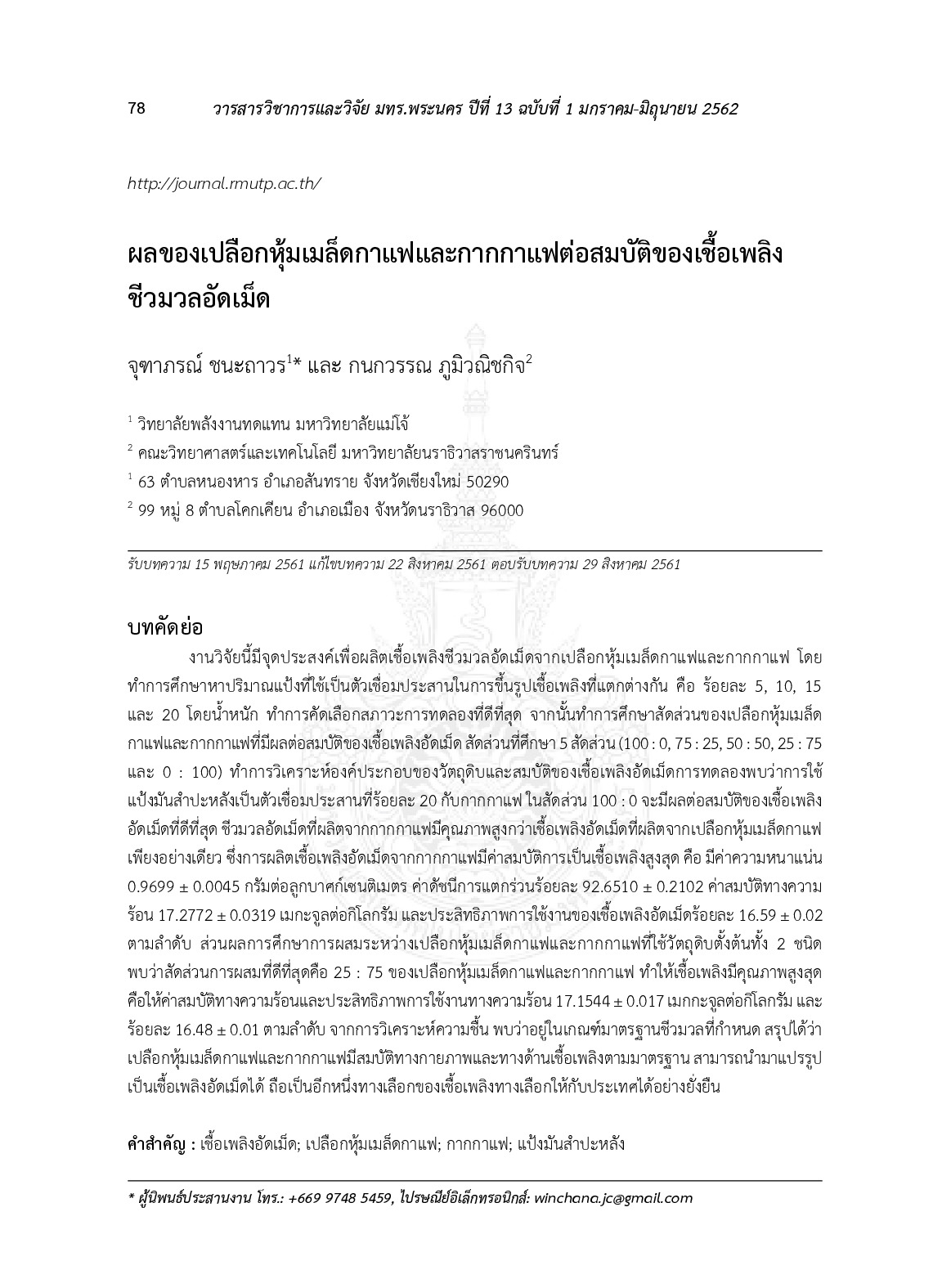
ผลของเปลือกหุ้มเมล็ดกาแฟและกากกาแฟต่อสมบัติของเชื้อเพลิงชีวมวลอัดเม็ด
The objective is to produce the biomass pellet fuel from coffee silverskin and spent of coffee grounds. To study the percentage of cassava powder as binder was mixed at 5 10 15 and 20% by weight and the best condition was chosen. Then to study the ratio of coffee silverskin and spent of coffee grounds was 5 ratios (100 : 0 75 : 25 50 : 50 25 : 75 and 0 : 100) on propertied of biomass pellet fuel. Characteristics and properties of raw materials and biomass pellet fuel were analyzed. The results found that the highest property of the biomass pellet fuel was 20% of cassava powder as binder. The biomass pellet from spent coffee grounds as main component was higher quality than coffee silverskin. The biomass pellet from spent coffee grounds was the maximum fuel property. The bulk density was 0.9699 0.0045 g/ cubic cm shatter index was 92.6510 ± 0.2102% heating value was 17.2772 ± 0.0319 MJ/kg and heat utilization efficiency was 16.59 ± 0.02%. The results from the part of coffee silverskin and spent of coffee grounds ratio showed that the best ratio from 2 raw materials was 25 : 75 that gave the highest quality. The heating value was 17.1544 ± 0.017 MJ/kg and heat utilization efficiency was 16.48 ± 0.01%. In addition the study also discovered that the biomass pellet had moisture contents in the levels acceptable under biomass standards. Thus in summary the coffee silverskin and spent coffee grounds had physical property and fuel property according to the standardization to be made into biomass pellet fuel. It considered to be one of alternative fuels in country permanently.