จำนวน Repository ( 5 )
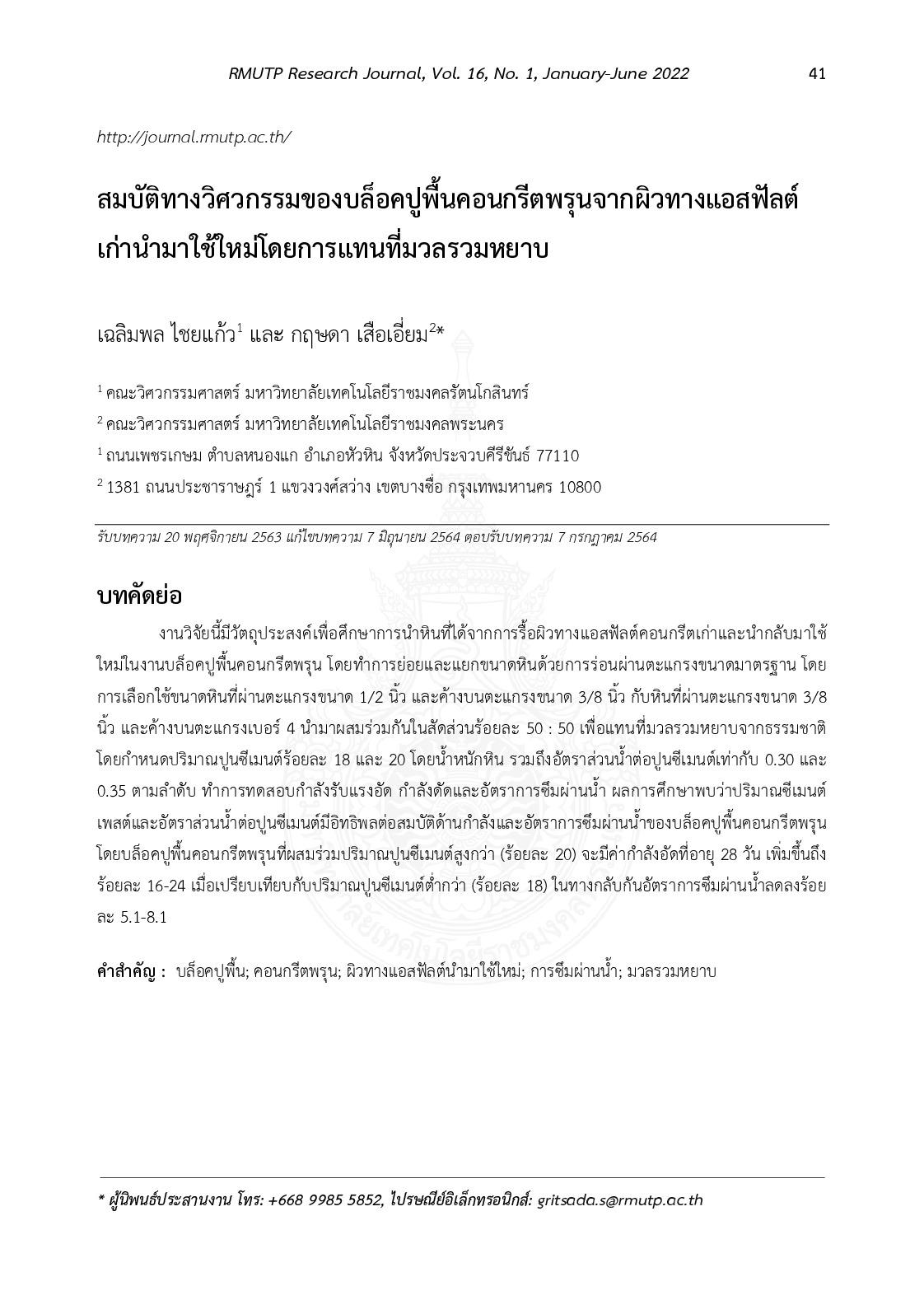
สมบัติทางวิศวกรรมของบล็อคปูพื้นคอนกรีตพรุนจากผิวทางแอสฟัลต์เก่านำมาใช้ใหม่โดยการแทนที่มวลรวมหยาบ
This research aimed to study the use of coarse aggregate obtained from removing old recycled asphalt pavement (RAP) in the production of the porous concrete paving block. Crushing and size separation of the coarse aggregate by using standard sieve size by selected the gradation size of the coarse aggregate that passed to sieve size 1/2” and retained on sieve size 3/8” and other that passed to sieve size 3/8” and retained on sieve size No.4 by mixing ratio 50 : 50 of the mass as replaced natural coarse aggregate. Portland cement quantity about 18% and 20% by weight of the aggregate. The water to cement ratio was 0.30 and 0.35 respectively. Compressive strength flexural strength and water permeability were investigated. The results showed that the cement content and water to cement ratio was influenced the strength properties and water permeability rate of the porous concrete paving block. The porous concrete paving block mixed with higher cement content (20%) had the compressive strength at the age of 28 days increased by 16-24% when compared with lower cement content (18%). On the other hand the water permeability rate decreased by 5.1-8.1%.
การศึกษาและพัฒนาวัสดุปูผิวทางแบบแอสฟัลติกคอนกรีตผสมด้วยเศษยางธรรมชาติป่น
This research presents the engineering properties of asphalt (AC 60/70) modified with different ratios of scrap natural rubber. Then select the best properties of the binder to mix asphaltic concrete. From laboratory testing results with adding 7% scrap natural rubber into mixtures for the best results. The properties of asphaltic concrete can be improved by adding 7% scrap natural rubber. For asphaltic concrete Marshall Stability increased with adding scrap natural rubber into asphalt. Moreover the stiffness modulus of asphaltic concrete can be improved 13.53 compared to AC 60/70.
การศึกษาและพัฒนาวัสดุปูผิวทางแบบแอสฟัลติกคอนกรีตผสมด้วยยางป่นรีไซเคิล
This paper present the engineering properties of asphalt (AC 60/70) modified with different ratios of crumb rubber. Then select the best properties of the binder to mix asphaltic concrete. From laboratory testing results with adding 11% crumb rubber into mixtures for the best results. The properties of asphaltic concrete can be improved by adding 11% crumb rubber. For asphaltic concrete Marshall Stability increased and flow decreased with adding crumb rubber into asphalt. Comparing to ordinary asphaltic concrete (AC 60/70) the rutting resistance was increased 18% for crumb rubber modified asphalt respectively. Moreover the fatigue resistance of crumb rubber modified asphalt improved to be 1.59 times compared to AC 60/70.
การศึกษาและพัฒนาวัสดุปูผิวทางแบบแอสฟัลติกคอนกรีตผสมด้วยยางพาราธรรมชาติ
This paper present the engineering properties of asphalt (AC 60/70) modified with different ratios of natural rubber. Then select the best properties of the binder to mix asphaltic concrete. From laboratory testing results with adding 6% natural rubber into mixtures for the best results. The properties of asphaltic concrete can be improved by adding 6% natural rubber. For asphaltic concrete Marshall Stability increased and flow decreased with adding natural rubber into asphalt. Comparing to ordinary asphaltic concrete (AC 60/70) the rutting resistance was increased 22% for natural rubber modified asphalt respectively. Moreover the fatigue resistance of natural rubber modified asphalt improved to be 2.06 times compared to AC 60/70.

การศึกษาและพัฒนาวัสดุปูผิวทางแบบแอสฟัลติกคอนกรีตผสมด้วยยางแผ่นรมควัน
This research presents the engineering properties of asphalt (AC 60/70) modified with different ratios of rib smoked sheet. Then select the best properties of the binder to mix asphaltic concrete. From laboratory testing results with adding 9% rib smoked sheet into mixtures for the best results. The properties of asphaltic concrete can be improved by adding 9% rib smoked sheet. For asphaltic concrete Marshall Stability increased with adding rib smoked sheet into asphalt. Moreover the stiffness modulus of asphaltic concrete can be improved 9.03 compared to AC 60/70.