จำนวน Repository ( 2 )

ผลของไคโตซานต่อปริมาณสารต้านอนุมูลอิสระและการต้านทานโรคใบไหม้ในข้าวสังข์หยดพัทลุง
This research was aimed to study the effect of chitosan on total polyphenol contents anthocyanin contents antiradical properties and resistance of rice blast disease in Sung Yod Phatthalung rice (Oryza sativar L.) cultivars. The chitosan was applied on rice leaves at concentrations of 50 100 and 500 ppm compared with the control (without the chitosan and only adding a 0.025% acetic acid respectively). The result showed that 500 ppm of chitosan could significantly increase the total polyphenol contents (220.75 mg GAE/100 g dry weight sample) anthocyanin contents (2.98 mg/100 g dry weight sample) and antiradical properties (83.15%) in the grain extracts of Sung Yod Phatthalung rice. In addition Necrosis test on rice leaves treated with 500 ppm of chitosans clearly indicated the plant resistance againt Pyricularia grisea. Therefore the future studies of chitosan activation mechanism will give more valuable information that possible to be applied in the healthy rice product development and fungal disease control.
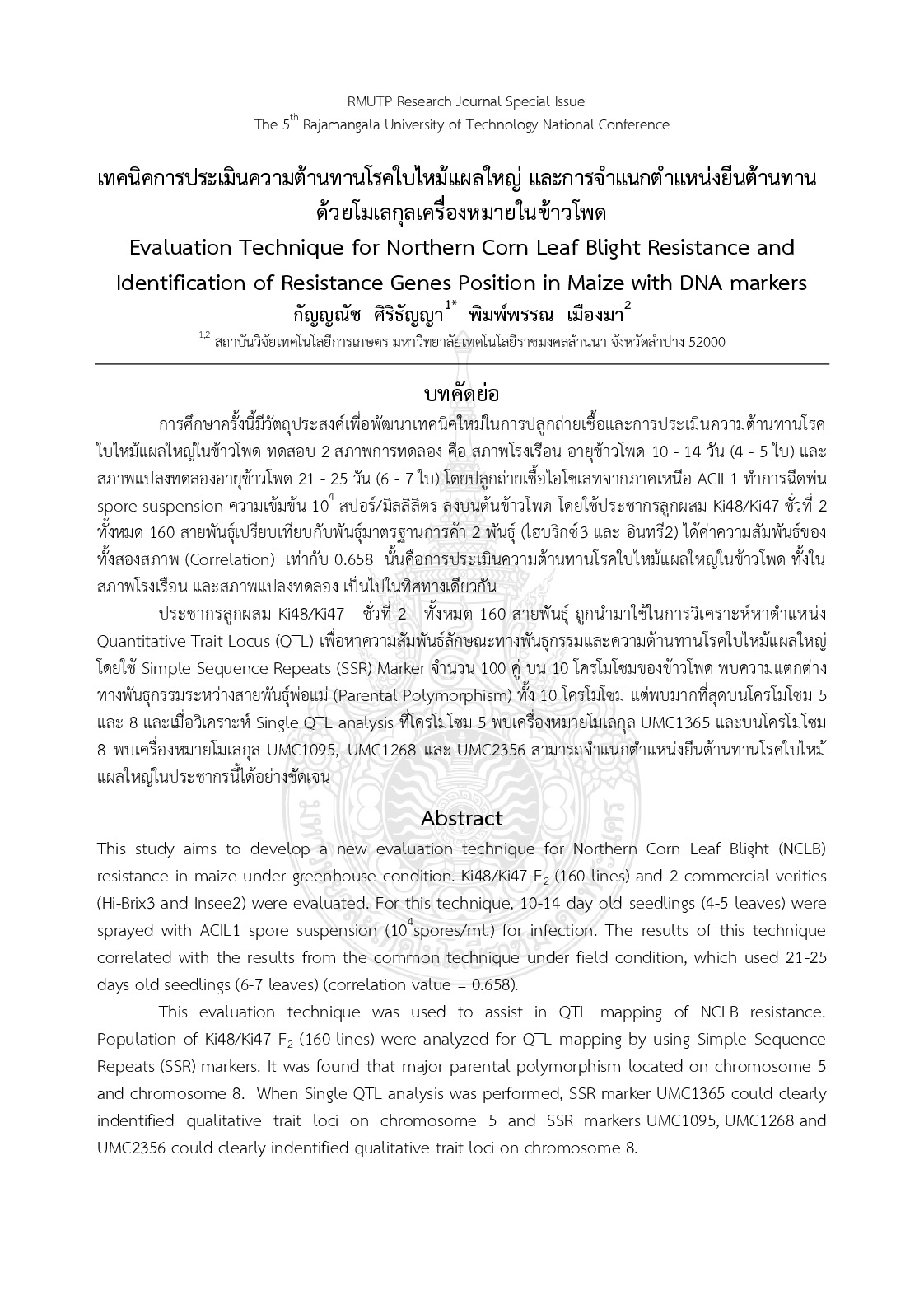
Evaluation technique for northern corn leaf blight resistance and identification of resistance genes position in maize with dna markers
This study aims to develop a new evaluation technique for Northern Corn Leaf Blight (NCLB) resistance in maize under greenhouse condition. Ki48/Ki47 F2 (160 lines) and 2 commercial verities (Hi-Brix3 and Insee2) were evaluated. For this technique 10-14 day old seedlings (4-5 leaves) were sprayed with ACIL1 spore suspension (104spores/ml.) for infection. The results of this technique correlated with the results from the common technique under field condition which used 21-25 days old seedlings (6-7 leaves) (correlation value = 0.658). This evaluation technique was used to assist in QTL mapping of NCLB resistance. Population of Ki48/Ki47 F2 (160 lines) were analyzed for QTL mapping by using Simple Sequence Repeats (SSR) markers. It was found that major parental polymorphism located on chromosome 5 and chromosome 8. When Single QTL analysis was performed SSR marker UMC1365 could clearly indentified qualitative trait loci on chromosome 5 and SSR markers UMC1095 UMC1268 and UMC2356 could clearly indentified qualitative trait loci on chromosome 8.