จำนวน Repository ( 41 )
แผ่นเกราะโลหะกันกระสุน
This research project aimed to analyze and design the pattern of a bulletproof metal armor plate as well as build a bulletproof metal armor plate for a small armored regular truck. The methodology consisted of the NIJ standard test and the finite element analysis. The bulletproof plates created were tested for a real firing. Their firing results were compared with those of NIJ-standard using a finite element program in this case applying with the program Ansys/Explicit Dynamic. SolidWorks program is employed as a tool to design and create 3D models of armor plates and bullets. The materials taken in the finite element simulation were SKD11 and SUS304 and the parameters utilized in the research were material types hardness values spacing between the plates and thickness. In the case of two armor plates stacked SKD11 material was designed for the first armor plate to be hit by the bullet. It served to destroy bullets. In addition the second armor plate made of SUS304 material served to absorb energy and obstruct the movement of bullets. For testing a 30-06 caliber M2 AP 166 Gr bullet was selected at a 0-degree angle and the velocities measured and set by the Ansys/Explicit Dynamic program were 901.7 m/s and 880 m/s respectively. The front plate made of SKD11 material with a thickness of 10 mm and the back plate made of SUS304 material with a thickness of 10 mm were fired 1 shot. The results showed that the bullet could penetrate the front armor plate but not penetrate the back-armor plate. In the NIJ 3 standard tests the shooting with a 7.62x51 mm NATO FMJ 148 Gr shell at a 0-degree angle for 5 times with velocities equal to 846.4 841.3 839.1 838.2 and 845.3 m/s was performed on the stacking front and back armor plates both made of SUS304 material with a thickness of 8 mm. The bullet velocity simulated by the Ansys program was 847 m/s resulting in the front plate having a bullet penetration and a slight bulge on the back plate. From the finite element simulation results and the actual test results it was found that the damage to the armor plates detected by both methods was consistent. Therefore the finite element program was selected to simulate the damage of armor plates resistant to penetration according to the NIJ standard Level 4. The results of the research could be concluded that the use of armor plates stacked with suitable different materials in multiple layers would affect the penetration resistance. Increased thickness and optimal spacing between the armor plates were important parameters in penetration resistance. Moreover it revealed that the higher the material hardness the better its ability to resist penetration. In particular this suggestion should be applied to the first armor plate or front armor plate.
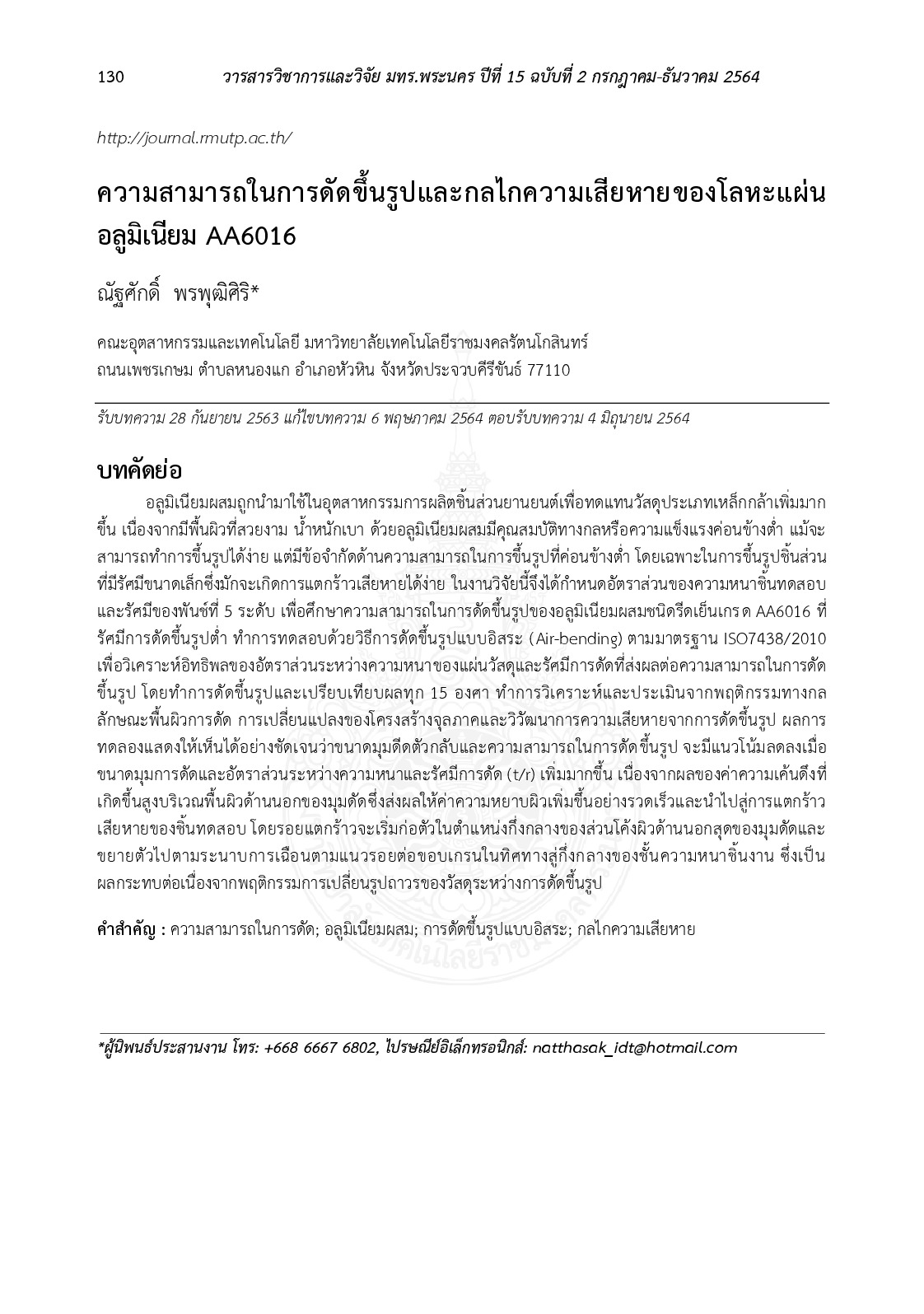
ความสามารถในการดัดขึ้นรูปและกลไกความเสียหายของโลหะแผ่นอลูมิเนียม AA6016
Aluminium alloys was used in the automotive parts industry increased for compensate steel parts material due to its lightweight and good surface. Since aluminium alloys are there relatively low mechanical properties although they can be deformed easily but the major limitation is their low formability. Especially the less bending radius which is often bending surface damaged easily. In the present work five-difference ratio of sheet thickness and bending radius for study to the bendability of cold rolled aluminum alloys AA6016 at low bending radius. The bending test by Air-bending method according to ISO 7438: 2010. To compare the results every 15 degrees. The mechanical behaviour surface roughness microstructure and damage evolution in the fillet region were analysed by experimental research. The experiment clearly showed that the Spring-back angle and bendability tend to decrease as the bending angle and material thickness increase. Due to the high tensile stress on the bending surface it effected to the surface roughness increases rapidly and led to the damage on the specimen bending surface. The initial cracks occur on the middle of the outer surface curvature and propagation in the shear plane pattern to the middle of the sheet thickness along the grain boundary. This is the consequence of plastic deformation by bending test.
การสังเคราะห์อนุภาคนาโนโลหะโดยการระเหยด้วยเลเซอร์ในน้ำ
Nanomaterials are widely used in many applications such as medicine cosmetic industry and other. When the size of the particle is reduced the number of atoms on the surface and the ratio between surface area to volume of the material increase result in the enhancement of the material’s physical magnetic and optical properties. There are many methods to synthesize the nanoparticle such as grinding chemical reaction electrochemical method and laser ablation. In this research laser ablation was chosen to synthesize the metal nanoparticles because this method is quick and convenient and does not produce hazardous waste. The results show that the laser with 6V electric potential could synthesize the metal nanoparticles with the smallest size. The metal nanoparticles with larger size were obtained when higher electrical potential of 8V and 10V were used. In conclusion the electric potential of the laser affects the size of the metal nanoparticle obtained from laser ablation.

การศึกษาพัฒนาเพิ่มมูลค่าของโลหะเงินสเตอร์ริงผสมแพลเลเดียมเพื่อเพิ่มคุณสมบัติต้านความหมองสำหรับอุตสาหกรรมเครื่องประดับ
The study of silver metal used in the non-plated jewelry industry was found to be dull or black but it was a basic feature of silver. To react with air easily in Thailand. The hot weather must be maintained regularly. The concept that we can study the development of silver metal with resistance to tarnish to slow down will have a positive effect on the jewelry industry. The team has developed a concept to bring other elements to meet the potential. The element used here is palladium (Pd) because the palladium is in the same group as the nickel and platinum groups in the periodic table. It is a metal (Nobel Metal) which is very durable corrosion. Usually white is natural and when used to polish the skin is glistening and in most cases in the jewelry industry is often used as part of the alloy such as making the natural gold color close to the platinum. The authors performed the experiments by introducing silver metal with palladium in an appropriate ratio and tested it with artificial stone. And save the record. It is divided into 4 periods of 5-20 days in normal temperature. The results of the study showed that 92.5% copper 6.8% and 0.7% palladium had a shade of L value of 59% over 20 days. It can be used to produce silver jewelry at a lower tarnished rate. In the jewelry industry
การดูดซับโลหะหนักโดยใช้เรซินแลกเปลี่ยนไอออนที่ทำจากผงไผ่และการดัดแปรพื้นผิวด้วยแมงกานีสออกไซด์
The objective of this work was to study the adsorption efficiency of bamboo and its surface modified with manganese oxide for removal of Pb(II) ion. The adsorption of Pb(II) from aqueous solution onto bamboo (BB) and manganese oxide-modified bamboo powder (MnO-BB) was evaluated based on batch experiment. The adsorption efficiency of MnO-BB onto Pb(II) was investigated as a function of the initial pH of 6 equilibrium time of 30 min adsorbent concentration of 5 g/L and initial concentration of Pb(II) solution in the range of 50-500 mg/L. The adsorption isotherms of Langmuir Freundlich and Dubinin-Radushkevich were used to describe the equilibrium isotherm. It is observed that the data from MnO-BB adsorbents fitted well to the Langmuir isotherm. The maximum monolayer adsorption capacities of MnO-NC were estimated as 38.76 mg/g. By comparing with BB the amount of Pb(II) adsorbed onto MnO-BB was more than BB by about 40 times under the optimized adsorption condition. According to Dubinin-Radushkevich isotherm the adsorptive mechanism of Pb(II) onto MnO-BB was chemisorption. The kinetic studies of Pb(II) demonstrated that the adsorption of Pb(II) onto MnO-BB adsorbent followed a pseudo second-order model with a good correlation. The adsorption mechanism was processed via chemical ion exchange between H+ and bonded MnO groups and Pb(II) ions in solution