จำนวน Repository ( 8 )
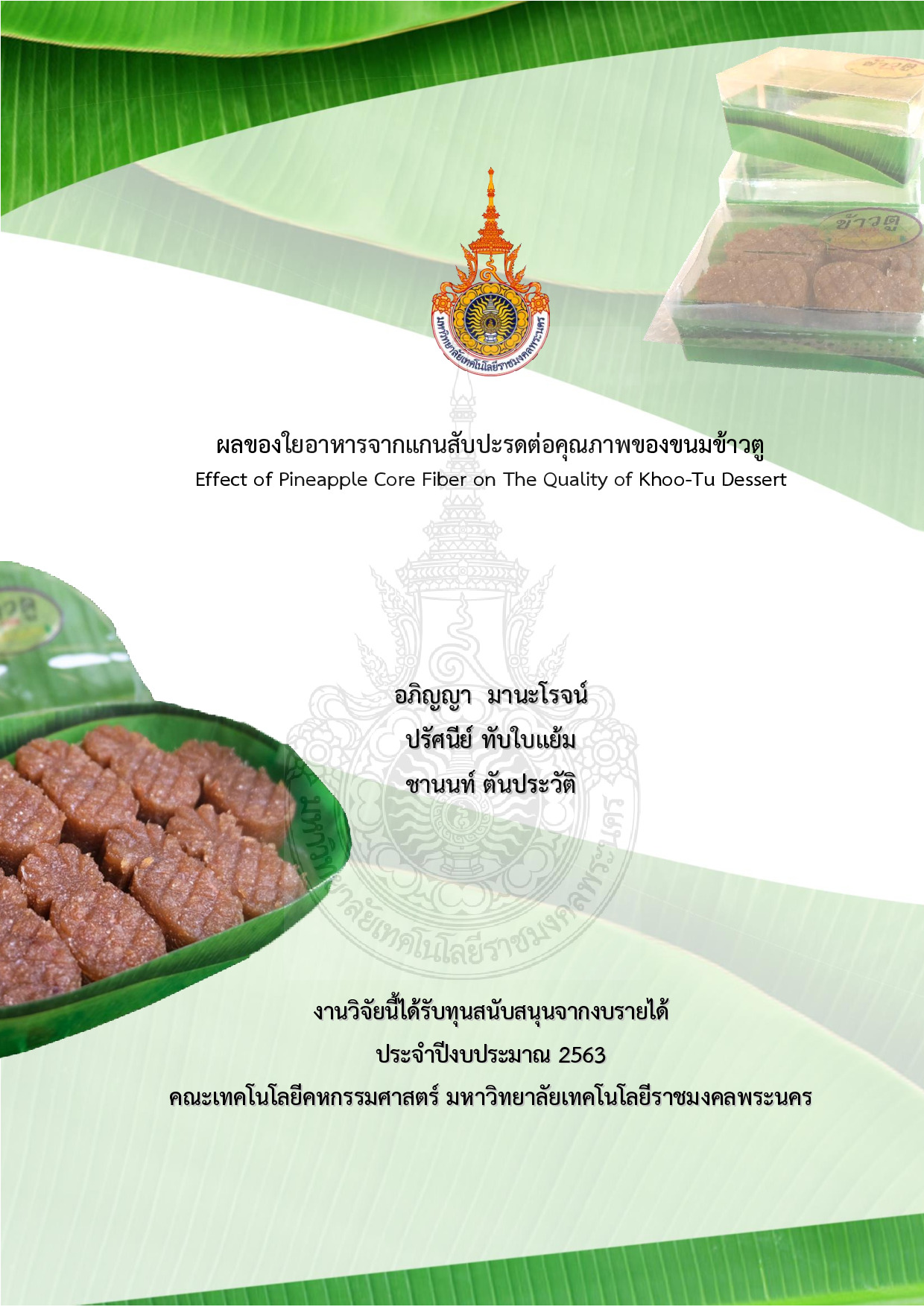
ผลของใยอาหารจากแกนสับปะรดต่อคุณภาพของขนมข้าวตู
These research objectives are to study the basic formulas of Khoo-Tu dessert (dried rice balls made from rice and coconut) and to study the volume of pineapple cores instead of coconut in Khoo-Tu. The test of Khoo-Tu dessert basic formulas by 9 - point hedonic scale method of 50 examiner laboratory the results show acceptance rated on a moderate scale (7). After that substituting coconut with pineapple core the amount of 0 25 50 75 and 100 of the weight coconuts.It was found that at 75% of the substitution level the tasters evaluated the greatest acceptance (p> 0.05). The basic formulas had a pH of 6.24 the Pineapple core formulas 5.94 (p> 0.05). Water Activity (aw)of Khoo-Tu the basic formula was 0.85 and the pineapple core formula was 0.90 (p> 0.05). The color value of the pineapple core Khoo-Tu was L * (brightness value) (37.31) b * (yellowness value) (9.45) rather than the basic formula Khoo-Tu (p> 0.05). The nutritional value of the pineapple core Khoo-Tu was 316 Kcals protein 2.71 % fat 8.86 % ash 0.52 % carbohydrates 56.3 % dietary fiber 3.99 % insoluble fiber 3.60 % and 0.39% of water-soluble dietary fiber that was found in the pineapple core Khoo-Tu to provide lower nutritional value than basic formula Khoo-Tu. The microbiological quality of basic formula and pineapple core formula was found that the total variable count fungi and bacillus serous were less than 10 colonies / 1 g sample and staphylococcus aurias were not found in both samples. The shelf life of rice (Room temperature) found that the basic recipe was 12 days and the pineapple core recipe It has a shelf life of 6 days. At chilled temperature (4 degrees Celsius) it was found that the basic formula and pineapple core formula had a shelf life of 25 days with all microorganisms less than 1 x 10⁴ colonies/sample 1 gram fungus less than 100 colonies /1 gram sample and All microorganisms and fungi exceeded the standard on the 28th day.

ใยอาหารที่มีสารต้านอนุมูลอิสระจากเปลือกถั่วและการประยุกต์ใช้ในผลิตภัณฑ์อาหาร
Foods rich in dietary fiber and antioxidants have attracted great attention to both of consumers and food manufacturers because of their significant health benefits. Increased consumption of dietary fiber improves lowering blood pressure and cholesterol levels. Furthermore it prevent a number of gastrointestinal disorders such as constipation and hemorrhoids. Antioxidants are bioactive compounds that can delay or inhibit the oxidation by inhibiting the initiation or propagation of oxidative chain reactions. These free radical reactions cause human diseases such as cardiovascular disease and cancer. Legumes are an excellent source of compounds having antioxidant. Hence recent research has been focused on the potential utilization of bean coat which was by-products from processing industry to the development of new functional ingredients for food nutrition enrichment. The extraction of bioactive compounds from seed coats are used as a food ingredient for various foods processing such as tofu with soybean hull fiber black bean seed coat in maize flours for the production of cookies and whole wheat bread. Therefore research and development of new functional foods from bean seed coat used as ingredient for the preparation of food products to improve food nutrition will be necessary to provide for Industrial manufacturing according to demand and sufficient for healthy food consumption in the future.
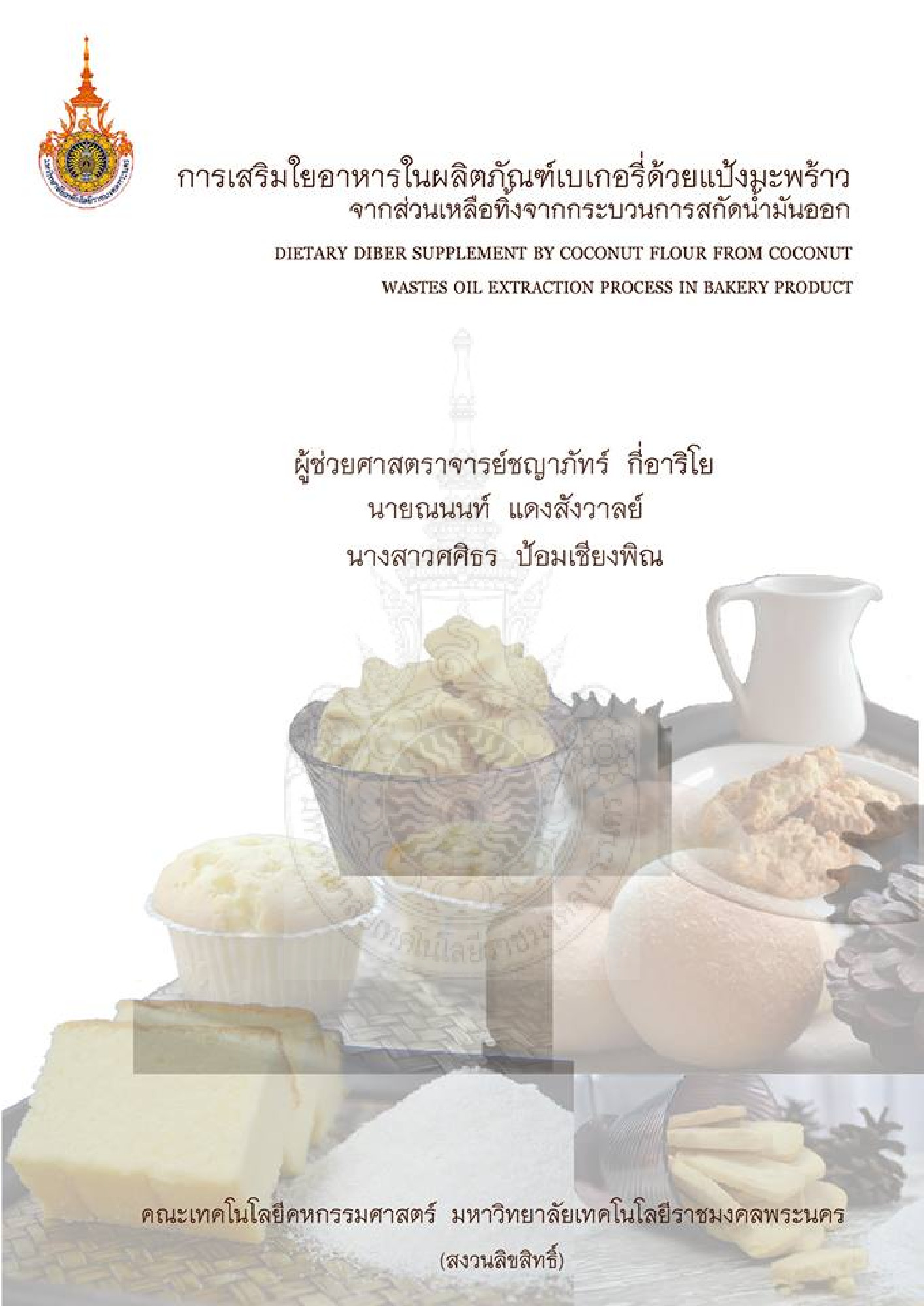
การเสริมใยอาหารในผลิตภัณฑ์เบเกอรี่ด้วยแป้งมะพร้าวจากส่วนเหลือทิ้งจากกระบวนการสกัดน้ำมันออก
The studies of Dietary Fiber Supplement by coconut flour from coconut Wastes Oil Extraction process in Bakery Product was investigated Production of coconut flour from coconut wastes oil extraction drying at 55 ° C for 12 hours and then grinding to powder gave the off-white fine powder. The chemical compositions of coconut flour were 57.70 % carbohydrate 29.4 % fat 6.23 % moisture 5.20 % protein and 1.48 % ash by dye weigh. Butter cake making experiment by substitution of wheat flour with coconut flour at 5 % of wheat flour weigh which has the highest sensory scores comparing butter cake with the control found that increase dietary fiber 1.34 g. /100 g. The majority of the tested consumers (92%) accepted butter cake with 5 % of coconut flour substitution. Muffin making experiment by substitution of wheat flour with coconut flour at 15 % of wheat flour weigh which has the highest sensory scores comparing muffin with the control found that increase dietary fiber 2.34 g /100 g. The majority of the tested consumers (81%) accepted muffin with 15 % of coconut flour substitution. Cornflake cookie making experiment by substitution of wheat flour with coconut flour at 20 % of wheat flour weigh which has the highest sensory scores comparing cornflake cookie with the control found that increase dietary fiber 3.54 g. /100 g. The majority of the tested consumers (94 %) accepted cornflake cookie with 20 % of coconut flour substitution. Butter cookie making experiment by substitution of wheat flour with coconut flour at 10 % of wheat flour weigh which has the highest sensory scorescomparing butter cookie with the control found that increase dietary fiber 3.04 g. /100 g. The majority of the tested consumers (94 %) accepted Butter cookie with 10 % of coconut flour substitution. Frozen cookie making experiment by substitution of wheat flour with coconut flour at 20 % of wheat flour weigh which has the highest sensory scores comparing cookie with the control found that increase dietary fiber 4.02g. /100 g. The majority of the tested consumers (93 %) accepted 20 % of coconut flour substitution. Butter bread making experiment by substitution of wheat flour with coconut flour at 15 % of wheat flour weigh which has the highest sensory scores comparing butter bread with the control found that increase dietary fiber 2.22 g. /100 g. The majority of the tested consumers (75 %) accepted 15% of coconut flour substitution. Whole wheat bread making experiment by substitution of wheat flour with coconut flour at 15 % of wheat flour weigh which has the highest sensory scores comparing whole wheat bread with the control found that increase dietary fiber 2.09 g. /100 g. The majority of the tested consumers (79 %) accepted 15 % of coconut flour substitution. Pie crust making experiment by substitution of wheat flour with coconut flour at 15 % of wheat flour weigh which has the highest sensory scores comparing pie crust with the control found that increase dietary fiber 2.91 g. /100 g. The majority of the tested consumers (82 %) accepted 15 % of coconut flour substitution.
การเสริมใยอาหารในผลิตภัณฑ์มาการองด้วยรำข้าวสังข์หยด
The objective of this research to study the three formula basic of macarons amount of Sangyod Rice Bran usage in macarons product and nutritional composition of macarons product. The sensory evaluate of three formula of macarons the second and the third formula basic macarons non-significant in odor liking ( P< ) . However the three formulas are significant in appearance color liking odor liking taste liking texture liking a nd overall liking ( P> ). When consideration in average score 3rd formula of macarons acceptable that the most one formula. Therefore the third formula used to determine the proper amount of Sangyod Rice Bran to add on macarons in the next step. For the Enhancing of Sangyod Rice Bran in macarons. The three levels as follow; added Sangyod Rice Bran for % % and % of all total weight. The taster remains to accept all sample of Sangyod Rice Bran in macarons. Especially at the % of Sangyod Rice Bran to added in macarons to the highest acceptance . However the resulted of added Sangyod Rice Bran at % to decrease in the appearance and overall liking of macarons .Therefore supplementation of fiber in macarons product with Sangy od Rice Bran is not affectin macarons. Furturemore spicies and amount of other bran for macarons production should be intensive studied.
การเสริมใยอาหารในผลิตภัณฑ์มาการองด้วยรำข้าวสังข์หยด
The objective of this research to study the three formula basic of macarons amount of Sangyod Rice Bran usage in macarons product and nutritional composition of macarons product. The sensory evaluate of three formula of macarons the second and the third formula basic macarons non-significant in odor liking (P<). However the three formulas are significant in appearance color liking odor liking taste liking texture liking and overall liking (P>). When consideration in average score 3rd formula of macarons acceptable that the most one formula. Therefore the third formula used to determine the proper amount of Sangyod Rice Bran to add on macarons in the next step. For the Enhancing of Sangyod Rice Bran in macarons. The three levels as follow; added Sangyod Rice Bran for % % and % of all total weight. The taster remains to accept all sample of Sangyod Rice Bran in macarons. Especially at the % of Sangyod Rice Bran to added in macarons to the highest acceptance. However the resulted of added Sangyod Rice Bran at % to decrease in the appearance and overall liking of macarons. Therefore supplementation of fiber in macarons product with Sangyod Rice Bran is not affect in macarons. Furturemore spicies and amount of other bran for macarons production should be intensive studied.