จำนวน Repository ( 3 )
Nutritional Quality of Fish Mixed with Algae Tofu
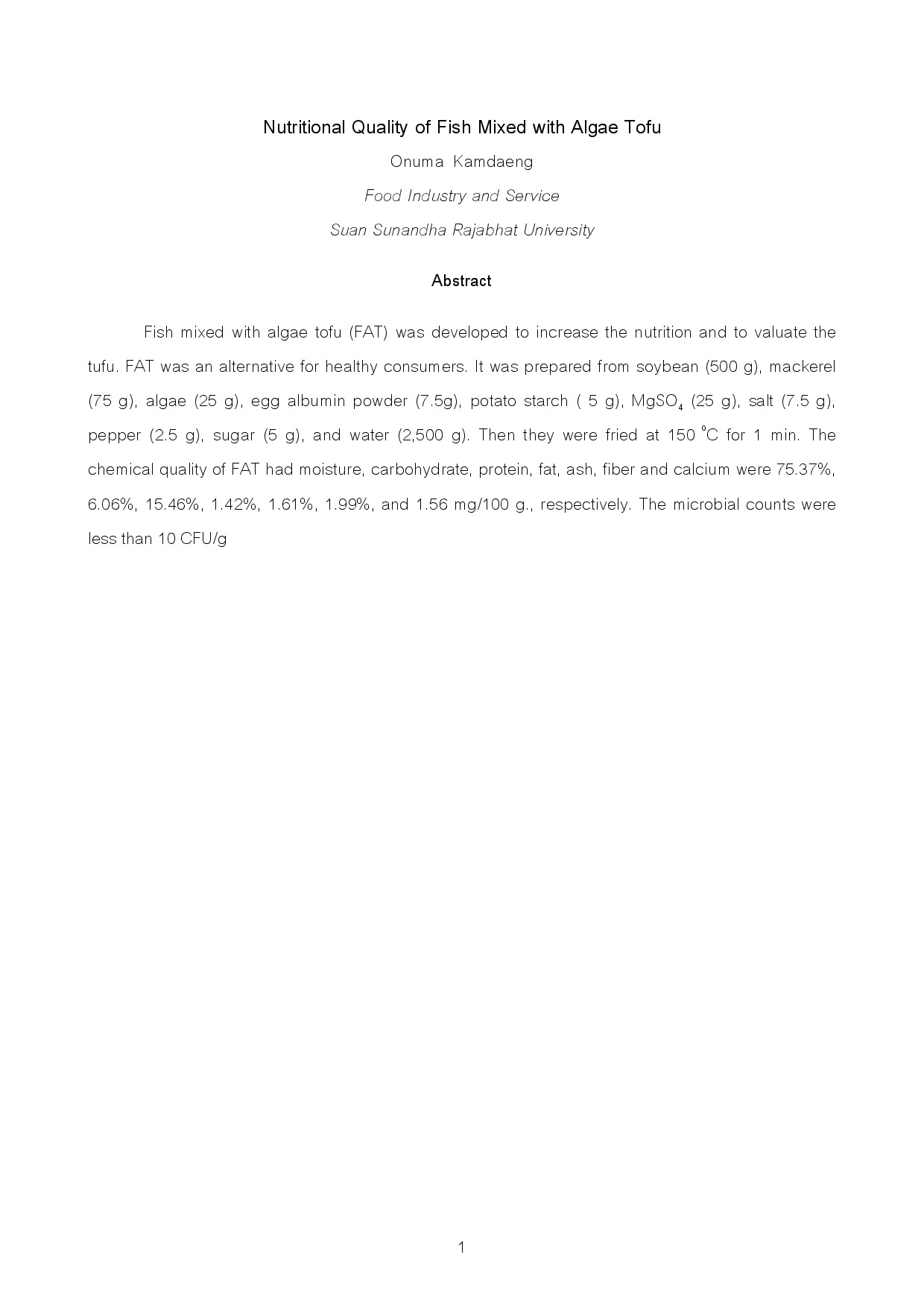
Fish mixed with algae tofu (FAT) was developed to increase the nutrition and to valuate the tufu. FAT was an alternative for healthy consumers. It was prepared from soybean (500 g) mackerel (75 g) algae (25 g) egg albumin powder (7.5g) potato starch ( 5 g) MgSO4 (25 g) salt (7.5 g) pepper (2.5 g) sugar (5 g) and water (2500 g). Then they were fried at 150 oC for 1 min. The chemical quality of FAT had moisture carbohydrate protein fat ash fiber and calcium were 75.37% 6.06% 15.46% 1.42% 1.61% 1.99% and 1.56 mg/100 g. respectively. The microbial counts were less than 10 CFU/g.
ประสิทธิภาพการกักเก็บคาร์บอนไดออกไซด์ด้วยสาหร่าย Spirulina sp.RMUTL
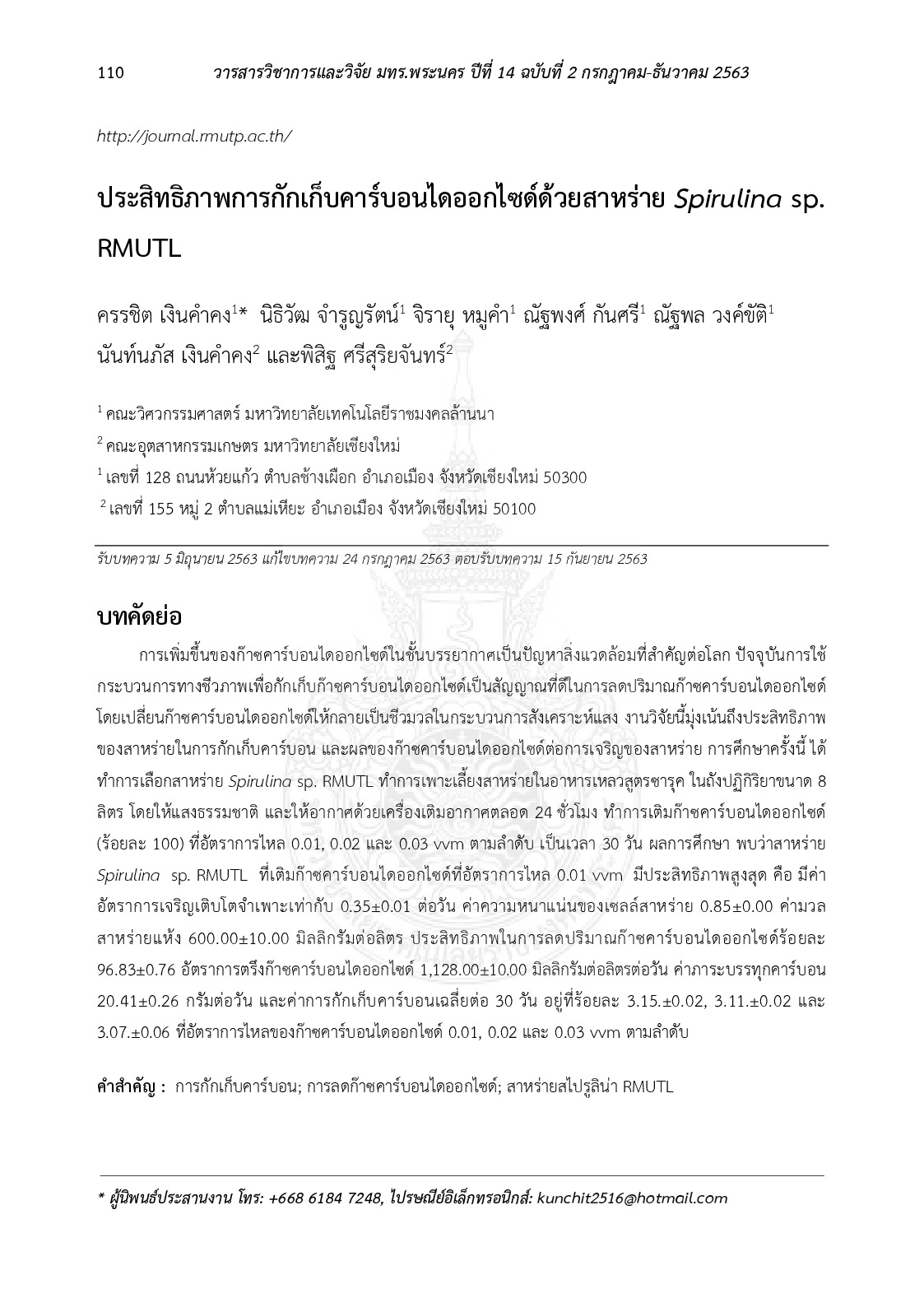
Increasing concentrations of CO2 in the atmosphere is causing severe environmental destruction to the earth. Bio-sequestration of CO2 is a promising way to completely sequester CO2 by converting it into biomass by way of photosynthesis. The current research focused on biomass productivity and CO2 sequestration efficiency using microalgae. The experiment choose Spirulina sp. RMUTL by cultivating in working volume 8 liters bioreactor with zarrouks medium for 24-hrs with light nature and aeration air. The CO2 (100%) was flushed into the medium with a flow rate were 0.01 0.02 and 0.03 vvm respectively. The period of all experiments were 30 days. The results showed that the maximum specific growth rate OD560 algae biomass productivity efficiency of CO2 reduction CO2 fixation rate and carbon loading rate were 0.35±0.01 d-1 0.85±0.00 600.00±10.00 mg.L-1 96.83±0.76% 1 128.00±18.80 mg.L-1.d-1 and 2 0 . 4 1 ±0 . 2 6 g. d-1 with 0.01 vvm CO2 flow rate. The average CO2 sequestration over 30 days were 3.15.±0.03 3.11.±0.02 and 3.07.±0.07% in 0.01 0.02 and 0.03 vvm CO2 flow rate respectively.
การศึกษาการผลิตก๊าซชีวภาพโดยการหมักร่วมระหว่างมูลไก่กับสาหร่ายหางกระรอก
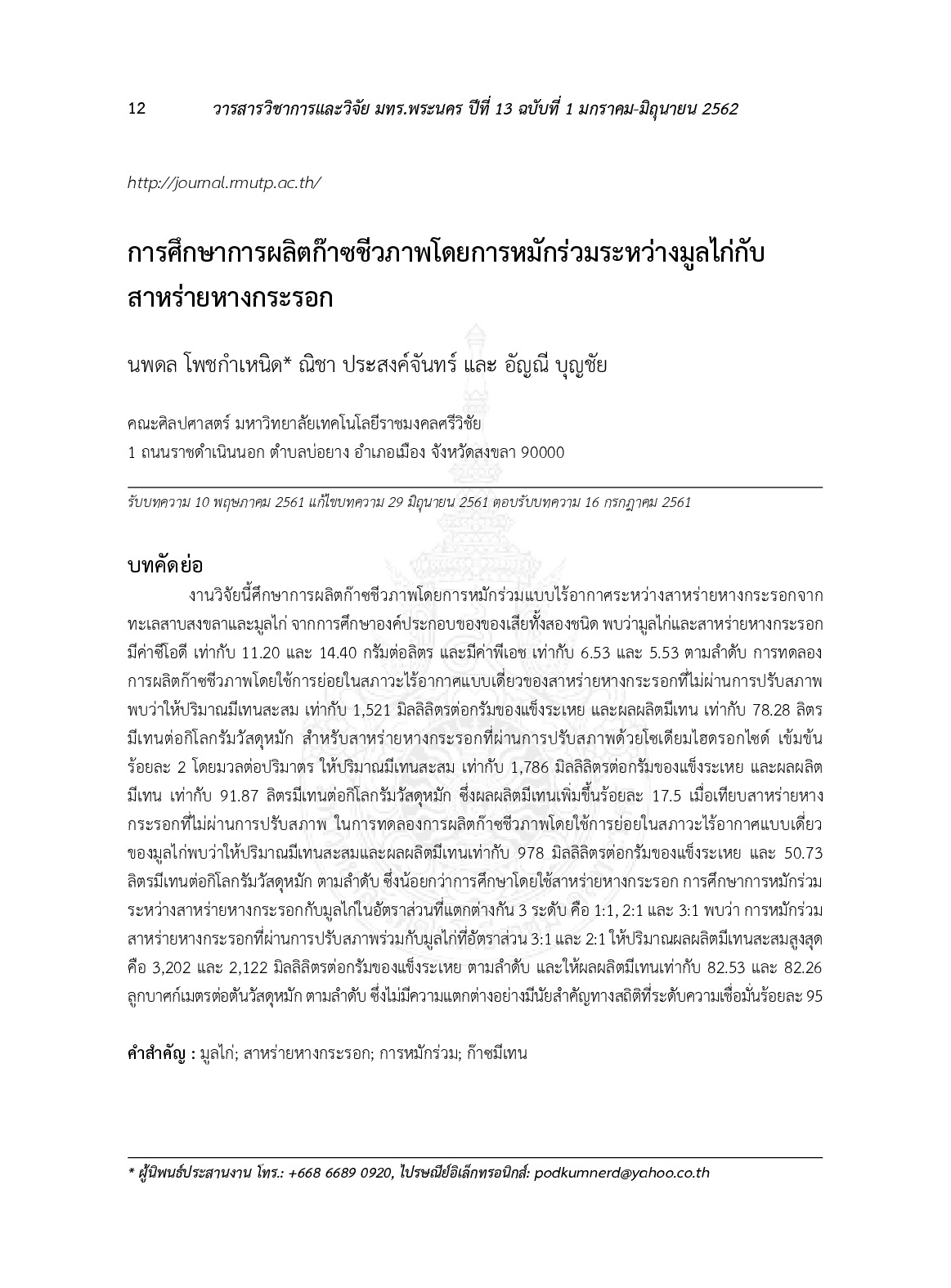
This work presented the production of biogas using anaerobic co-digestion between hydrilla verticillata (HV) from Songkhla Lake Basin and chicken manure (CM). From the study of compositions of both wastes it was found that the COD of CM and HV were 11200 and 14400 mg/l and pH were 6.5 and 5.5 respectively. The biogas production using anaerobic single-digestion of untreated hydrilla verticillata (UHV) gave accumulative methane of 1251 ml-CH4/g-VS and methane production of 78.28 L-CH4/kg-substrate was obtained. For hydrilla treated with 2% w/v NaOH (THV) the accumulative methane was 1786 ml-CH4/g-VS and the obtained methane production was 91.87 L- CH4/kg-substrate which was 17.5 % increase when compared to the UHV. For the biogas production using anaerobic single-digestion of CM it was found that the accumulative methane and methane production were 978 ml-CH4/g-VS and 78.28 L- CH4/kgsubstrate respectively. These were lower than the studies using HV. The study of anaerobic co-digestion of HV and CM at three different ratios; 1:1 2:1 and 3:1 was studied. It was found that the anaerobic co-digestion using THV and CM at ratio 3:1 and 2:1 gave the highest potential for biogas production. The accumulate methane of 3202.20 and 2079.19 ml- CH4/g-VS were obtained respectively. The methane productions were 2.53 and 82.26 L-CH4/ton-substrate for ratio 3:1 and 2:1 respectively which is no significant different at 95 % confidence interval.