จำนวน Repository ( 6 )
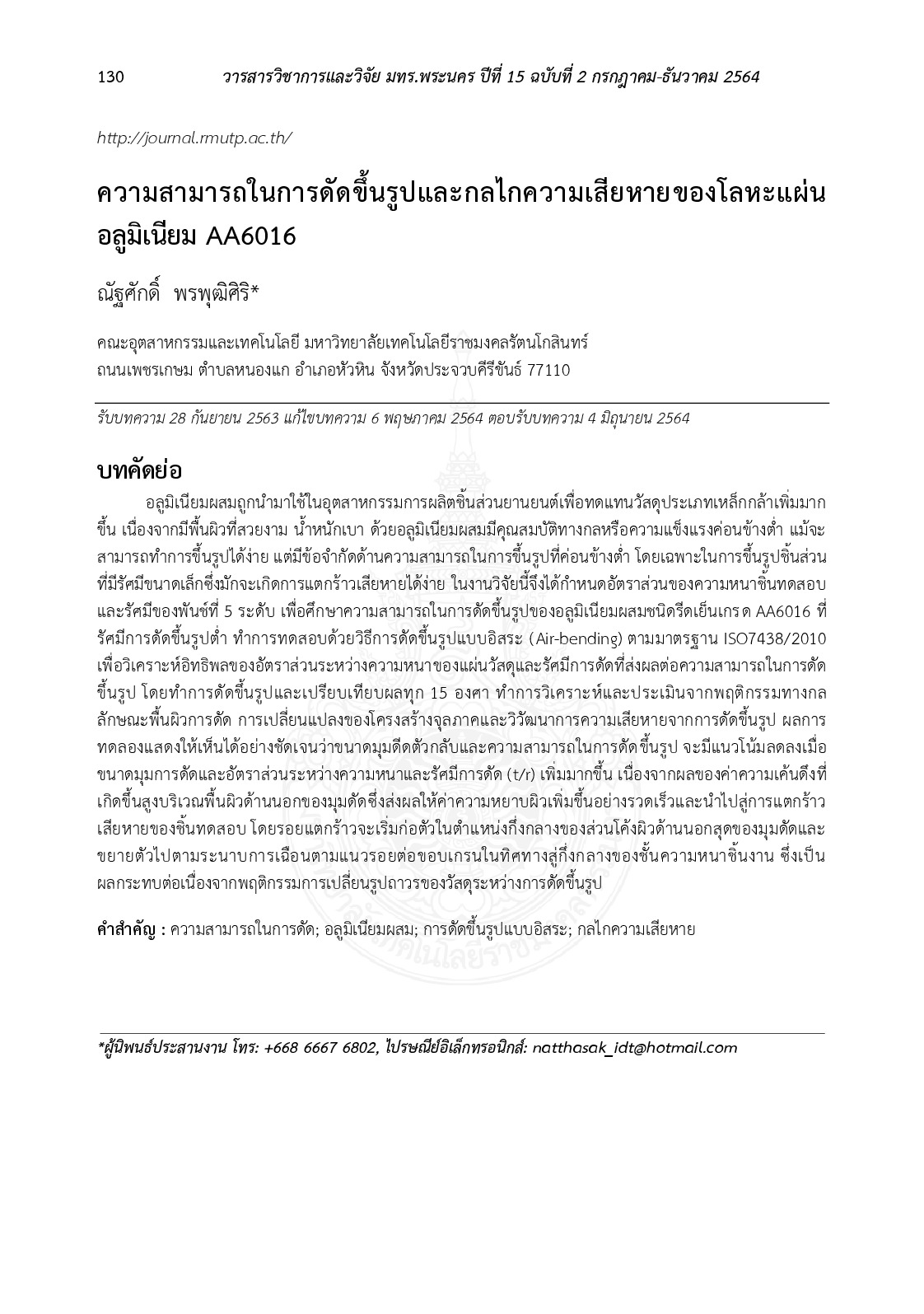
ความสามารถในการดัดขึ้นรูปและกลไกความเสียหายของโลหะแผ่นอลูมิเนียม AA6016
Aluminium alloys was used in the automotive parts industry increased for compensate steel parts material due to its lightweight and good surface. Since aluminium alloys are there relatively low mechanical properties although they can be deformed easily but the major limitation is their low formability. Especially the less bending radius which is often bending surface damaged easily. In the present work five-difference ratio of sheet thickness and bending radius for study to the bendability of cold rolled aluminum alloys AA6016 at low bending radius. The bending test by Air-bending method according to ISO 7438: 2010. To compare the results every 15 degrees. The mechanical behaviour surface roughness microstructure and damage evolution in the fillet region were analysed by experimental research. The experiment clearly showed that the Spring-back angle and bendability tend to decrease as the bending angle and material thickness increase. Due to the high tensile stress on the bending surface it effected to the surface roughness increases rapidly and led to the damage on the specimen bending surface. The initial cracks occur on the middle of the outer surface curvature and propagation in the shear plane pattern to the middle of the sheet thickness along the grain boundary. This is the consequence of plastic deformation by bending test.
การปรับปรุงสมบัติทางไทรโบโลยีของผิวอะลูมิเนียมด้วยกระบวนการอโนไดซ์เสริมนาโนไททาเนียมไดออกไซด์
Aluminium was used in many industrial applications due to good properties such as ductile high corrosion resistant and high electrical conductivity. Since wear resistance of aluminium was very poor so that it was a limitation of using this material in several conditions. In this research aluminium was improved the wear resistance properties by using anodizing process and adding some titanium dioxide particles on the surface. The effect of anodizing process duration on the wear resistence property was studied. It was found that the process duration and amount of titanium dioxide play the important role on improvement of tribological properties of aluminium.
การเพิ่มสมบัติทางไทรโบโลยีของผิวอลูมิเนียมด้วยกระบวนการทางเคมีไฟฟ้ากับนาโนซิลิกอกนไดออกไซด์
Aluminum is a lightweight material which are popularly used in various parts of the industry. However there are some limitations on the tribological properties such as abrasive wear and friction when it was compared to other metals. Tribological properties of aluminium was improved with anodizing process and silicon dioxide supplement. the effect of time on surface structure and friction coefficient were studied with with scanning electron microscope and sliding wear tester. It was found that friction coefficient of aluminium was decreased after improvement process was applied.
การปรับปรุงการติดตั้งงานประตูบานเลื่อนอลูมิเนียมและกระจก ด้วยเทคนิคการศึกษาการเคลื่อนไหวและเวลา กรณีศึกษา บริษัท กลาสไลน์ จำกัด
This paper aim to be improvement the installation methods for Sliding Aluminium Door and Glass in order to be the good quality product by applying the motion and time study design the new model of the receiver lock set for the sliding door. The step of study process started from studied the sliding door installation processes gathering the works process and reducing unnecessary and duplicate of work process on site elimination establishing standardized time for modifying the installation process. From the result before applied new method we founded that the installation process before installation process improvement we were spent the time of installation process at 45.38 minute per set and after we used the new method we founded that the installation process time was 35.36 minute per set it can be decreased the installation time was 10.02 minute and the efficiency of work process operation was increased 22.08 percent and the line balancing performance before improvement was 56.73 percent and after improvement was 88.40 percent and the line balancing performance was increased 31.67 percent. Unless there are the improvement installation methods it makes the company in case study will be do the work to be delay and cannot be hand over the works just in time by the schedule planning.
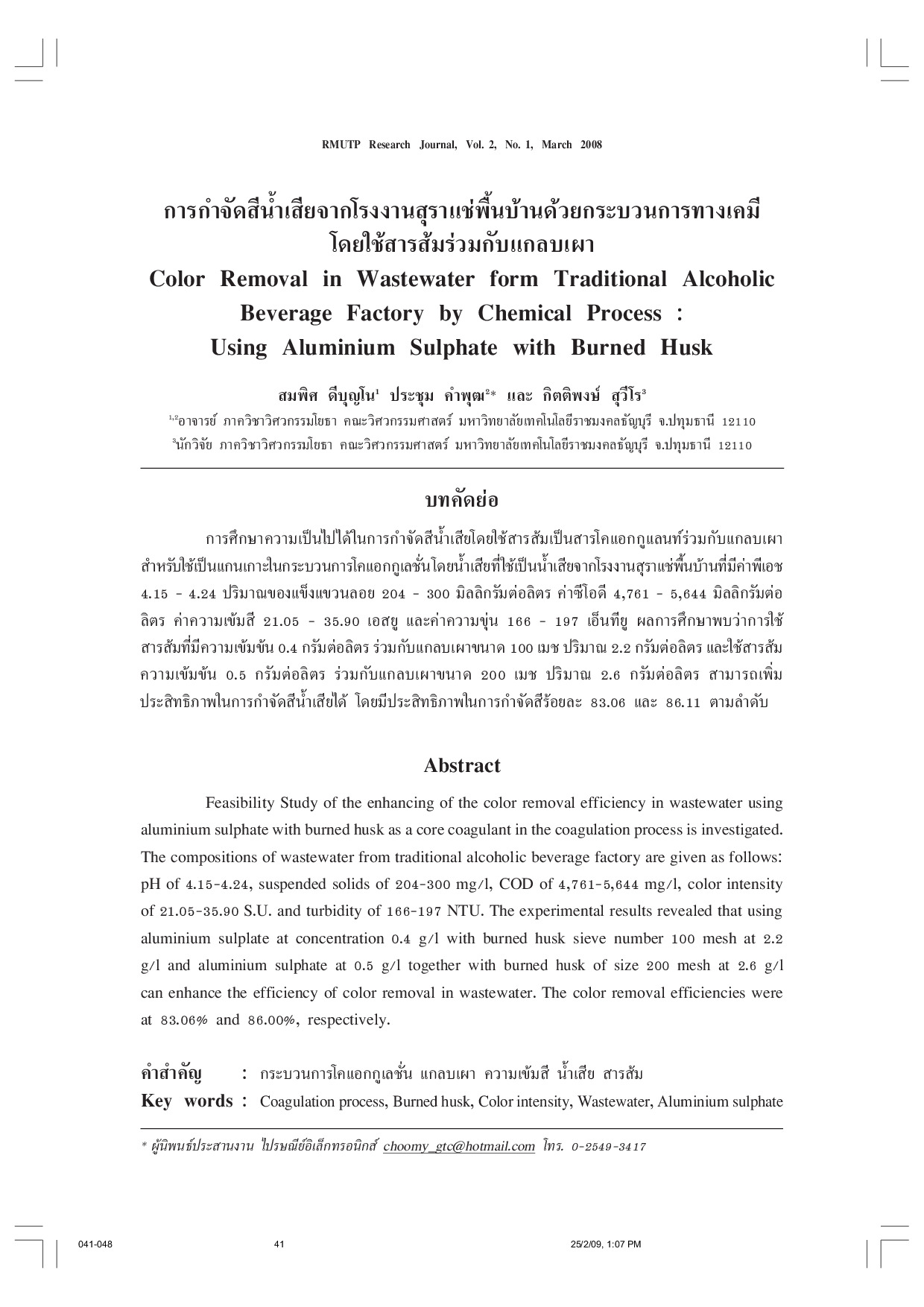
Color Removal in Wastewater form Traditional Alcoholic Beverage Factory by Chemical Process : Using Aluminium Sulphate with Burned Husk
Feasibility Study of the enhancing of the color removal efficiency in wastewater using aluminium sulphate with burned husk as a core coagulant in the coagulation process is investigated. The compositions of wastewater from traditional alcoholic beverage factory are given as follows: pH of 4.15-4.24 suspended solids of 204-300 mg/l COD of 4761-5644 mg/l color intensity of 21.05-35.90 S.U. and turbidity of 166-197 NTU. The experimental results revealed that using aluminium sulplate at concentration 0.4 g/l with burned husk sieve number 100 mesh at 2.2 g/l and aluminium sulphate at 0.5 g/l together with burned husk of size 200 mesh at 2.6 g/l can enhance the efficiency of color removal in wastewater. The color removal efficiencies were at 83.06% and 86.00% respectively.