จำนวน Repository ( 3 )
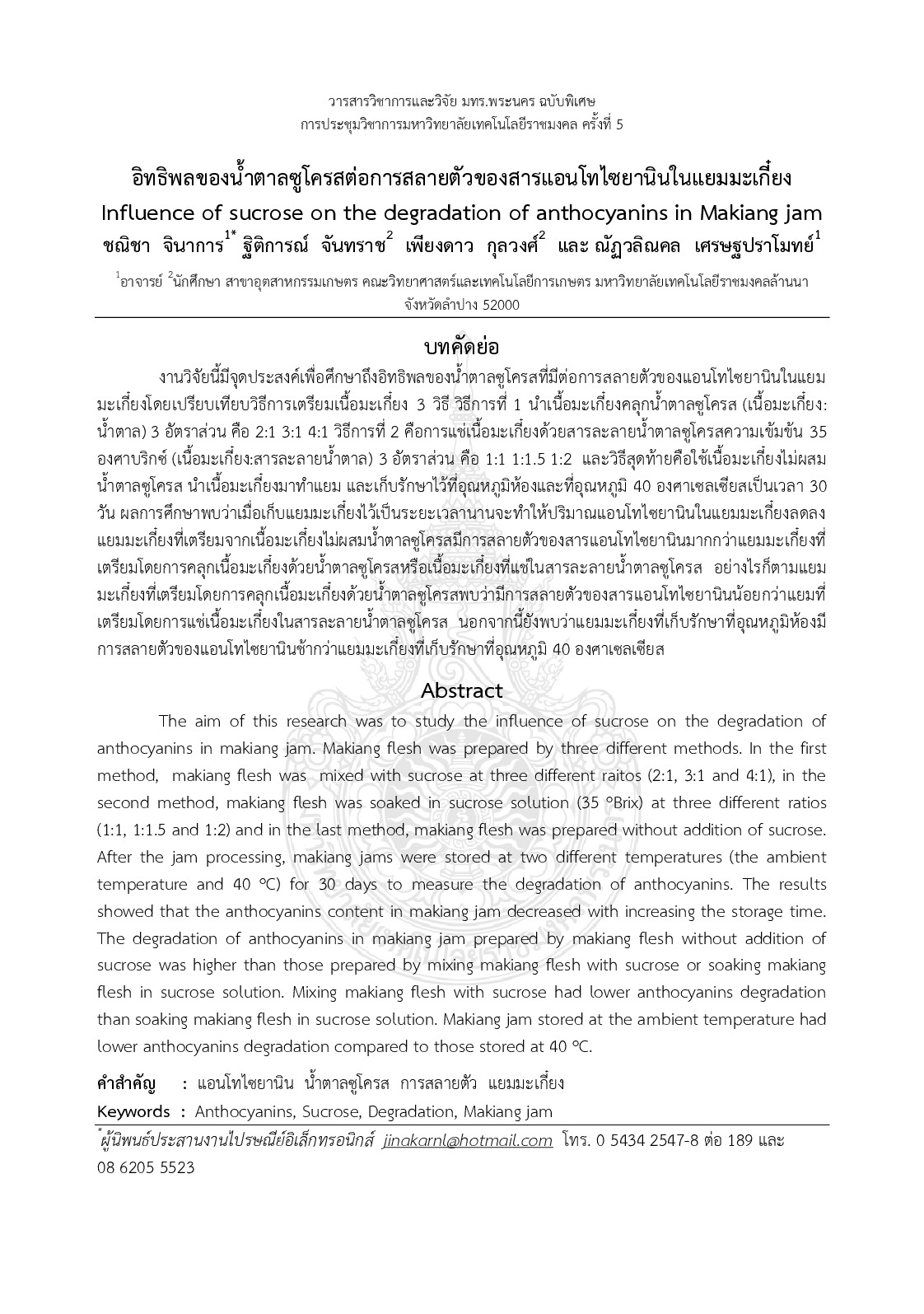
Influence of sucrose on the degradation of anthocyanins in makiang jam
The aim of this research was to study the influence of sucrose on the degradation of anthocyanins in makiang jam. Makiang flesh was prepared by three different methods. In the first method makiang flesh was mixed with sucrose at three different raitos (2:1 3:1 and 4:1) in the second method makiang flesh was soaked in sucrose solution (35 Brix) at three different ratios (1:1 1:1.5 and 1:2) and in the last method makiang flesh was prepared without addition of sucrose. After the jam processing makiang jams were stored at two different temperatures (the ambient temperature and 40 C) for 30 days to measure the degradation of anthocyanins. The results showed that the anthocyanins content in makiang jam decreased with increasing the storage time. The degradation of anthocyanins in makiang jam prepared by makiang flesh without addition of sucrose was higher than those prepared by mixing makiang flesh with sucrose or soaking makiang flesh in sucrose solution. Mixing makiang flesh with sucrose had lower anthocyanins degradation than soaking makiang flesh in sucrose solution. Makiang jam stored at the ambient temperature had lower anthocyanins degradation compared to those stored at 40 C.
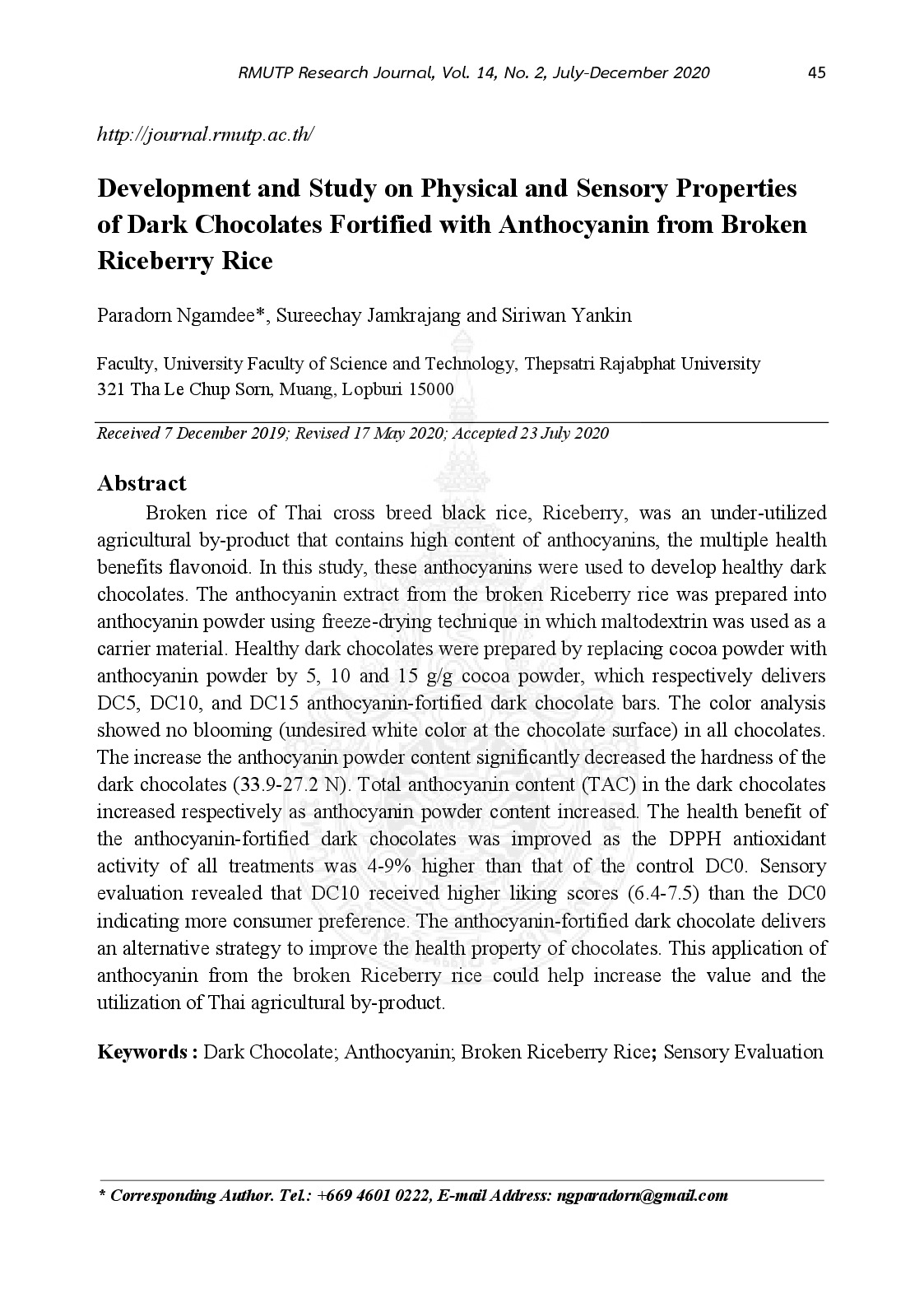
Development and study on physical and sensory properties of dark chocolates fortified with anthocyanin from broken riceberry rice
Broken rice of Thai cross breed black rice Riceberry was an under-utilized agricultural by-product that contains high content of anthocyanins the multiple health benefits flavonoid. In this study these anthocyanins were used to develop healthy dark hocolates. The anthocyanin extract from the broken Riceberry rice was prepared into anthocyanin powder using freeze-drying technique in which maltodextrin was used as a carrier material. Healthy dark chocolates were prepared by replacing cocoa powder with anthocyanin powder by 5 10 and 15 g/g cocoa powder which respectively delivers DC5 DC10 and DC15 anthocyanin-fortified dark chocolate bars. The color analysis showed no blooming (undesired white color at the chocolate surface) in all chocolates. The increase the anthocyanin powder content significantly decreased the hardness of the dark chocolates (33.9-27.2 N). Total anthocyanin content (TAC) in the dark chocolates increased respectively as anthocyanin powder content increased. The health benefit of the anthocyanin-fortified dark chocolates was improved as the DPPH antioxidant activity of all treatments was 4-9% higher than that of the control DC0. Sensory evaluation revealed that DC10 received higher liking scores (6.4-7.5) than the DC0 indicating more consumer preference. The anthocyanin-fortified dark chocolate delivers an alternative strategy to improve the health property of chocolates. This application of anthocyanin from the broken Riceberry rice could help increase the value and the utilization of Thai agricultural by-product.

การพัฒนาเครื่องดื่มสารสกัดจากอัญชันและกระเจี๊ยบแดง
The objectives of this study were to (1) evaluate physical and chemical properties of the commercial beverages from fruit and vegetable extracts (2) develop a beverage from butterfly pea and roselle extracts (3) analyze the shelf-life of this product and (4) determinate the consumer acceptance of the beverage from extracts of butterfly pea and roselle. The findings showed that the commercial beverages from fruit and vegetable extracts were clear and dark brown color 3.43-3.67 (pH) 16.50-35.00°Brix (total soluble solids) and low anthocyanin content. The optimum extraction of butterfly pea and roselle was boiling at 70+2°C and evaporation at vacuum pressure (72 millibar). This process resulted in the final anthocyanin content approximately 1366.98 and 4090.19 mg/l for butterfly pea and roselle extracts respectively. Then the butterfly pea and the roselle extracts were blended at various ratios. Based on sensory evaluators (n=50) the 50:50 blend was the most preferential with respect to overall acceptability (p≤0.05). The decrease in the anthocyanin content was observed during storage for 5 weeks. No Coliform bacteria E. coli Salmonella spp. and yeast and mould were found in all samples while the total plate counts were still accepted asconsidered for the standard set by the Ministry of Public Health. An acceptance test showed that consumers (n=100) absolutely accepted this product.