จำนวน Repository ( 4 )
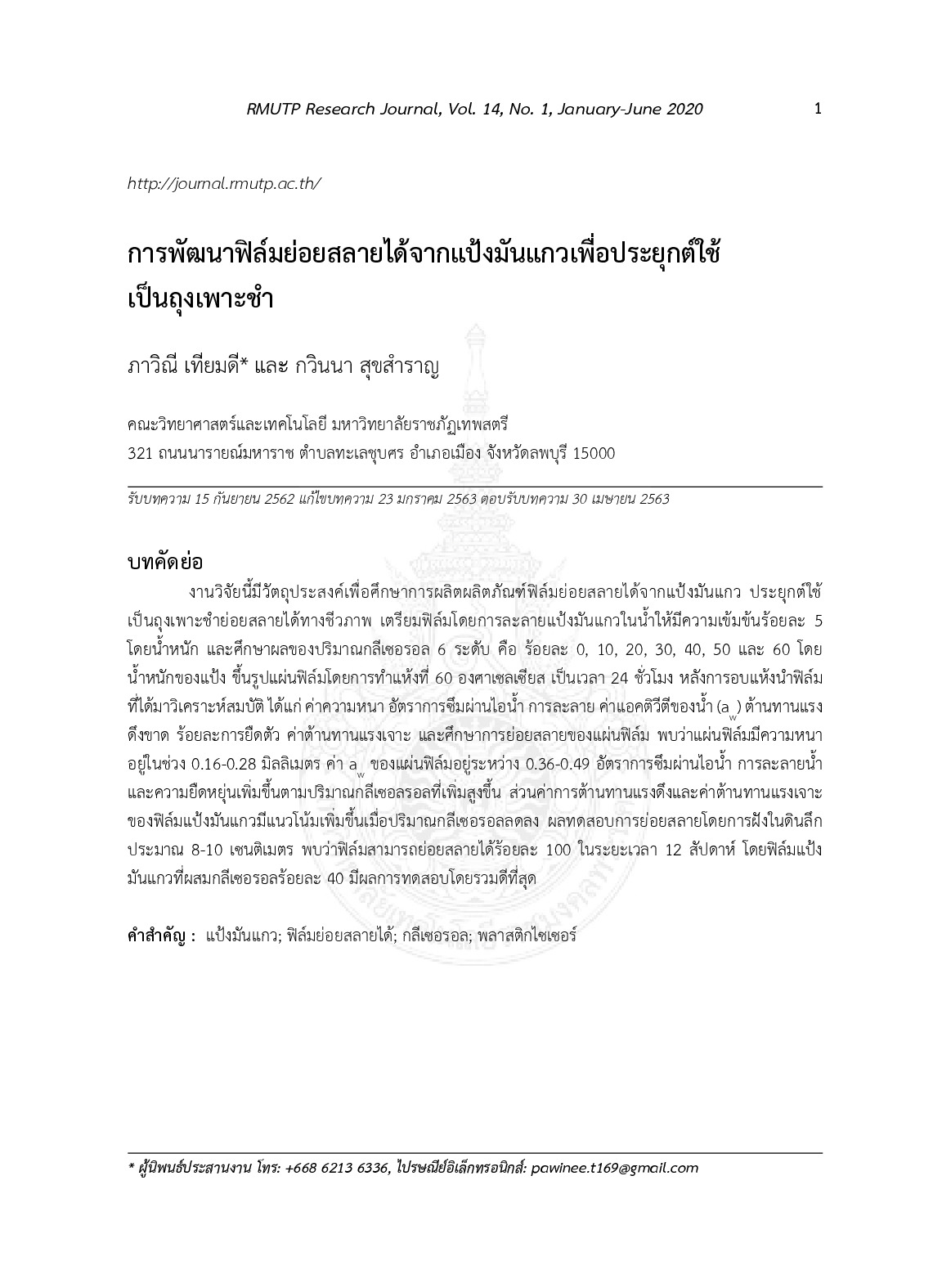
การพัฒนาฟิล์มย่อยสลายได้จากแป้งมันแกวเพื่อประยุกต์ใช้เป็นถุงเพาะชำ
This research aimed to study the production of a biodegradable film from Jicama starch (Pachyrhizus erosus (L.) Urbar) for plant bag application. The film was prepared by dissolving Jicama starch in water to the concentration of 5 wt%. To study the effect of the glycerol content the glycerol was added at 6 levels; 0 10 20 30 40 50 and 60 wt%. The film was casted in a molded and dried at 60 oC for 24 h. After drying properties of films; thickness water activity (aw) solubility tensile strength (TS) elongation (%E) puncture strength and the degradation of the films were evaluated. The thickness of the films was in the range of 0.16-0.28 mm. The aw of films ranged from 0.36-0.49. The water vapor permeability water solubility and flexibility of the film increased with the increasing of glycerol content. Tensile and puncture strength of the starch films tended to increased when the glycerol content decrease. After the films were buried under the ground (8-10 cm depth) for 12 weeks they were degraded by 100%. The Jicama starch film with 40 wt% glycerol showed the best overall properties.
การผลิตและพัฒนาบรรจุภัณฑ์ที่ย่อยสลายได้จากวัสดุเชิงประกอบพลาสติก ชีวภาพและเส้นใยธรรมชาติที่ผ่านการปรับปรุงด้วยสารไซเลน
This work aimed to study the improvement of mechanical properties and cost reduction of biodegradable packaging made from polylactic acid (PLA) by using sisal fiber. Because sisal fiber as natural fiber is good mechanical properties biodegradable material and low cost. The variables studied were the addition of sisal fiber surface treatment with epoxy silane and fiber direction. Their effects were investigated by tensile flexural and impact testings and morphology analysis. The results suggested that the addition of sisal fiber increased Young’s modulus Flexural modulus and ultimate tensile stress whereas elongation at break and impact strength tended to decrease. For the effect of surface treatment it was found that tensile and flexural moduli increased with epoxy silane treatment but tensile flexural and impact strengths slightly changed. Surface treatment by epoxy silane led to good interfacial bonding by hydrogen bonding between oxirane ring of epoxy silane and hydroxyl group of PLA. The effect of fiber direction revealed that tensile properties of composite in fiber direction of 0o were higher than those of composite in fiber direction of 45o. Fiber direction did not affect flexural and impact properties.
การผลิตภาชนะใส่แอลกอฮอล์เจลอุ่นอาหารที่สามารถย่อยสลายได้เองตามธรรมชาติ
Nowadays container of alcohol for warm food is produced from raw material of alloy mixture of tin chromium and manganese. When the container is heated with the flame temperature at 300 c which it is burned about 10 minutes. The container is transformed into trash that it’s difficult to disintegrate for destroying the environment. This reason is that the sawdust is taken for useful and alloy substitute. Manufacturing container from the sawdust on alloy with alcohol gel substitute for warm food the process of forming is essential that mold extrusion and compression mold are designed appropriate to size shape of workpiecesafedurablesuitable work including preparing forming sawdusttest for burningpreparing synchronizationdesign work and selecting material for mold. The result of project revealed that the burning was taken about 26 minutes per piece while metal container had 15 minutes. Furthermore sawdust container was about 73.33 percent and the temperature of combustion higher than metal container about 51.88 percent. Sawdust container costs 2.45 baht per cup and lower than 51.00 percent whereas metal container costs 5 baht per cup. The rate of precipitation into process of biodegradation container from sawdust and water showed that the rate of good biodegradation was depended on precipitation into process of biodegradation.
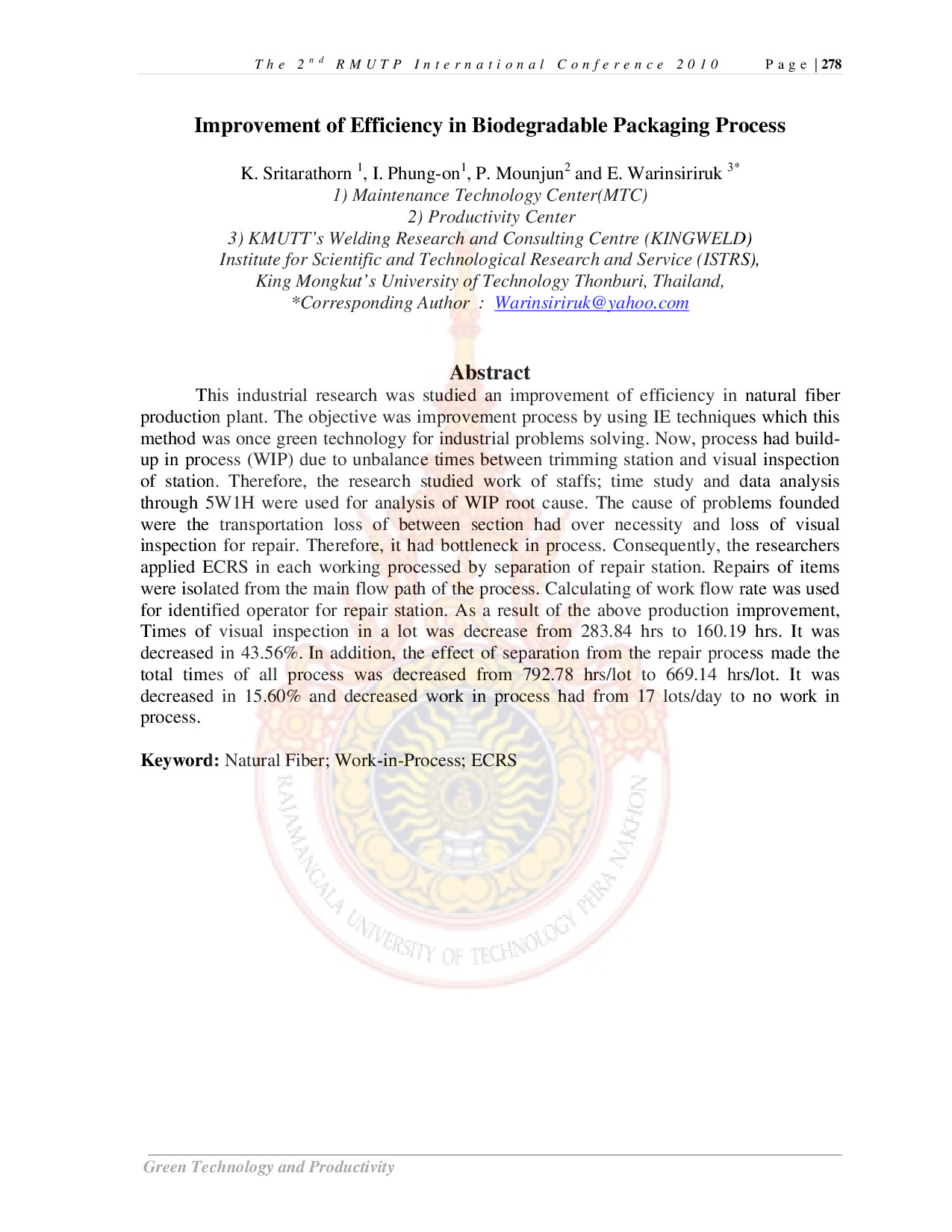
Improvement of Efficiency in Biodegradable Packaging Process
This industrial research was studied an improvement of efficiency in natural fiber production plant. The objective was improvement process by using IE techniques which this method was once green technology for industrial problems solving. Now process had build-up in process (WIP) due to unbalance times between trimming station and visual inspection of station. Therefore the research studied work of staffs; time study and data analysis through 5W1H were used for analysis of WIP root cause. The cause of problems founded were the transportation loss of between section had over necessity and loss of visual inspection for repair. Therefore it had bottleneck in process. Consequently the researchers applied ECRS in each working processed by separation of repair station. Repairs of items were isolated from the main flow path of the process. Calculating of work flow rate was used for identified operator for repair station. As a result of the above production improvement Times of visual inspection in a lot was decrease from 283.84 hrs to 160.19 hrs. It was decreased in 43.56%. In addition the effect of separation from the repair process made the total times of all process was decreased from 792.78 hrs/lot to 669.14 hrs/lot. It was decreased in 15.60% and decreased work in process had from 17 lots/day to no work in process.