จำนวน Repository ( 6 )

การศึกษาตัวแปรที่มีผลต่อสมรรถนะการฉีดเชื้อเพลิงของหัวฉีดรถยนต์ที่ใช้น้ำมัน ไบโอดีเซล และ น้ำมันไพโรไลซิส
The purpose of this research is to study on variables affecting fuel injection performance of biodiesel fuel injection and pyrolysis fuel. To test for variables affecting the fuel injection performance of biodiesel fuel injectors and pyrolysis fuel. By experimenting and modeling using computer programs to compare results. Finally for to use the information in the design of the car nozzle to work well with Biodiesel and pyrolysis fuel. The tested fuels which are pyrolysis fuel Bio-diesel fuel and diesel fuel are tested by tester Anton Paar@ Stabinger Viscosmeter (model SVM 3000/G2) ASTM D341 standard. The result shown that the density of the fuel is increasing normally. However the viscosity of the diesel and biodiesel are strong increased whereas the reducing of temperature is unaffected to the pyrolysis fuel. The fuel injection performance test showed that the density and viscosity of fuel were the major variables that affected the injection performance of the fuel. In case of using pyrolysis oil Injection performance is trend to higher other fuels and cold conditions.
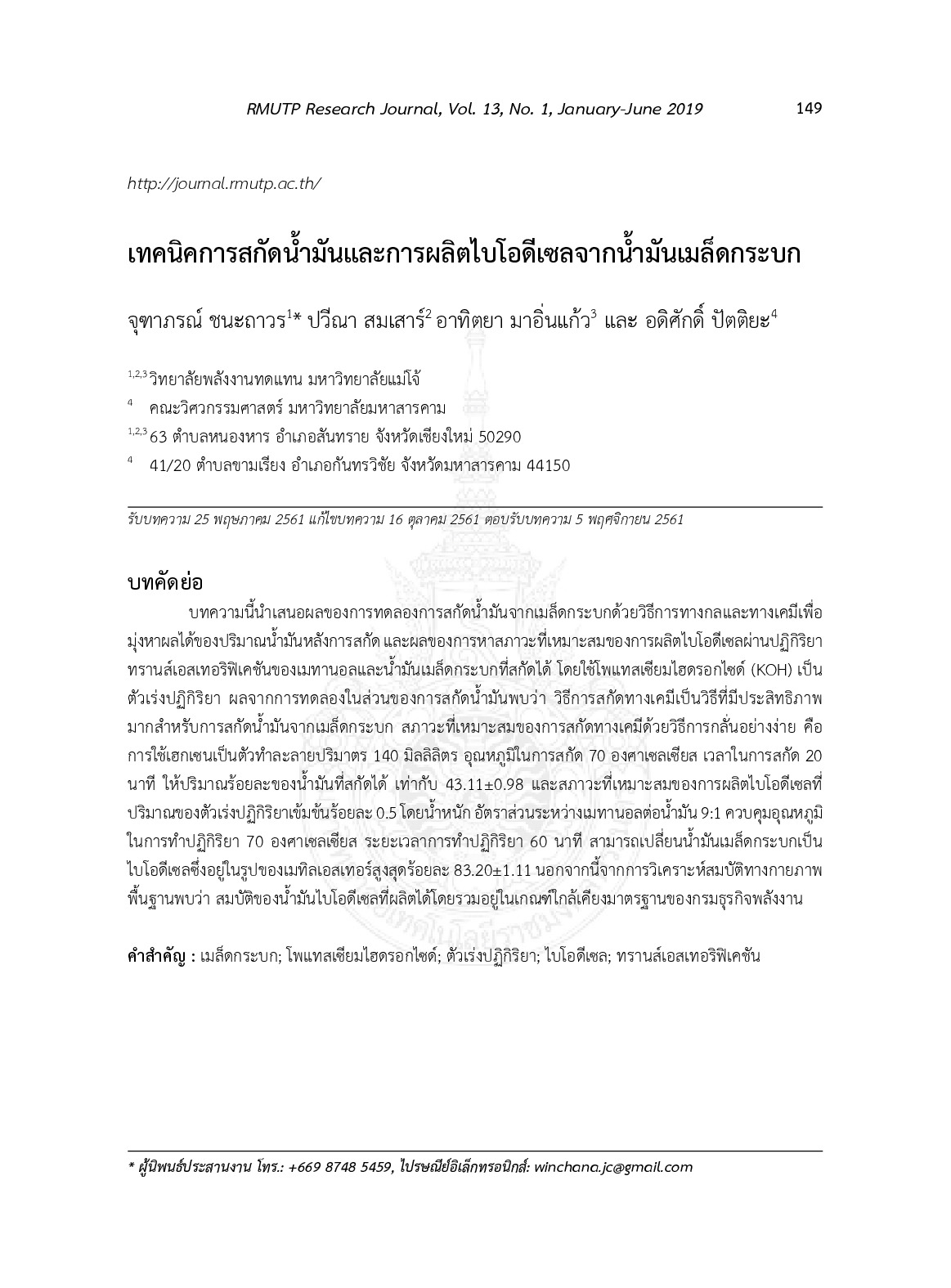
เทคนิคการสกัดน้ำมันและการผลิตไบโอดีเซลจากน้ำมันเมล็ดกระบก
This paper presents the experimental results of the oil extraction process from wild almond seeds by mechanical and chemical methods. The optimum conditions for the biodiesel production from the extracted oil via transesterification reaction using methanol and potassium hydroxide (KOH) are reported. Chemical extraction was found to be an effective technique for wild almond oil extraction. Simple distillation was used as oil extraction unit applying 140 ml of n-hexane as solvent at 70ºC for 20 min. The oil yield was 43.11±0.98%. This extracted oil was used as raw material for biodiesel production with the maximum yield of 83.20±1.11%. The optimum conditions for biodiesel production were the catalyst loading of 0.5 wt% and 9:1 molar ratio of methanol to oil in a controlled reaction temperature of 70ºC for 60 min. Finally the properties of biodiesel were analyzed and most properties met the requirements of the department of energy business standard.
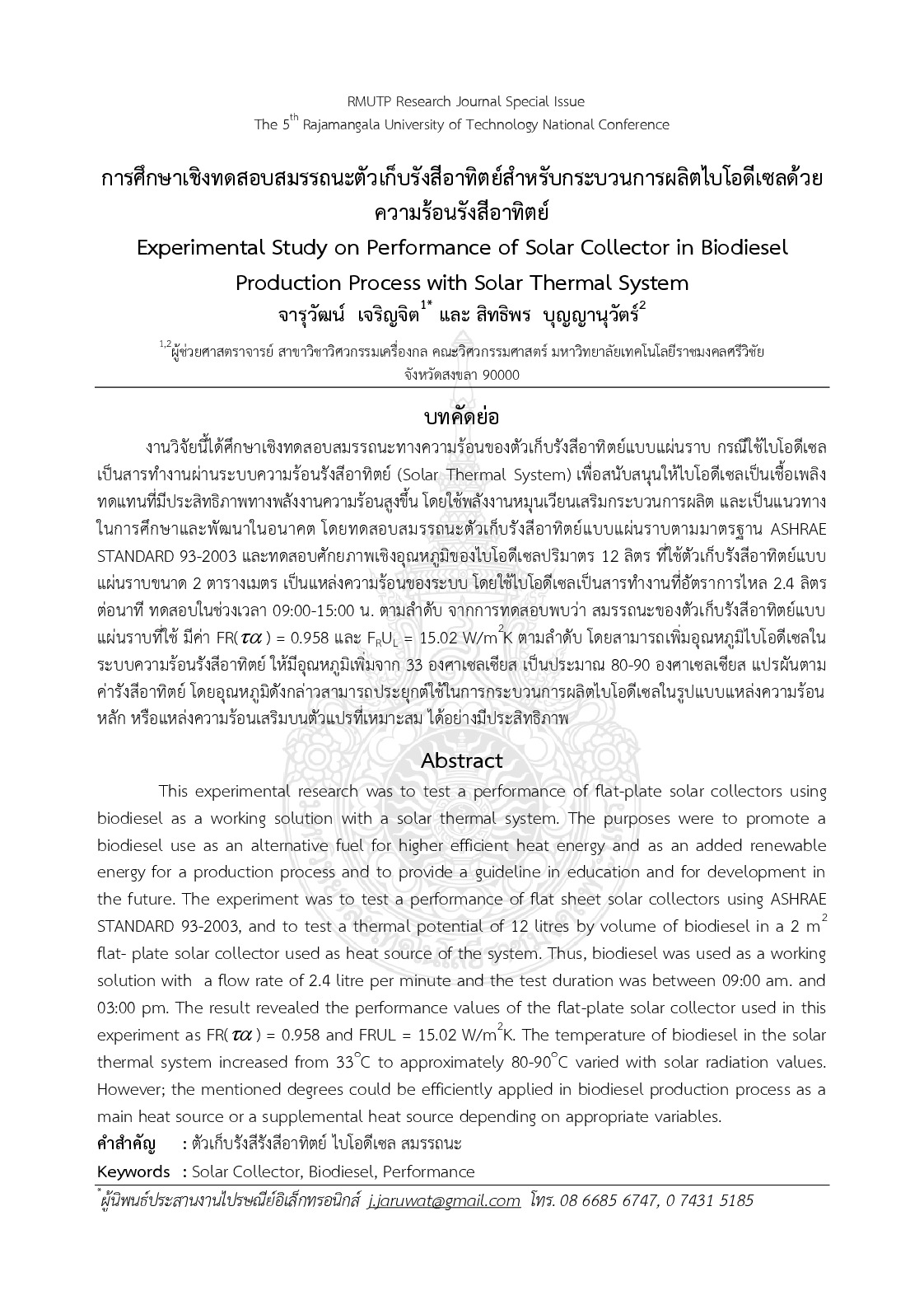
Experimental study on performance of solar collector in biodiesel production process with solar thermal system
This experimental research was to test a performance of flat-plate solar collectors using biodiesel as a working solution with a solar thermal system. The purposes were to promote a biodiesel use as an alternative fuel for higher efficient heat energy and as an added renewable energy for a production process and to provide a guideline in education and for development in the future. The experiment was to test a performance of flat sheet solar collectors using ASHRAE STANDARD 93-2003 and to test a thermal potential of 12 litres by volume of biodiesel in a 2 m2 flat- plate solar collector used as heat source of the system. Thus biodiesel was used as a working solution with a flow rate of 2.4 litre per minute and the test duration was between 09:00 am. and 03:00 pm. The result revealed the performance values of the flat-plate solar collector used in this experiment as FR( ) = 0.958 and FRUL = 15.02 W/m2K. The temperature of biodiesel in the solar thermal system increased from 33๐C to approximately 80-90๐C varied with solar radiation values. However; the mentioned degrees could be efficiently applied in biodiesel production process as a main heat source or a supplemental heat source depending on appropriate variables.
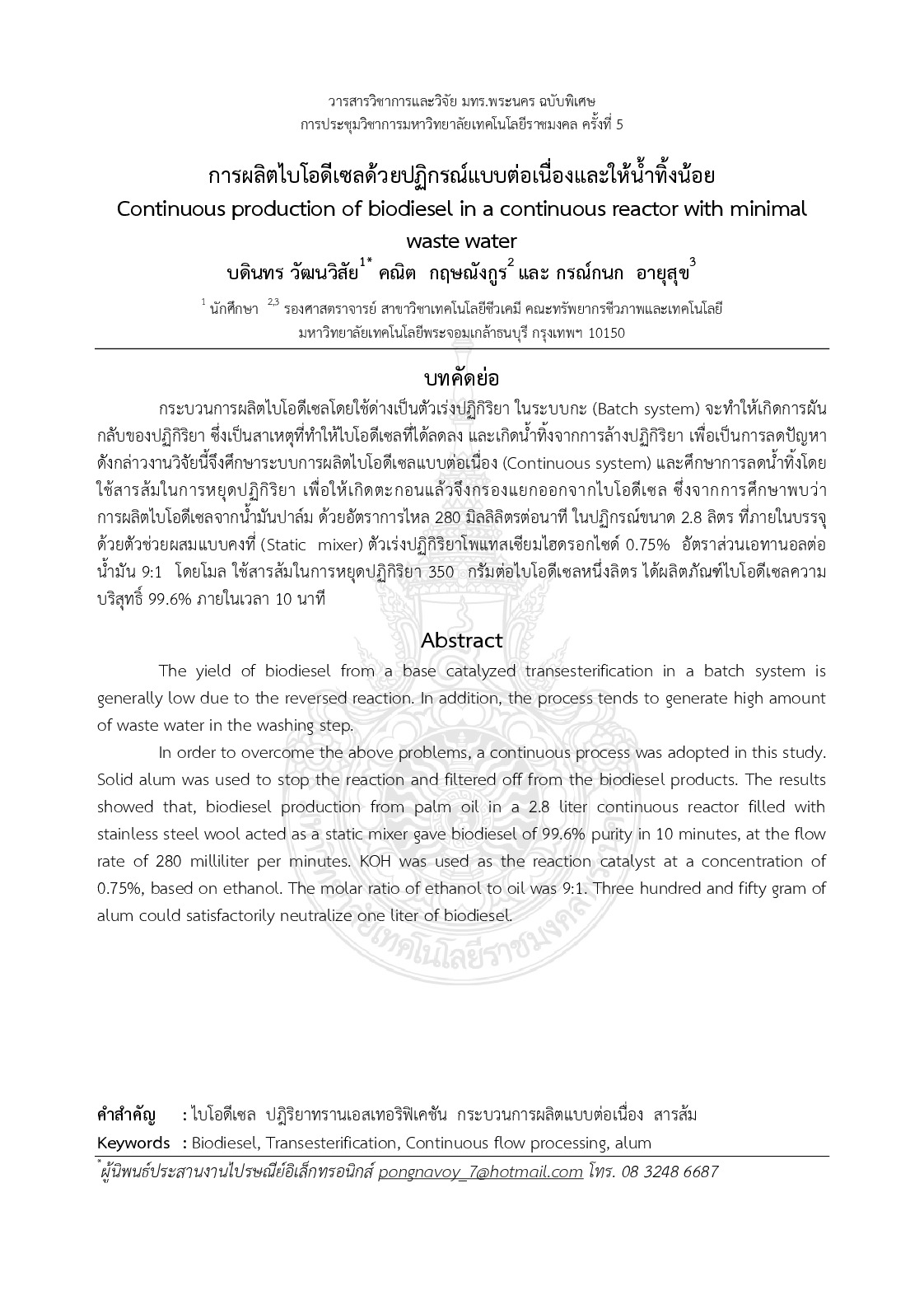
Continuous production of biodiesel in a continuous reactor with minimal
The yield of biodiesel from a base catalyzed transesterification in a batch system is generally low due to the reversed reaction. In addition the process tends to generate high amount of waste water in the washing step. In order to overcome the above problems a continuous process was adopted in this study. Solid alum was used to stop the reaction and filtered off from the biodiesel products. The results showed that biodiesel production from palm oil in a 2.8 liter continuous reactor filled with stainless steel wool acted as a static mixer gave biodiesel of 99.6% purity in 10 minutes at the flow rate of 280 milliliter per minutes. KOH was used as the reaction catalyst at a concentration of 0.75% based on ethanol. The molar ratio of ethanol to oil was 9:1. Three hundred and fifty gram of alum could satisfactorily neutralize one liter of biodiesel.
Media Exposure,Usage and Gratification towards Alterntive Energy Information: Case study on Gasohol, NGV and Biodiesel Consumption of Inhabitants in Bangkok
This research aimed to examine knowledgeexposureusage and gratification towards alternative energy information of inhabitants in Bangkok. The data from the samples were collected by questionnaires. The findings were as follows; 1. The alternative energy internet information exposure differs significantly among the sample groups of different sex. 2.The media expusure through televisionsraduisnewspapermagazine and internet differs significantly among the sample groups of different age. 3.The media exposure through radios and newspapers differs significantly among the sample groups of different income. 4.The media exposure through televisions and interne differs significantly among the sample groups of different educational background. 5.The media exposure through televisionsradios newspapermagazine and internet differs significantly among the sample groups of different career. 6. The knowledge on GasoholNGV and Biodiesel differs significantly among the sample groups of different age. 7.The knowledge on Gasohol and Biodiesel differs significantly among the sample groups of different income. 8.The knowledge on Biodiesel differs significantly among the sample groups of different educational background. 9.The knowledge on Biodiesel differs significantly among the sample groups of different career. 10. The internet usage and gratification differs significantly among the sample groups of different internet exposure.