จำนวน Repository ( 9 )

ผลิตภัณฑ์งานประดิษฐ์ถ่านดูดกลิ่นจากภูมิปัญญาการเผาถ่านไม้โกงกาง : กลุ่มเปลือกไม้บ้านเขายี่สาร ตำบลเขายี่สาร อำเภออัมพวา จังหวัดสมุทรสงคราม
The Research Projects of Production of Deodorizing Charcoals from Mangrove Charcoal : an Applied Local Wisdom of “Pleakmai Group” at Baan Khaoyeesarn Amphawa district Samutsongkarm Province. The objective is as follows. 1) Design and development of charcoal deodorizing from mangrove charcoal. 2) To pass on knowledge of the invention of deodorize charcoal ones. The results revealed that 1. 5 experts answer Questionnaire about the model of charcoals derived from mangrove. Most of souvenir were chosen by expert are deodorizing pillow deodorizing cactus pot and deodorizing key chain. Most of home decoration product are deodorizing mobile deodorizing tissue box and deodorizing picture frame. 2. The target group questionnaire satisfaction was as follows. Course with satisfaction The Research Projects of Production of Deodorizing Charcoals from Mangrove Charcoal : an Applied Local Wisdom of “Pleakmai Group” at Baan Khaoyeesarn Amphawa district Samutsongkarm Province. Consider each objective found. The objective of the research project was accord with demand of the community was the highest level with average 4.82. Accord with the needs of the trainees and up-to-date content of the curriculum with average was 4.8. Overall consideration was found highest satisfaction average was 4.71 with standard deviation 0.60. Satisfaction with the research project of Production of Deodorizing Charcoals from Mangrove Charcoal : an Applied Local Wisdom of “Pleakmai Group” at Baan Khaoyeesarn Amphawa district Samut songkarm Province. When considering each topic That was found as following. In the service processing the project team were prepared and also concentrate to good service 4.82 Secondly the lecturers had the highest level of expertise and also knowledge in the content was training with an average of 4.80. Satisfaction was at the highest level. The mean was 4.67 standard deviation was 0.82. Satisfaction of product The Research Projects of Production of Deodorizing Charcoals derived from Mangrove : an Applied Local Wisdom OF “Pleakmai Group” at Baan Khaoyeesarn Amphawa district Samutsongkarm Province as following. The souvenir The target group is satisfied with the souvenir. Satisfaction of deodorizing cactus pot was highest level average was 4.73. Satisfaction of deodorizing pillow was highest level average was 4.72. And satisfaction of deodorizing key chain was highest level average was 4.33. The Home decoration The target group satisfied with the home decoration. Satisfaction of deodorizing tissue box was highest level average was 4.79. Satisfaction of deodorizing mobile was highest level average was 4.71. And satisfaction of deodorizing picture frame was highest level average was 4.65.
Bananas drying performance with a developed hot Air dryer using waste heat from charcoal production process
The purpose of this research is to develop a hot air dryer using waste heat from a200 liter kiln for drying bananas and to investigate its drying performance. The main parts of the dryer consist of the drying chamber that has dimensions 0.71x0.83x.091 m3 the air circulation system and a heat exchanger which receives waste heat from the exhaust tube and kiln surface. The dryer was developed by designing a drying chamber on the top of a 200 liter kiln to reduce heat lost in the structure and an exhaust gas heat exchanger was developed using groups of copper tubes for increasing then heat transferred to the air. The drying performances were analyzed by measuring specific drying rates and specific energy consumption. Experiments were performed under different temperatures of 60 70 and 80℃ And at a constant velocity of 1.8 ms-1. Eucalyptus was selected as the heat source. Thirty kg of peeled bananas were prepared at an initial moisture content of 241.19±31.50% dry basis and were dried until to final moisture content of 48.47±10.46% dry basis. All experiments were carried out in duplicate. For temperatures of 60 70 and 80 ℃ the ave age specific drying rates were 0.085±0.0004 0.114±0.0009 and 0.1277±0.010 kg water h-1kesolid-1 and the average specific energy consumptions were 1.42±0.055 1.21±0.355 and 1.04±0.074 MJ/kg water respectively. Some dried bananas had burned at a temperature of 80℃ so at temperature of 70 ℃ was the optimal condition in this experiment. This produced good color a high specific drying rate and low specific energy consumption.
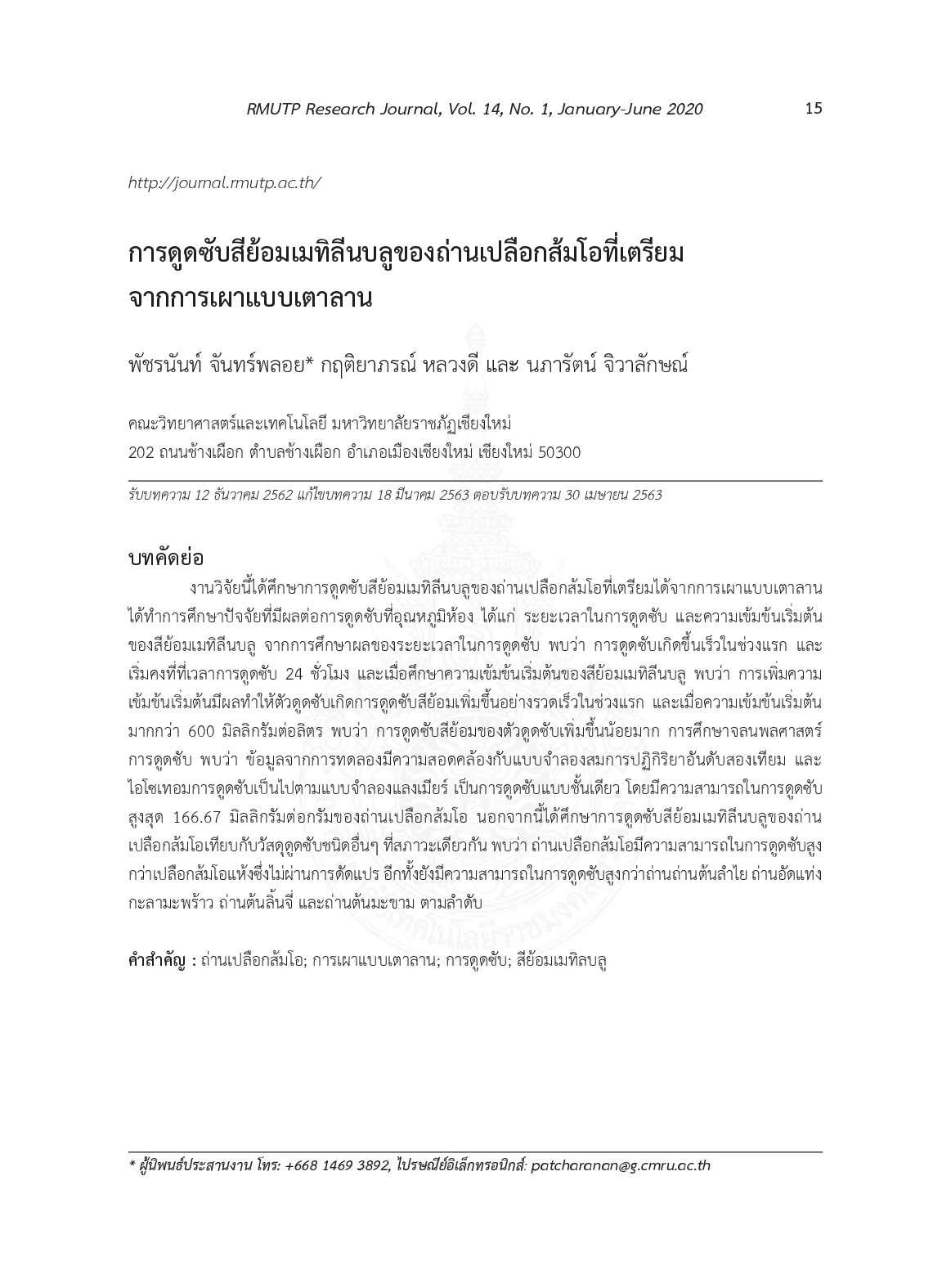
การดูดซับสีย้อมเมทิลีนบลูของถ่านเปลือกส้มโอที่เตรียมจาการเผาแบบเตาลาน
The pomelo peels charcoal was successfully prepared by traditional charcoal burning and its adsorption of methylene blue was investigated. The influences of methylene blue adsorption including contact time and methylene blue initial concentration were studied at room temperature. The adsorption rate initially increased rapidly until 24 h and 600 mg/L of methylene blue initial concentration. The further increase in contact time and methylene blue initial concentration did not significantly increase the adsorption due to it reached equilibrium. Kinetic of adsorption were investigated that the pseudo-second order model best described adsorption kinetic data. The adsorption isotherms were evaluated and the data correlated with Langmuir adsorption model with the maximum adsorption capacity was found to be 166.67 mg/g. The adsorption of pomelo peel charcoal was studied comparing to other adsorbents at the same experimental conditions. The results showed higher adsorption of pomelo peel charcoal than dried pomelo peel longan wood charcoal coconut shell charcoal litchi wood charcoal and tamarind wood charcoal respectively.
A study on activated carbon from bagasse and charcoal adsorption efficiency in decolorization and COD of sugar factory wastewater from rajburi sugar co., ltd
The current time activated Carbon spaciously have been used in the process of wastewater Treatment and Air Pollution Treatment because of it can absorb various materials such as colors smells and organic materials both in the wastewater or air pollution In this research the researcher interest to study the activated carbon from bagasse as become more quantity in the country to use for reducing the pollution of wastewater at Sugar Company and recycling the leaving materials. This study is the Experimental Research being divided into 2 kinds of charcoal: 1) synthesizing activated carbon from bagasse 2) charcoal. The three contents of waste water: 10 50 and 100 percent are used for analyzing and testing at three periods of time: 30 60 and 90 minutes. The example of the wastewater were analyzed the color and COD. The using activated carbon from the bagasse with the content of wastewater at 10% shown that it could not absorb the color differently at every periods of time the color remained lower than 5 Pt-Co and it could reduce more COD at the more periods of time. At the content of waste water 50% shown that the more using time for absorbing the color the quality of absorbing become lower (10 15 and 20 Pt-Co) but it became more reduce COD while the absorbing the color at the content of waste water 100% found that when used the more time quality of absorbing the color became lower (25 30 and 35) while the quality of reducing the COD became increase. The charcoal at the content of wastewater 10% its’ absorbing color was 5 Pt-Co at the all periods of time but the result of reducing the COD was increase: 4300 4000 and 3800 respectively. As the testing the content of waste water at 50% shown that the more using the time its’ quality of absorbing the color became lower while the quality of reducing the COD became decrease: 7330 6500 and 6030 respectively. As studying the content of waste water 100% found that the more using the time for treatment the waste water its’ quality became decrease but it could more reduced COD. The comparison between the activated carbon from bagasse and the charcoal shown that the activated carbon from bagasse can absorb the color better than the charcoal at 0.25 Pt-Co and could more reduce COD than the charcoal 43.5 % by average at the content of waste water 10%. While the waste water 50% the activated carbon from bagasse could more absorb the color than the charcoal at 55% and can more reduced the COD than the charcoal 19.34% averagely. For the content of waste water 100 % the activate carbon from bagasse could more absorb the color than the charcoal at 54.17% and reduced the COD 7.83% by averaging.
การผลิตถ่านอัดแท่งจากวัสดุเหลือทิ้งทางการเกษตรโดยใช้เปลือกทุเรียนผสมเปลือกลูกจาก
This research focuses on the production of charcoal briquettes from agricultural residues by using durian and nypa palm peel mixtures. The objectives of this study are to study the combustion efficiency of charcoal briquettes; study the suitable ratio for the production of briquettes with the ratios of durian : nypa palm peel mixtures as 100:0 50:50 25:75 and 0:100; recycle the agricultural residues as the renewable energy sources and analyze the fuel characteristics; moisture content ash content volatile matters fixed carbon and heating value. The results showed that the best ratio for the combustion efficiency of charcoal briquettes is 50:50 with the minimum moisture content of 4.68% the minimum ash content of 2.70% the volatile matters of 10.33% ; the maximum fixed carbon of 25.56% and all characteristics are met with the standard of charcoal briquettes from the local community products. In the ratio of 100:0 it showed the maximum heating value as 5399 calories per gram. Therefore the 50:50 charcoal briquettes are suitable as the renewable energy source. Besides the capacity of odor adsorption was analyzed by adding the odor substances (mothball) in two bottles with three mothballs for each bottle for two consecutive days before removal. Then sic of 50:50 charcoal briquettes were added into one bottle. Ten testers smelled the bottle every two days for six days. The result showed that the bottle with the charcoal briquettes had odor less than the bottle without briquettes. Hence the charcoal briquettes from durian and nyla palm peel mixtures have the best odor adsorption capacity and are suitable for household uses.