จำนวน Repository ( 5 )
Effects of Fat Substitute on Survived Probiotic Bacteria in Yoghurt Ice Cream
The objective of this research was to compare amounts of fat substitutes supplied in the industries in order to determine their ability to encapsulate probiotic microbes in the production of yoghurt ice cream to ensure maximum survived probiotic microbes. In this research two fat substitutes Purity SM 100 and CRYSTAL texTM 648 were used to substitute skim milk in the standard formulas in order to study numbers of survived probiotic microbes and to test the sensory acceptance. For the sensory acceptance it was found that the probiotic yoghurt ice cream containing 20% Purity SM100 is acceptable at the maximum significance (p ≤ 0.05) because its flavor and taste was better than other samples as well as the best overrun with statistical significant differences (p ≤ 0.05). However by addition of both fat substitutes at different concentrations pH values of probiotic yoghurt ice cream products did not have statistical significant differences (p ≥ 0.05). When Lactobacillus acidophilus Bifidobacterium and Streptococcus thermophilus microbial starters were added into the probiotic yoghurt ice cream using both fat substitutes in place of skim milk at ratios of 10% 15% and 20% respectively under a storage condition of -20oC for 4 weeks it was found that types and amounts of fat substitutes affected the surviving rate of probiotic microbes in the product with a statistical significance (p ≤ 0.05). The addition of fat substitutes Purity SM100 and CRYSTAL texTM 648 at all concentration levels made probiotic microbes survived in the product which illustrated that both fat substitutes used in above experiments could encapsulate probiotic microbe cells. The survived probiotic microbes were in the range of 107 – 108 CFU/ml in comparison to the probiotic yoghurt ice cream with the standard formula without the addition of fat substitutes that has survived probiotic microbes of only 106 CFU/ml.
Knowledge, Awareness and Practice about Food and Nutrition of Adolescence in Muang District, Prachinburi Province
The research aimed to: 1. study and compare food and nutrition knowledge of adolescence by looking at gender and level of education. 2. study and compare the awareness of food and nutrition by comparing gender and level of education. 3. study and compare the practice of food and nutrition by comparing gender and level of education. 4. study the relationship between knowledge awareness and practice of food and nutrition of the adolescence in Muang District Prachinburi Province. Tests and questionnaires were used to gather the data from 346 samples. The Stratified Random Sampling was used. The data were analyzed by using percentile mean standard deviation t-test one way analysis of variance and Pearson’s Product Moment correlation at 0.01 - 0.05 significant level. The study found that 1. 71.4% of the samples were female and 41.0% of the samples were high school graduates. 2. The sampling adolescence had good knowledge of food and nutrition. Different gender had significantly different level of food and nutrition knowledge at 0.01 while different level of study had no different level of food and nutrition knowledge. 3. The sampling adolescence had food and nutrition awareness at high level. Different gender had significantly different level of food and nutrition awareness at 0.01 while different level of study had no different level of food and nutrition awareness. 4. The sample group had good food and nutrition practice at moderate level with no difference between gender and level of study. 5. There was a positive relationship between food and nutrition knowledge awareness and practice of the adolescence at 0.05. The relationship between knowledge and awareness was moderate and the relationship between knowledge and practice was low.
Low Calorie Soy Milk Product Fortified with Beta-Carotene
The purposes of the study on low calorie soy milk product fortified with beta-carotene were 1) to study the suitable content of carrot which was one source of beta-carotene and sugar 2) to study the physical and chemical quality of the product 3) to study shelf- life of the product and 4) to investigate the product acceptance. Standard soy milk formula was studied and fortified with 3 levels of carrot and reduced 4 levels of sugar content. The 3x4 factorial Design was used to experiment and 9-points hedonic scale was used for sensory evaluation from 30 panelists. The results were found as follows: 1. For the content of carrot and sugar the panelists had the acceptance of carrot with 2000 gram and 65% of sugar reduction. The use of carrot and sugar had significant (p<0.05) effects on over all liking and milk’s taste. 2. For the physical quality it was found that L* value was 6.50 a* value was 20.13 b* value was 10.44 viscosity was 27.80 centipoint total soluble solid was 11.33 + 0.01 degree Brix and ph was 6.55. For the chemical quality 100 gram of soy milk fortified with beta-carotene contained 37.45 kcal energy 2.48 g protein 0.01 g fat 6.86 g carbohydrate and 3.18 ml beta- carotene. 3. For shelf-life study it was found that the product did not change when kept in the temperature of 7 degree Celsius for 0-10 days except for 11-14 days. Total bacteria count was 4.8x10 CFU/cm3 when compared to Thai Community Product Standard (529/2547) it should be found lower than 1x10⁴ colony/ 1 cm3 . It was evidently found that low calorie soy milk fortified with beta-carotene was safety for consumer when kept for 14 days. 4. For the product acceptance it was found that 93% of the consumer satisfied the product price of 10 baht per 200 ml consumption.
The Study of Nutrition Knowledge, Consumption Behavior, and Nutritional Status of Kluaynamthai Bangkok Personnel
This research aimed to study the qualification of Kluaynamthai Hospital’s (KLH) personnel in three aspects; nutrition knowledge consuming behavior and nutritional status. The research also studied on the relationship of the three aspects. The Stratified Random Sample method was used. Questionnaires and the 2008 annual check up information were used to gather the data from 236 samples. The data were analyzed by using frequency percentile mean and standard deviation. The analysis of test score was done by a statistical method (Chi-square) with a 0.01-0.05 significant level. The study revealed that 65.68 % of Kluaynamthai Hospital’s personnel had excellent nutrition knowledge and 26.69 % 6.78% 0.42% and 0.42% had nutrition knowledge at good average meet criteria and under criteria respectively. The average of 2.91 of the group had good consuming behavior and the frequency of good consuming behavior at 2.69 or 91.95 % of the group’s consuming behavior was less affected by mass media. 49.58% of the group had normal nutrition status while 35.59% and 14.58 % had over nutrition and below nutritional status respectively. The study of the relationship between the nutrition knowledge and the consuming behavior revealed that there was the significant relationship between the two variables at significant level of 0.05.
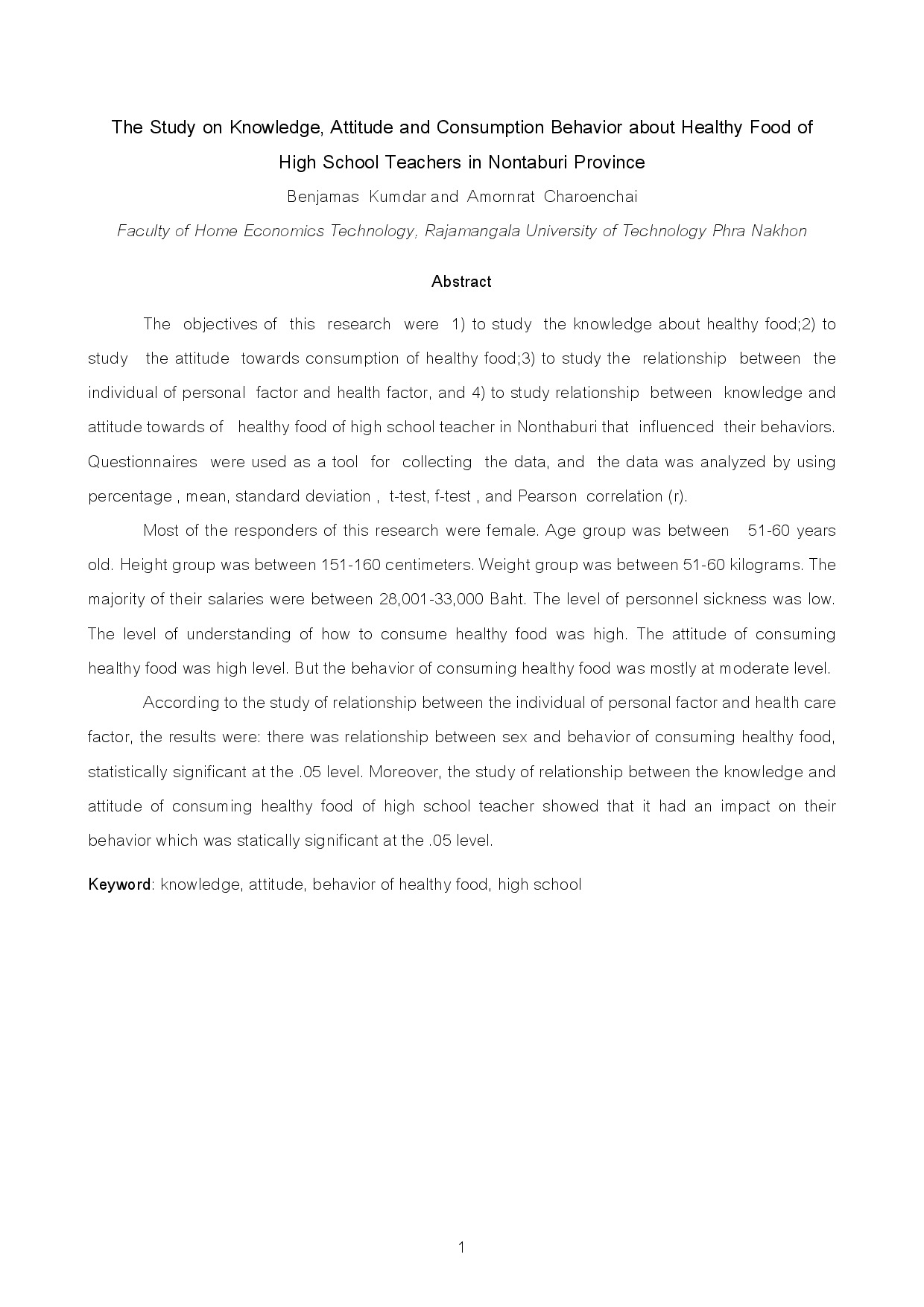
The Study on Knowledge, Attitude and Consumption Behavior about Healthy Food of High School Teachers in Nontaburi Province
The objectives of this research were 1) to study the knowledge about healthy food;2) to study the attitude towards consumption of healthy food;3) to study the relationship between the individual of personal factor and health factor and 4) to study relationship between knowledge and attitude towards of healthy food of high school teacher in Nonthaburi that influenced their behaviors. Questionnaires were used as a tool for collecting the data and the data was analyzed by using percentage mean standard deviation t-test f-test and Pearson correlation (r). Most of the responders of this research were female. Age group was between 51-60 years old. Height group was between 151-160 centimeters. Weight group was between 51-60 kilograms. The majority of their salaries were between 28001-33000 Baht. The level of personnel sickness was low. The level of understanding of how to consume healthy food was high. The attitude of consuming healthy food was high level. But the behavior of consuming healthy food was mostly at moderate level. According to the study of relationship between the individual of personal factor and health care factor the results were: there was relationship between sex and behavior of consuming healthy food statistically significant at the .05 level. Moreover the study of relationship between the knowledge and attitude of consuming healthy food of high school teacher showed that it had an impact on their behavior which was statically significant at the .05 level.