จำนวน Repository ( 7 )
Finite element analysis of armor piercing bullet penetrating hard steel
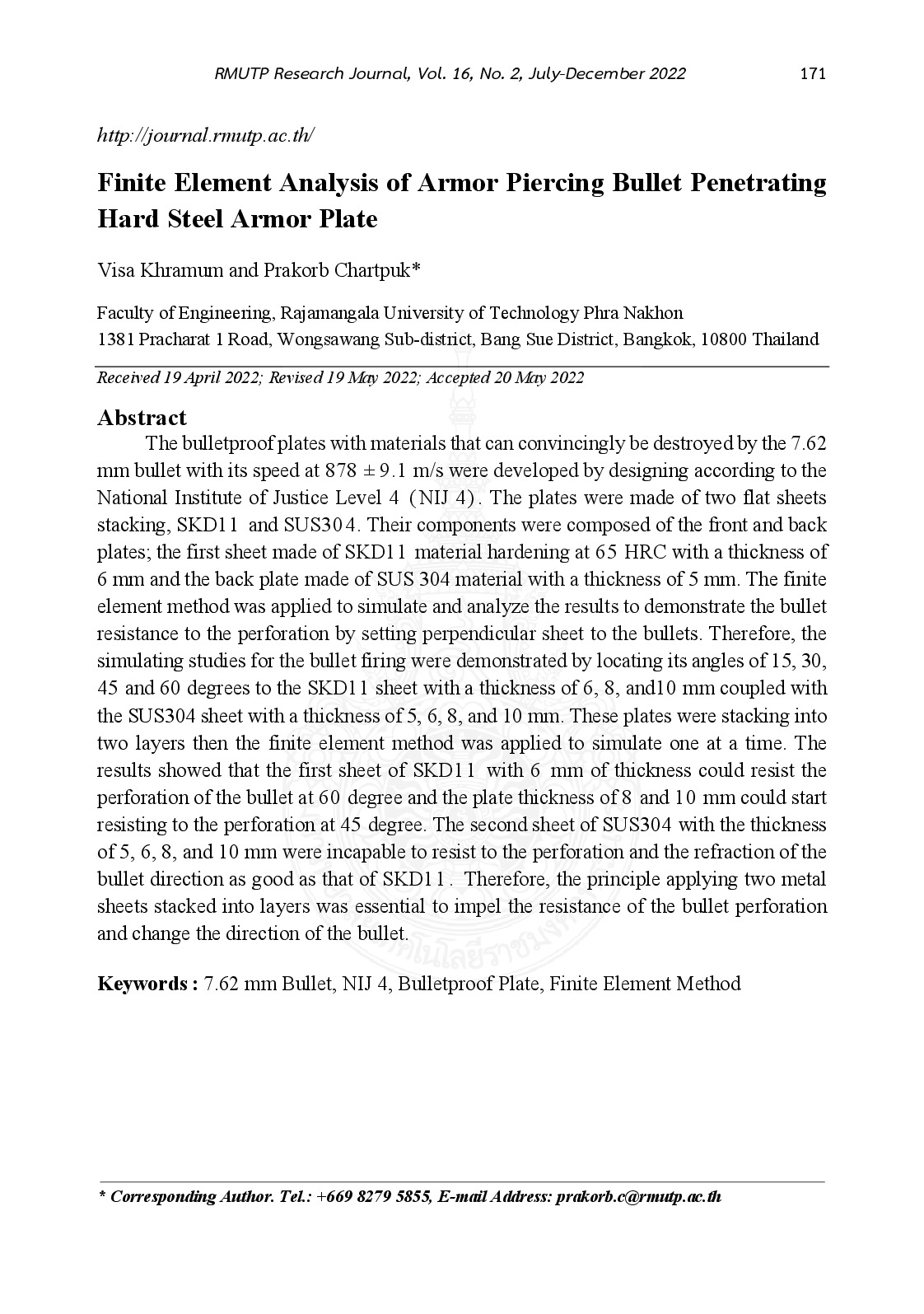
The bulletproof plates with materials that can convincingly be destroyed by the 7.62 mm bullet with its speed at 878 ± 9.1 m/s were developed by designing according to the National Institute of Justice Level 4 (NIJ 4). The plates were made of two flat sheets stacking SKD11 and SUS304. Their components were composed of the front and back plates; the first sheet made of SKD11 material hardening at 65 HRC with a thickness of 6 mm and the back plate made of SUS 304 material with a thickness of 5 mm. The finite element method was applied to simulate and analyze the results to demonstrate the bullet resistance to the perforation by setting perpendicular sheet to the bullets. Therefore the simulating studies for the bullet firing were demonstrated by locating its angles of 15 30 45 and 60 degrees to the SKD11 sheet with a thickness of 6 8 and10 mm coupled with the SUS304 sheet with a thickness of 5 6 8 and 10 mm. These plates were stacking into two layers then the finite element method was applied to simulate one at a time. The results showed that the first sheet of SKD11 with 6 mm of thickness could resist the perforation of the bullet at 60 degree and the plate thickness of 8 and 10 mm could start resisting to the perforation at 45 degree. The second sheet of SUS304 with the thickness of 5 6 8 and 10 mm were incapable to resist to the perforation and the refraction of the bullet direction as good as that of SKD11. Therefore the principle applying two metal sheets stacked into layers was essential to impel the resistance of the bullet perforation and change the direction of the bullet.
การออกแบบรูปแบบล้อรันแฟลทที่เหมาะสมสำหรับรถยนต์บรรทุกปกติขนาดเล็กติดเกราะด้วยระเบียบวิธีไฟไนต์เอลิเมนต์
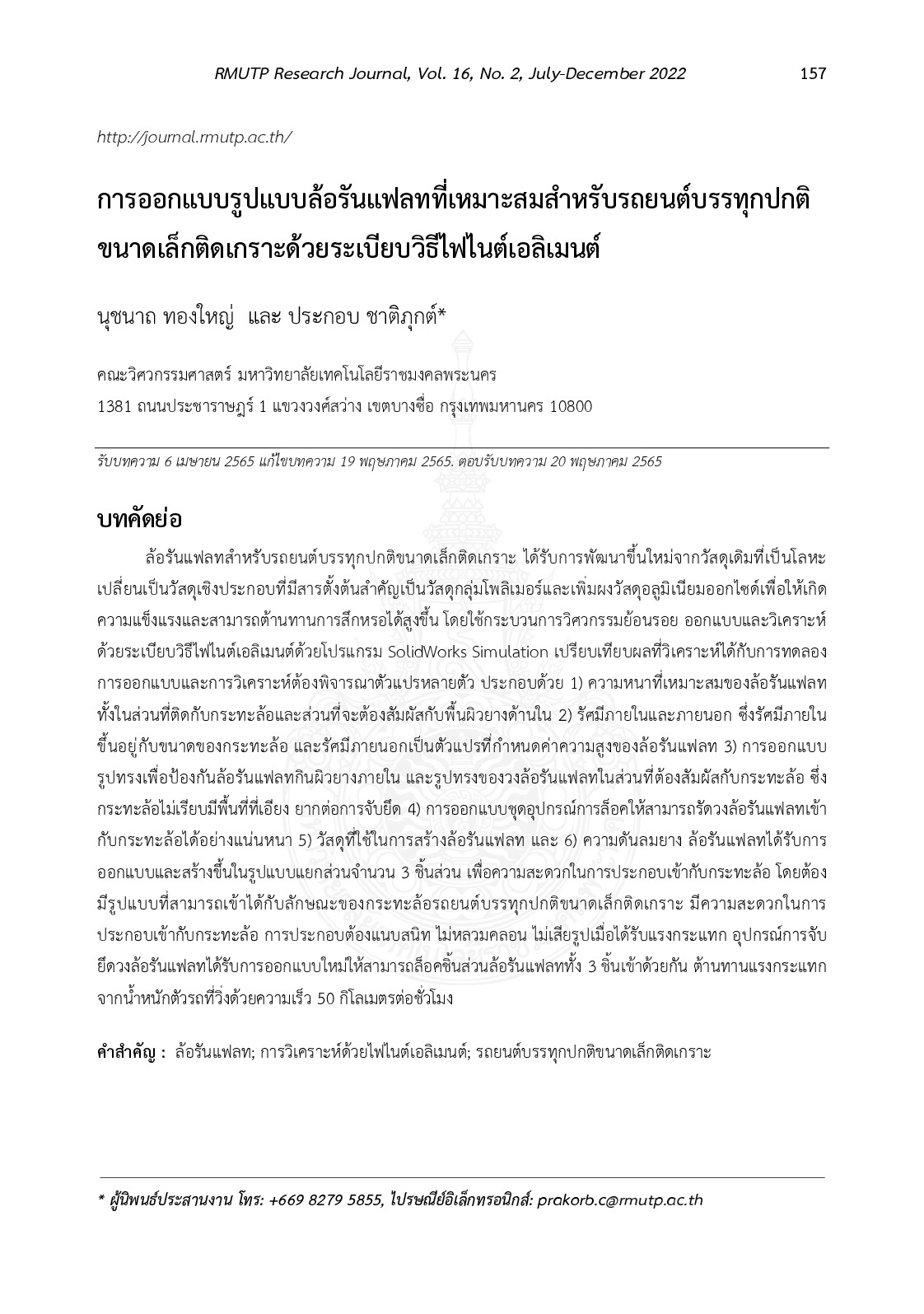
Run flat wheels for small armored regular trucks have been re-developed by transformation from the original metallic material to compound materials polymer group materials as important raw materials then added with aluminum oxide powder to achieve higher strength and wear resistance. The research was performed by using reverse engineering processes including designing and analysis with finite element methodology with the SolidWorks Simulation program and comparing the analyzed results with outcome experiments. Several variables used for the design and analysis were 1) the optimal width of the run flat wheel at the parts both attached to the wheel pan and contacted with the inner rubber surface 2) internal and external radiuses. The internal radius is depending on the size of the wheel pan and the external radius is a variable that determines the height of the Run flat wheel. 3) the shape designed to prevent wearing of the inner tire surface of the run flat wheel and the shape of the run flat reel in the part contacted with the wheel pan. This wheel pan part is such uneven inclined area which is difficult to hold. 4) a design locking kit for tightly fastening the run flat reels to the wheel pan 5) the material used to create the run flat wheel and 6) tire pressure. The run-flat wheels were then designed and constructed in a modular form of 3 parts for ease of the wheel pan assembly. In designing pattern the assembling run flat reels had to be fit into the characteristics of a small armored regular truck wheel pan convenient to assemble with a wheel pan and tightly attached without looseness or deformation when impacted. The run flat reel gripping device has been redesigned to lock all three run flat parts together. It brought up the impact resistance from body weight was at 50 km/hr.
การวิเคราะห์พารามิเตอร์ที่มีผลกระทบต่อความสามารถในการต้านทานของการเจะทะลุของกระสุนบนผิวเกราะอะลูมิเนียมด้วยระเบียบวิธีไฟไนต์เอลิเมนต์
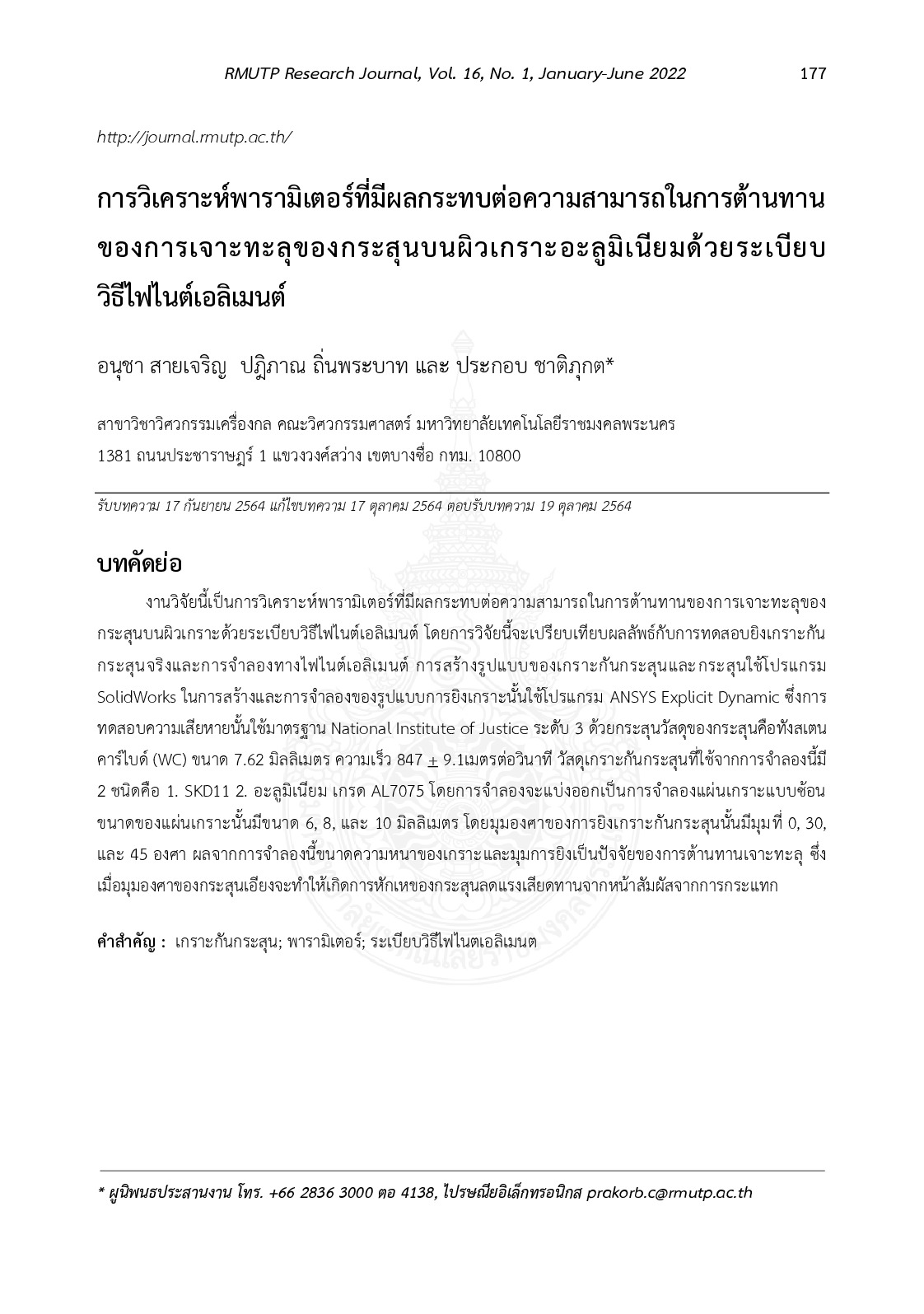
This research analyzes the parameters affecting the penetrating resistance of shells on the armor surface by the finite element method. In this study the results were compared with real bulletproof armor firing tests and finite element simulations. modeling of bulletproof armor using Solid Works program. Creating and simulating armor firing pattern using ANSYS Explicit Dynamic program. damage test is based on National Institute of Justice level 3 standards with material of the ammunition is 7.62 mm tungsten carbide (WC) and speed 847 + 9.1m/s. there are two types of bulletproof armor used in this simulation 1. SKD11 2. Aluminum AL7075. The simulations is into 1 category Simulation of stacked armor plates. The sizes of the armor plates are 6 8 and 10 mm and the angles of firing of bulletproof armor are 0 30 and 45 degrees. result of this simulation armor thickness and firing angle are factors of penetration resistance. when the angle of the projectile is tilted it will cause the projectile to deflect reducing the frictional contact from the impact.
สมบัติทางกลของพอลิเอทิลีนน้ำหนักโมเลกุลสูงยิ่งยวดเชิงประกอบด้วยอลูมิเนียมออกไซด์สำหรับการใช้งานทางวิศวกรรม
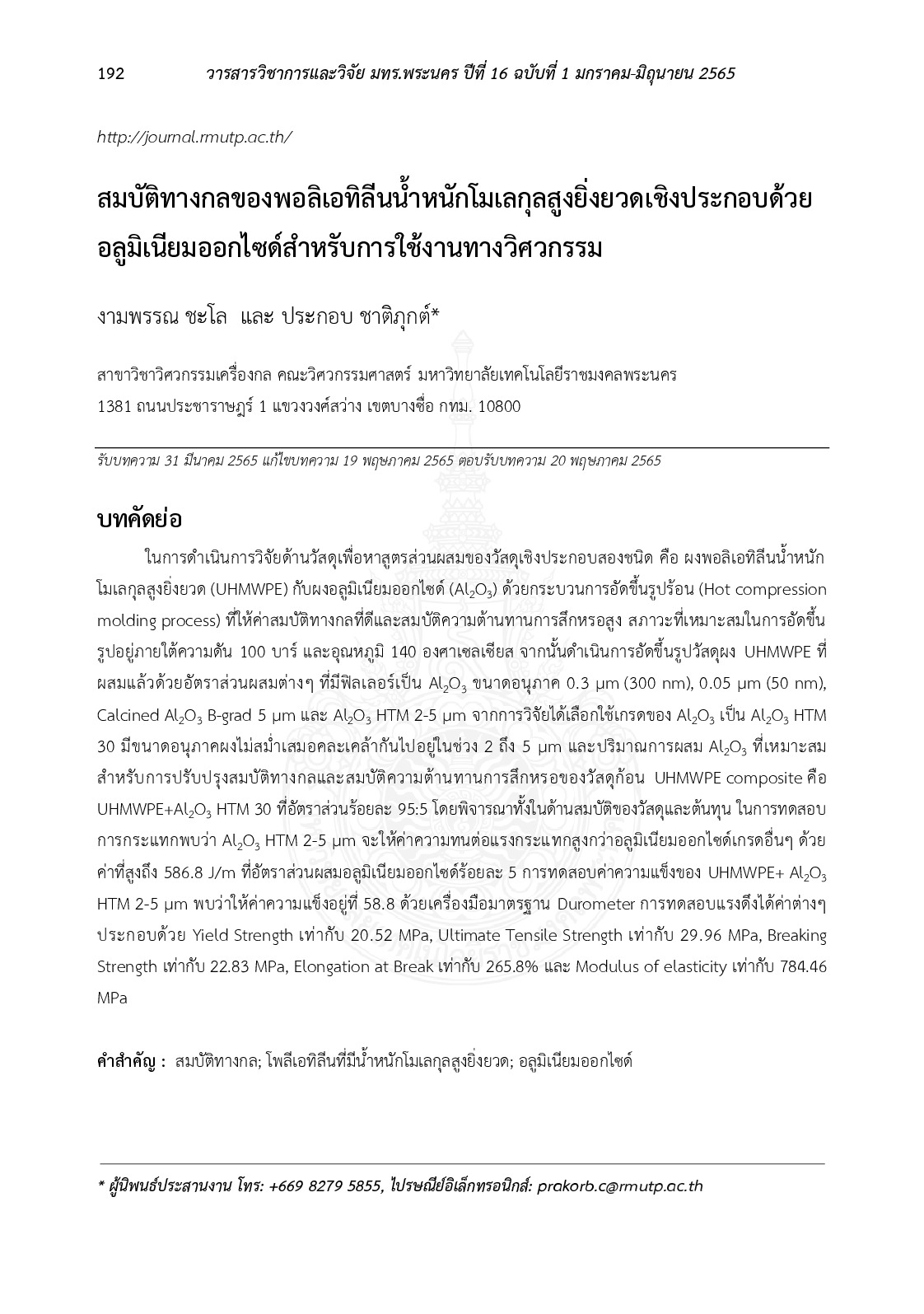
In conducting the research on Material Science two composite materials ultra high molecular weight polyethylene (UHMWPE) powder and aluminum oxide (Al2O3) powder were formulated by hot compression molding process. The formulated materials demonstrated good mechanical properties and high wear resistance properties. Based on the studies the Al2O3 grade selected was Al2O3 HTM 30 harboring mixed uneven powder particle sizes ranging from 2 to 5 microns (μm) and selected proportion of Al2O3 alloy mixed for improving mechanical and wear resistance properties of the UHMWPE composite material was the UHMWPE+Al2O3 HTM 30 at a ratio of 95:5%. When considering both material properties and cost effectiveness in the impact test 2-5 μm Al2O3 HTM carried the higher impact strength than other aluminum oxide grades with the values up to 586.8 J/m at a ratio of 5% aluminum oxide. The hardness test of the 2-5 μm UHMWPE+ Al2O3 HTM delivered the hardness at 58.8 using the standard durometer. The tensile test values consisted of Yield Strength Ultimate Tensile Strength Breaking Strength Elongation at Break and Modulus of elasticity equal to 20.52 MPa 29.96 MPa 22.83 MPa 265.8% and 784.46 MPa respectively.
Molecular weight polyethylene composites for high wear resistance under temperature changes and lubricant to apply for use in industrial machinery parts
The objective of this research is a study to determine optimum forming condition of semi-finished bulk UHMWPE by using ram extruder that obtain maximum yield strength and minimum wear rate for apply to use in area of medical and mechanical application. Experimental extrusion specified forming condition consists of the temperature of 140 150 and 160 ºC and pressure of 3 5 8 and 10 MPa with the temperature exposure time of 30 minutes. After known optimum forming condition of UHMWPE powder thus forming UHMWPE filled with different kind of filler to study and determine optimum weight fraction of various types of filler that affect onto wear resistance property of UHMWPE composites. Result extruded condition at the temperature of 1 5 0 ºC under pressure of 5 MPa with exposure time of 30 minutes is an optimum extruded condition due to specimen shown a maximum yield strength ultimate tensile strength and elongation of 20.43 ± 1.21 MPa 28.33 ± 1.53 MPa and 285.60 ± 6.41 % respectively and obtain minimum wear rate of 3.02 10-9 ± 5.27 10-10 mm3/Nm. Its mechanical properties and wear resistance property higher than imported bulk UHMWPE by 23.3 % and 4.75 times respectively due to the formation of cross-linking are occurred in polymer chain and also its degree of crystallinity is high equal to 61.52%. For bulk UHMWPE IR-spectrum shown a variation peak of carbonyl group (C=O) are occurred that that it indicated the oxidation reaction at the end of polymer chain and tis degree of crystallinity is equal to 53.31% which result to decrease strength of polymer. In the case of UHMWPE filled with filler optimum weight fractions of various types of filler are as follows. 1. The filling of 0.3 wt. % Al2O3 particle size 0.05 μm shown yield strength ultimate tensile strength and elongation of 23.17 ± 3.35 MPa 34.78 ± 2.80 MPa and 229.00 ± 6.09% respectively that its mechanical properties was increased by 18.55% (increasing of ultimate tensile strength). For the wear rate is equal to 2.09 10-9 ± 3.39 10-10 mm3/Nm or its wear resistance was increased by 1.44 times in compared with initial bulk UHMWPE. 2. The filling of 0.4 wt. % Al2O3 particle size 0.3 μm shown yield strength ultimate tensile strength and elongation of 21.93 ± 0.51 MPa 25.40 ± 0.69 MPa and 267.67 ± 22.03% respectively that its mechanical properties was increased by 11.54% (increasing of ultimate tensile strength). For the wear rate is equal to 2.32 10-9 ± 4.78 10-10 mm3/Nm or its wear resistance was increased by 1.30 times in compared with initial bulk UHMWPE. ฉ 3 . The filling of 0.4 wt. % Al2O3 particle size 1 μm shown yield strength ultimate tensile strength and elongation of 23.93 ± 1.89 MPa 26.77 ± 1.20 MPa and 296.54 ± 7.51% respectively that its mechanical properties was increased by 5.83% (increasing of ultimate tensile strength). For the wear rate is equal to 2.14 10-9 ± 3.16 10-10 mm3/Nm or its wear resistance was increased by 1.41 times in compared with initial bulk UHMWPE 4 . The filling of 4 wt. % Al2O3 particle size 5 μm shown yield strength ultimate tensile strength and elongation of 22.57 ± 2.01 MPa 26.31 ± 3.11 MPa and 136.66 ± 11.67% respectively that its mechanical properties was increased by 7.68% (increasing of ultimate tensile strength). For the wear rate is equal to 2.37 10-9 ± 5.71 10-10 mm3/Nm or its wear resistance was increased by 1.27 times in compared with initial bulk UHMWPE