จำนวน Repository ( 5 )
แรงจูงใจต่ออาชีพเชฟของนักศึกษาโรงเรียนการเรือนมหาวิทยาลัยราชภัฏสวนดุสิต
The research aims to study Motivation of Students to the Chef Occupation School of Culinary Arts Suan Dusit Rajabhat University. The samples were classified from individual of factors of 400 students studying in the first year to the fourth year in the program of Culinary Technology and Service at School of Culinary Arts Suan Dusit Rajabhat University. The tool is used to collect data is questionnaires and data analyze is by means of percentage median and standard deviation. However independent test is used for testing and median differences while one way Anova is applied for analysis of variance and LSD (Fisher’s Least Significant Differences) is used for analysis of double effect by statistical significance at the 0.05 level. The result from the research shows that samples consisting of male 50% and female 50% the most students age are more than 21 have their dominicide in Bangkok with parents of educational background of technical certificate and diploma level working in a private sector. The average family income is among 30000 to 40000 Baht per month. Most samples of students finished high school from the North with an average GPA between 2.51 to 3.00 with the most no experience in culinary lessons and with less than one year experience in food working firld. The students motivation to the chef occupation indicate that most samples in general gives priority to motivational factors to the chef occupation at a high level. The motivational factors has mostly affected to the chef occupation are ability and social respectively. The least effective motivational factors to the chef occupation are the ability. The outcome of motivational analysis is the chef occupation of students at School of Culinary Arts Suan Dusit Rajabhat University are classified from individual factors point out that of adult students high school location average GPA educational year and parents different educational background have different motivation to the chef occupation of students at School of Culinary Arts Suan Dusit Rajabhat University by statistical significance at the 0.05 level.
การพัฒนาโครงสร้างผ้าของเครื่องแต่งกายเชฟที่เหมาะสมกับการปฏิบัติงานของเชฟในครัวอาหารไทย
The purpose of this research were 1) Development and production of the cotton fabric suitable for use in the kitchen apparel chef Thailand 2) test the suitability of the fabric from the fabric used to make kitchen apparel chef in Thailand. Tools used in the study are the fabrics used to make clothing chef woven pattern 2/1 for 3 structures 1) Cotton100 2) Polyester Microfiber and 3) TR. Being three fabrics to test of the fabric aspects of the durability of color to light color fastness to washing colorfastness to perspiration strength of the yarn yarn number weight yarn yarn twist yarn thickness weaving and resistance to abrasion properties of the fabric the effect of moisture. The quantitative data were analyzed by descriptive statistics from assessment and feedback of chef’s uniforms by the establishment of a laboratory in the kitchen by cooking in Thailand 15 Thailand kitchen. The chefs were wearing 3 sets each 5 days per a types of them for 15 days. Each of chef’s uniform made from the different types of fabrics. Data analysis and interpretation with the average 5 level content analysis and evaluation. Data analysis in descriptive and narrative. The results founded that Chef of food establishments restaurants Hotel and restaurant with 15 people most of the food is the leader in working kitchen (Executive chef) the timetable of working in the evening in the Thai-kitchen from 12:00 to 21:00 o’clock for 5 days a week. It’s about environments of Thai-Kitchen The temperature of the kitchen operations in restaurants and room temperature and after the experimental wear three types of 15 day Chef has been satisfied in sample number 2. It is Micro Fiber fabrics because there is good ventilation not get heat easy to clean fabric good reflect of oil or anti-oil water absorption and drying rate of the normal range. Micro Fiber fabric when Chef wear it not heavy able to wear at all times. The results of the test and analysis Micro Fiber Cloth material that is resistant to very light. The fabric is not easily broken. Strength and abrasion resistance as possible. It is oil on fabric and yarn on the oil splash in the Kitchen. Including the ability to absorb water and the distribution of water as much as possible.
ผลการใช้นาโนเทคโนโลยีของเครื่องแต่งกายเชฟที่มีผลต่อความปลอดภัยในอาหาร
The research regarding effect of nanotechnology use in making chef apparel on safety of food had the objectives to study about the result of using nano materials coating on yarn and fabric; to study about the use of nano materials which are suitable for fabric to be sewn for being chef apparel and to study the effect of using of nanotechnology for chef apparel on smell and the inhibition of pathogenic bacteria growth using three types of nano materials including Zinc oxide nano Silver nano and Titanium dioxide nano to be coated on four samples including cotton thread T/R thread cotton fabric and T/R fabric. The researcher tested the fabric sample for inhibiting growth of pathogenic bacteria and found that Zinc oxide nano and Silver nano were not different in inhibiting growth of pathogenic bacteria. But the coating on the fabric is more convenient and cheaper. And effective against Gram-positive bacteria. A bacterium that is often found in personal hygiene unclean conditions better than or equal to SS.S3%. Then Four kinds of fabric were sewn to be chef apparel. Actual chef tried wearing to test effectiveness in resisting bacteria. When the apparel was used for two times it was found that T/R fabric which was coated with Zinc oxide nano and Silver nano had different ability to resist gram-positive bacteria and gram-negative bacteria. Fabric T/R Silver nano coating remains effective against bacteria as well and proper to be sewn as chef apparel.
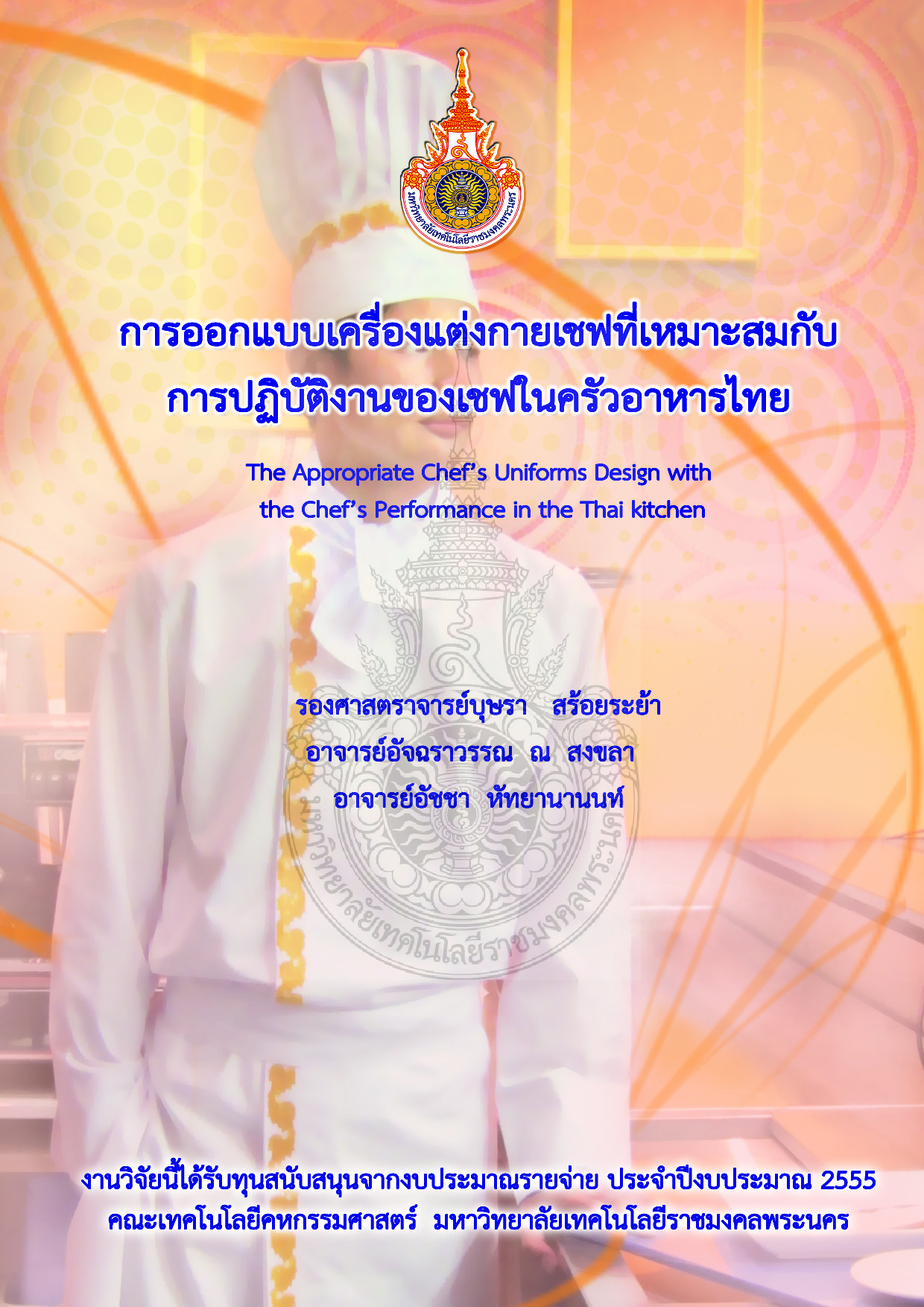
การออกแบบเครื่องแต่งกายเชพที่เหมาะสมกับการปฏิบัติงานของเชฟในครัวอาหารไทย
This research is the designing of chef apparel in order to appropriate with their tasks in Thai kitchen. The objective of this research are to design the appropriate chef apparel to work in the Thai kitchen and study the consumer satisfaction of apparel designing for the chef in Thai kitchen. Starting from sketching chef outfits. There are 60 styles from 15 styles of each category. For example hat chef jacket scarf and napkin. There are 5 sketches selection of each category by specialist. Therefore researchers set in to five outfits for sewing and survey the satisfaction amount 200 random sampling using 100 customers at Central Pinklao and 100 Thai kitchen chefs or Thai food business investor. The assessment and questionnaire was analyses through statistical and percentage to demonstrate in table. The study result in consumers’ satisfaction with regard the designing of chef apparel in order to appropriate with their tasks in Thai kitchen found that were mostly 59.5 percentages’ samples as male and 39 percent in an age range between 46 years. There are 50 percent of samples was professional chef sample with 47.5 percent of Bachelors degree and 33 percent of receiving monthly income from 30001 baht upwards. From the mostly research of consumer used to take the service in restaurant with a chef uniform was 90 percent. The 94 percent of opinions about Thai identity not show in chef uniform and also they agree with Thai identity in chef uniform 96 percent. The analysis of the satisfaction of consumers to the appropriate chef’s uniforms design with the chef’s performance in the Thai kitchen The analysis results showed that the overall images of all design as follow the first design is number 2 average in 31.04 in the highest level of satisfaction. Next the second design is number 3 average in 4.16 in the satisfaction level. Then the third design is number 4 average in 4.15 in the highest level of satisfaction. The fifth design is number 5 average in 3.92 in the high level of satisfaction and the last design is number 1 average in 3.29 satisfaction level was moderate.
ทัศนคติของเซฟต่อการออกแบบชุดเซฟที่มีเอกลักษณ์ไทยเพื่อใช้ในครัวอาหารไทยที่มีลักษณะเป็นครัวเปิด
The objectives of this research were 1) to study the Thai chefs attitudes toward Thai cuisine chef apparel 2) to study the designing of Thai ornamental pattern and suitable colors of embroidery thread for embellishment on Thai cuisine chef apparel 3) to study the design of embellishment of Thai ornamental pattern on Thai cuisine chef apparel. The sample used were the chefs who are the members of Thai Chef Association working in Thai cuisine of restaurants and other shops located within Bangkok metropolitan and circles. The total numbers were 300. Tool used was a questionnaire divided into 3 sections. The first section was the questions about general information of the chef status. The second one was the section concerning attitude and basic data on chef apparel featuring inspecting lists 6 and 14 items respectively. The last one was 40 items asking about the chefs opinion in order to rate the agreement characterizing as estimated measurement. The statistical tools used to analyze were percentage. means and standard deviation. Consequently the apparel chefs wanted was formed. After that 5 Thai ornamental patterns were designed and layout the decorative design on 10 chef apparels with embroidering by 9 colored embroidery threads. In order to select the suitable design 7 experts consisting of experts on fashion design and experts on Culinary Art. Food Science and Education cooperatively answering the questions of visual satisfaction using 9 -points Hedonic ScaleQuestionnaire. The analyzing of variation was used One Way ANOVA and differential analysis of means used Duncans New Multiple Range Test at significant 95%. The result is that most chef are women 69% and men 31% age range 21-30 years of age 92.67% earning between 10000-30000 baht per month 85.53% holding Bachelor degree 90.00% working experience in food 1-5 years 89.00% most of them are assistant chef 48.00%. Most chefs knew the priority of apparel used while working is consist of shirt pant apron and head wear. They must be white and can be suitably useful for working which affected the hygiene for chef food cooked. On the part of the beauty of the apparel embroidering Thai ornamental pattern is considered as middle rank of priority. The desirable chef apparel was apparel with one pocket on the right side of jacket breast and another one on the right side of jacket waist. The sleeves are type of three quarter. In the front of jacket is double-breast that fully overlapping style round neck line Chinese collar and middy length apron with a cincture. The designing of Thai ornamental pattern is found that Kan Tor Dork pattern has got the most satisfactory score at 7.397?1.306. On the part of designing of embroidery thread colors 7: the embroidery thread color number 6083 6055 and 6087 has got the most satisfactory score at 7.086?1.687 which is the most: that is the ornament which is used the color of Sand Blonde and Muted Yellow. The designing of laying out the ornamental pattern on the apparel is found that the type number 8 has got the most satisfactory score at 8.00?0.817. It is the type of apparel which was designed by using straight line going from the middle of the left shoulder to the waist making acute angle and then apparel to the arm continuing to the round of the sleeves and finally ended at the seam on inner arm. For apron the ornamental pattern used parallel line and transverse lines on the apparel. Whose end meets the edge of front fold at the edge of the apron and then paSSing through on the back those lines passed to meet the edge of the right side of the apron.