จำนวน Repository ( 2 )

การวิจัยเพื่อการพัฒนาปฏิบัติการเคมีวิเคราะห์ : การวิเคราะห์กึ่งจุลภาคเพื่อเป็นมิตรต่อสิ่งแวดล้อม
Analytical chemistry laboratory manual was developed for the student in the Division of Enviromental Science and Technology Faculty of Science and Technology Rajamangala University of Technology Phra Nakhon with the aim of promising the laboratory skill of the student in the preparation and standardize the solution gravimetric analysis volumetric analysis and finally spectroscopy analysis. Traditionally in the analytical laboratory pricey analytical grad of the reagent with large amounts and quantities is required. Moreover some of them are toxic and harmful to the environment. These can cause a problem for the university in which the budget is limited. In this work the idea of the small but powerful experiment was conducted. All the chemical and reagent was reduced to 50%. In the final laboratory instead of costly and toxic reagent some substances were replaced with the natural material such as water extraction from purple cabbage. According to the results the developed experiments were accurate enough for practicing the student except for the precipitation titration experiment. In order to evaluate the understanding a mini-project was assigned to the student in the group. By using the developed manual the student can overcome the problem in the lab and the awareness of the environment was also improved.
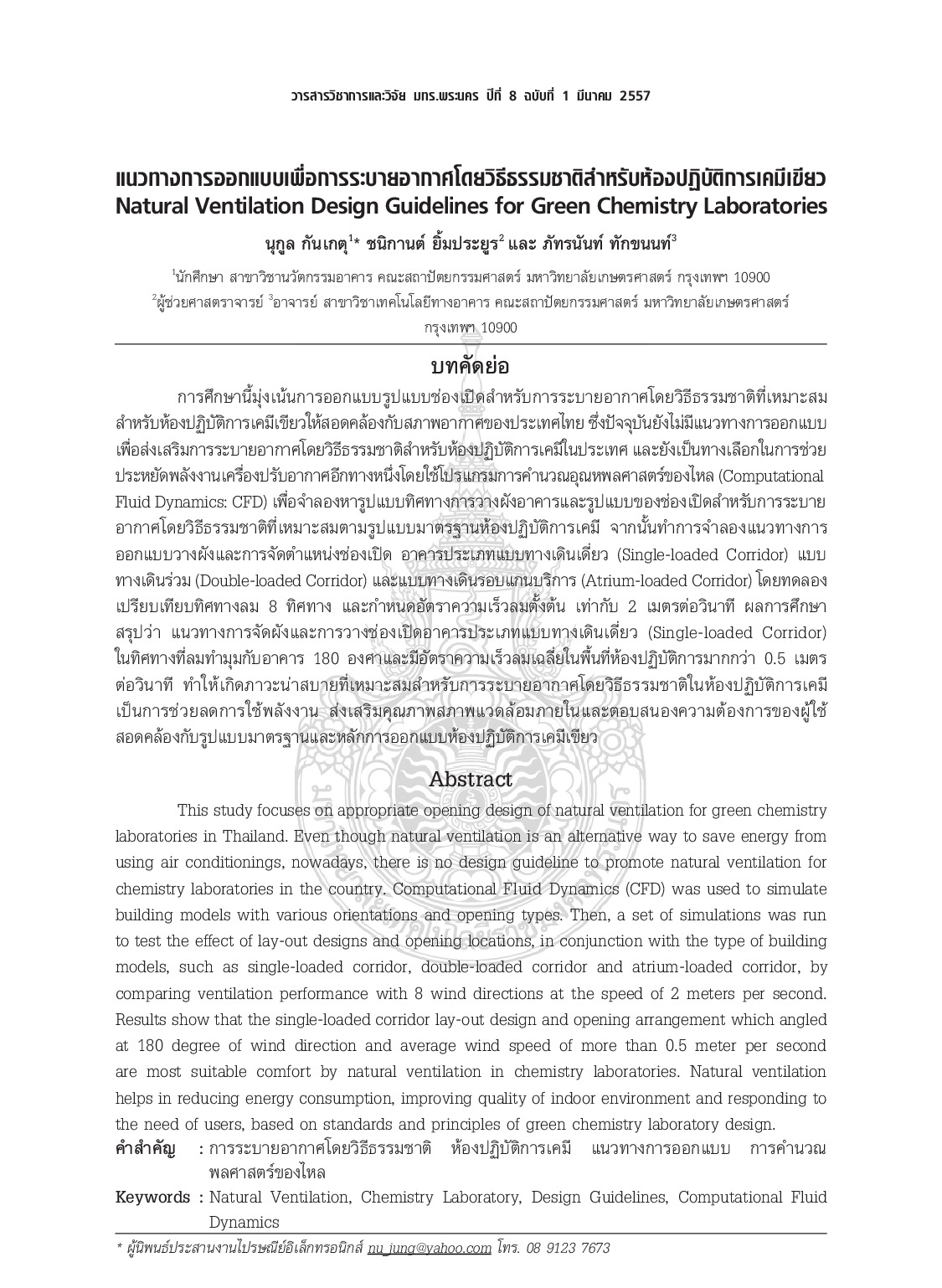
Natural ventilation design guidelines for green chemistry laboratories
This study focuses on appropriate opening design of natural ventilation for green chemistry laboratories in Thailand. Even though natural ventilation is an alternative way to save energy from using air conditionings nowadays there is no design guideline to promote natural ventilation for chemistry laboratories in the country. Computational fluid dynamics (CFD) was used to simulate building models with various orientations and opening types. Then a set of simulations was run to test the effect of lay-out designs and opening locations in conjunction with the type of building models such as single-loaded corridor double-loaded corridor and atrium-loaded corridor by comparing ventilation performance with 8 wind directions at the speed of 2 meters per second. Results show that the single-loaded corridor lay-out design and opening arrangement which angled at 180 degree of wind direction and average wind speed of more than 0.5 meter per second was the most suitable comfort for improved natural ventilation in chemistry laboratories. Natural ventilation helps in reducing energy consumption improving quality of indoor environment and responding to the need of users based on standards and principles of green chemistry laboratory design.