จำนวน Repository ( 9 )
การพัฒนาไอศกรีมนมเสริมอกไก่
Milk ice cream is the one of most popular dessert in many countries. But the most milk ice cream contains high amounts of sugar and fat. It is for this reason that consumers who exercise regularly concern about the impact of ice cream consumption on health and have led to a considerable rise in high protein ice cream demand for this consumer group. Therefore the objective of this study was to develop the milk ice cream with high protein from chicken breast by varying chicken breast in milk ice cream at 5 10 and 15% by total weight. The result showed that 10 % chicken breast ice cream had the best physical and sensory properties. The viscosity overrun texture and melting rate of the developed formula were 89.05 cps 108.05% 34584 g force and 23% respectively. The lightness (L*) redness (a*) and yellowness (b*) value were 87.10 5.08 and 20.54 respectively.
การผลิตไก่อบโอ่งโดยใช้ความร้อนจากรังสีอินฟราเรดไกล
The objectives of this research were to construct a jar oven for the production of roasted chicken using heat from far-infrared radiation and to find the amount of electricity and specific energy consumption used in the production of roasted chicken. The physical properties in terms of color softness cooking yield and water holding capacity of roasted chicken were also investigated. By using far-infrared radiation at electrical power levels of 1000 1200 and 1400 watts to roast marinated chicken which had an initial mass of about 1650 grams until the mass of the roasted chicken had a lower than 1220 grams. From the experimental results it was found that the production of roasted chicken at far- infrared radiation with a high electrical power level requires significantly less electricity and specific energy consumption than that with low electrical power level (P≤0.05). Roasted chicken breasts with far-infrared radiation at 1400 watts had significantly higher lightness (L value) but lower redness (a value) and yellowness (b value) than those of 1000 watts (P≤0.05). However lightness (L value) yellowness (b value) and redness (a value) of the roasted chicken breast with far-infrared radiation at 1200 watts were not significantly different from those at 1000 and 1400 watts (P>0.05). The shear force and water holding capacity of roasted chicken were significantly increased when the electrical power levels of far-infrared radiation increased (P≤0.05). Moreover the electrical power levels of far-infrared radiation (1000 1200 and 1400 watts) did not significantly affect the cooking yield of roasted chicken (P>0.05).Sponso
การพัฒนาไอศกรีมนมเสริมอกไก่สำหรับผู้ออกกำลังกาย
Abstract Milk ice cream is the one of most popular dessert in many countries. But the most milk ice cream contain high amounts of sugar and fat. It is for this reason that consumers who exercise regularly concern about the impact of ice cream consumption on health and have led to a considerable rise in high protein and low sugar ice cream demand for this consumer group. Therefore the objective of this study was to develop the reduced energy milk ice cream by using chicken breast and inulin. Milk ice cream was supplemented with chicken breast at 5 10 and 15% by total weight. The result showed that 10% chicken breast ice cream was highest score of sensory evaluation. Sugar was substituted with inulin at 25 50 and 75% by weight. The result showed that the replacement of sugar with 50% inulin was suitable for ice cream. The chicken breast ice cream with inulin formula were determined the physical properties. The result showed that viscosity overrun texture and melting rate of the developed formula were 147 cps 41% 11780 g force and 6% respectively. The lightness (L*) redness (a*) and yellowness (b*) value were 88.68 4.60 and 19.11 respectively. The proximate compositions moisture and protein content of the chicken breast ice cream with inulin formula were 68.03 and 11.79% higher than basic formula whereas fat and ash content of the chicken breast ice cream with inulin formula were 6.02 and 0.45% lower than basic formula. Microbiological quality of the chicken breast ice cream with inulin formula were in the acceptable limit according to Notification of the Ministry of Public Health. In addition the total energy of the chicken breast ice cream with inulin formula was lower than basic formula. The cost of the chicken breast ice cream with inulin formula was higher than basic formula at 16.23%.
การศึกษาการผลิตก๊าซชีวภาพโดยการหมักร่วมระหว่างมูลไก่กับสาหร่ายหางกระรอก
This work presented the production of biogas using anaerobic co-digestion between hydrilla verticillata (HV) from Songkhla Lake Basin and chicken manure (CM). From the study of compositions of both wastes it was found that the COD of CM and HV were 11200 and 14400 mg/l and pH were 6.5 and 5.5 respectively. The biogas production using anaerobic single-digestion of untreated hydrilla verticillata (UHV) gave accumulative methane of 1251 ml-CH4/g-VS and methane production of 78.28 L-CH4/kg-substrate was obtained. For hydrilla treated with 2% w/v NaOH (THV) the accumulative methane was 1786 ml-CH4/g-VS and the obtained methane production was 91.87 L- CH4/kg-substrate which was 17.5 % increase when compared to the UHV. For the biogas production using anaerobic single-digestion of CM it was found that the accumulative methane and methane production were 978 ml-CH4/g-VS and 78.28 L- CH4/kgsubstrate respectively. These were lower than the studies using HV. The study of anaerobic co-digestion of HV and CM at three different ratios; 1:1 2:1 and 3:1 was studied. It was found that the anaerobic co-digestion using THV and CM at ratio 3:1 and 2:1 gave the highest potential for biogas production. The accumulate methane of 3202.20 and 2079.19 ml- CH4/g-VS were obtained respectively. The methane productions were 2.53 and 82.26 L-CH4/ton-substrate for ratio 3:1 and 2:1 respectively which is no significant different at 95 % confidence interval.
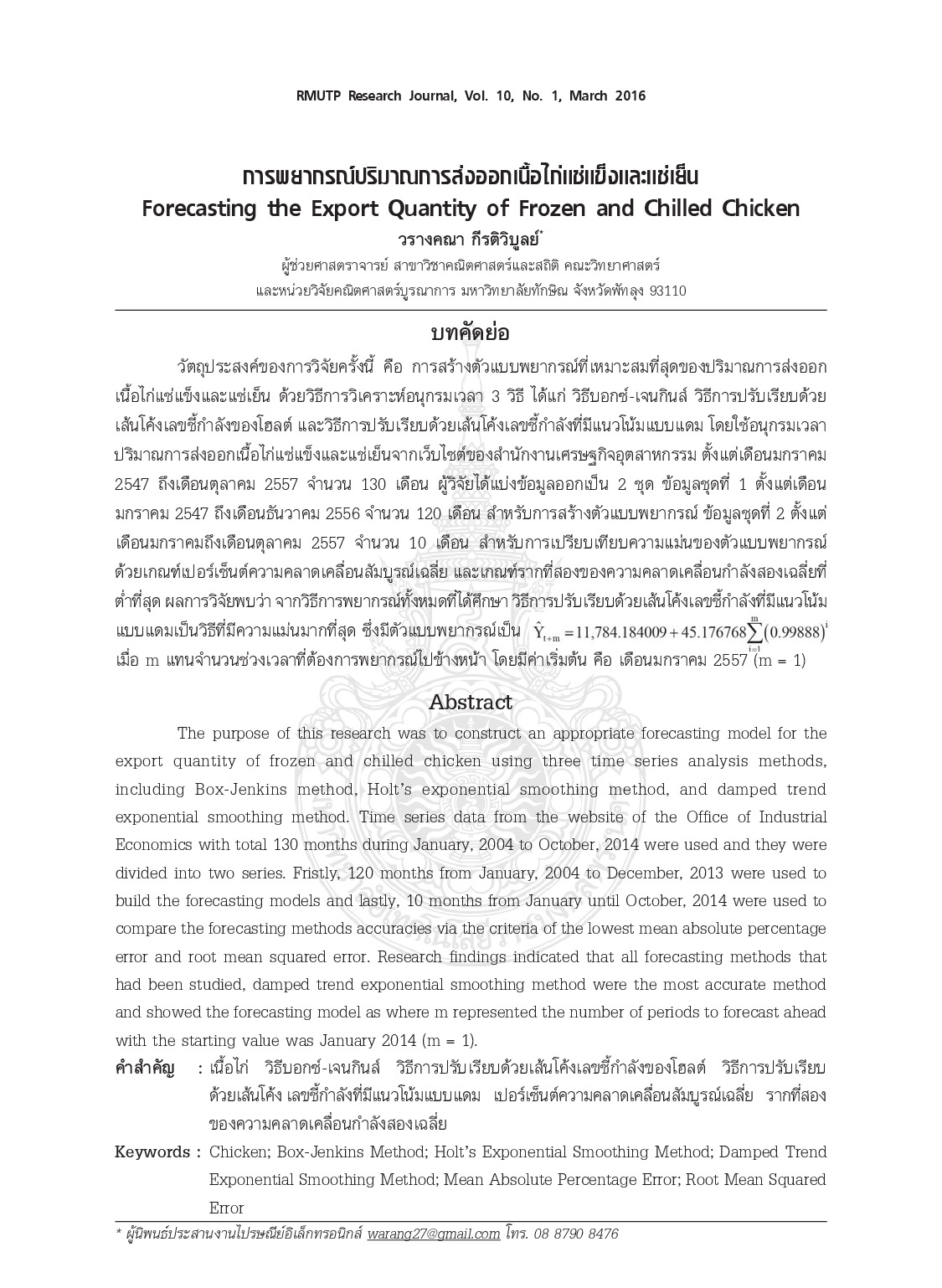
การพยากรณ์ปริมาณการส่งออกเนื้อไก่แช่แข็งและแช่เย็น
The purpose of this research was to construct an appropriate forecasting model for the export quantity of frozen and chilled chicken using three time series analysis methods including Box-Jenkins method Holt’s exponential smoothing method and damped trend exponential smoothing method. Time series data from the website of the Office of Industrial Economics with total 130 months during January 2004 to October 2014 were used and they were divided into two series. Fristly 120 months from January 2004 to December 2013 were used to build the forecasting models and lastly 10 months from January until October 2014 were used to compare the forecasting methods accuracies via the criteria of the lowest mean absolute percentage error and root mean squared error. Research findings indicated that all forecasting methods that had been studied damped trend exponential smoothing method were the most accurate method and showed the forecasting model as where m represented the number of periods to forecast ahead with the starting value was January 2014 (m = 1).