จำนวน Repository ( 4 )
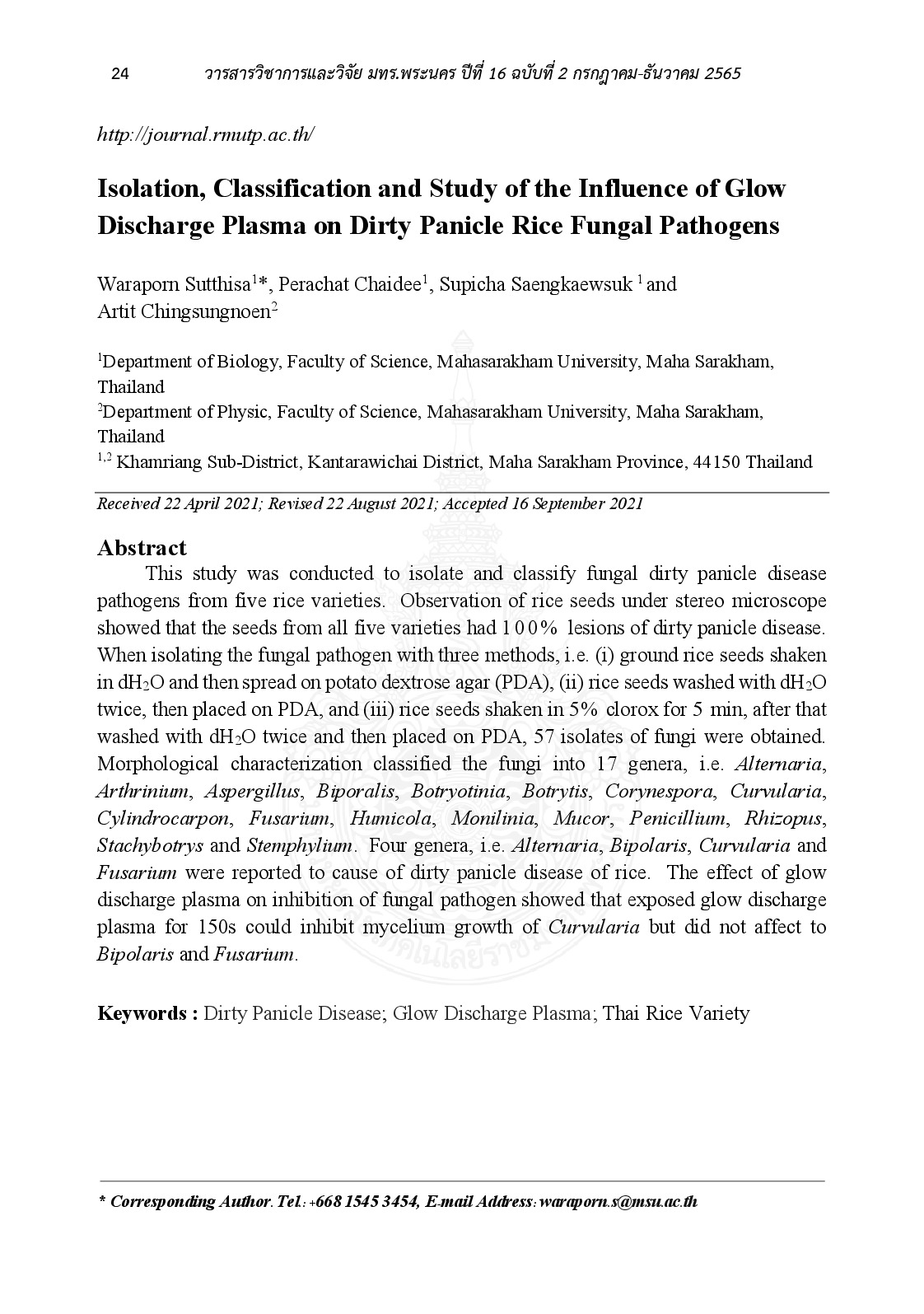
Isolation, classification and study of the influence of glow discharge plasma on dirty panicle rice fungal pathogens
This study was conducted to isolate and classify fungal dirty panicle disease pathogens from five rice varieties. Observation of rice seeds under stereo microscope showed that the seeds from all five varieties had 100% lesions of dirty panicle disease. When isolating the fungal pathogen with three methods i.e. (i) ground rice seeds shaken in dH2O and then spread on potato dextrose agar (PDA) (ii) rice seeds washed with dH2O twice then placed on PDA and (iii) rice seeds shaken in 5% clorox for 5 min after that washed with dH2O twice and then placed on PDA 57 isolates of fungi were obtained. Morphological characterization classified the fungi into 17 genera i.e. Alternaria Arthrinium Aspergillus Biporalis Botryotinia Botrytis Corynespora Curvularia Cylindrocarpon Fusarium Humicola Monilinia Mucor Penicillium Rhizopus Stachybotrys and Stemphylium. Four genera i.e. Alternaria Bipolaris Curvularia and Fusarium were reported to cause of dirty panicle disease of rice. The effect of glow discharge plasma on inhibition of fungal pathogen showed that exposed glow discharge plasma for 150s could inhibit mycelium growth of Curvularia but did not affect to Bipolaris and Fusarium.
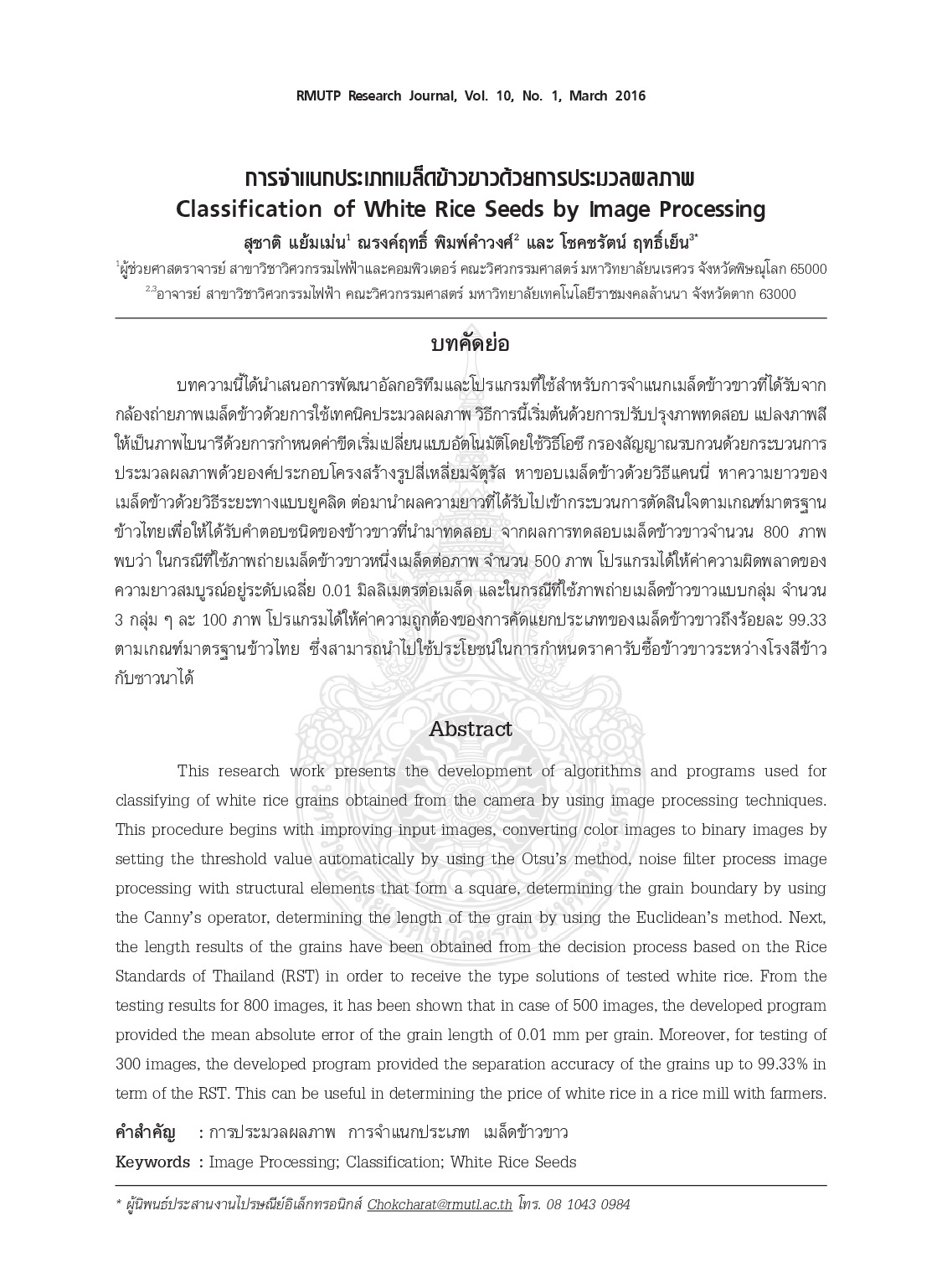
การจำแนกประเภทเมล็ดข้าวขาวด้วยการประมวลผลภาพ
This research work presents the development of algorithms and programs used for classifying of white rice grains obtained from the camera by using image processing techniques. This procedure begins with improving input images converting color images to binary images by setting the threshold value automatically by using the Otsu’s method noise filter process image processing with structural elements that form a square determining the grain boundary by using the Canny’s operator determining the length of the grain by using the Euclidean’s method. Next the length results of the grains have been obtained from the decision process based on the Rice Standards of Thailand (RST) in order to receive the type solutions of tested white rice. From the testing results for 800 images it has been shown that in case of 500 images the developed program provided the mean absolute error of the grain length of 0.01 mm per grain. Moreover for testing of 300 images the developed program provided the separation accuracy of the grains up to 99.33% in term of the RST. This can be useful in determining the price of white rice in a rice mill with farmers.

The optimal image processing for paddy studies : Variety classification and rice kernel damage inspection
This research report is manipulated that summarized the moment of research project in the subject of “The optimal image processing for paddy studies: Variety classification and rice kernel damage inspection”. This project had been take time in 12 mounts. We focused on rice variety classification and rice kernel damage inspection. We also investigated the apparent friction of rice surface. Results showed that area and size were the quantities that have the potential to classify rice variety and also rice kernel damage inspection. In addition we also found that geometric mean diameter performed characteristic to apparent friction of rice surface in kerosene. These results have the potential to be the basis information in terms of developing instrument for quality control and variety classification of cereal.
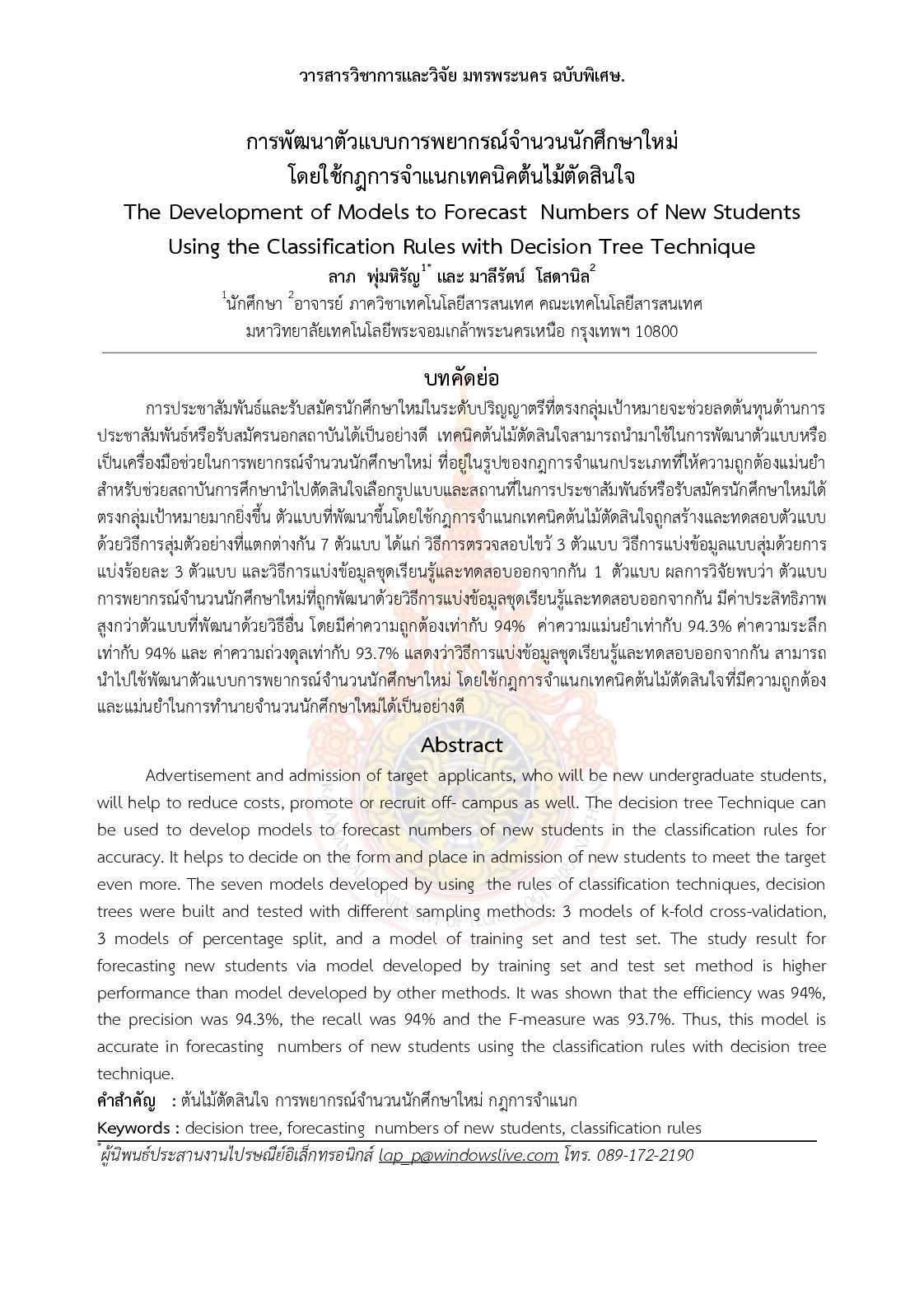
The Development of Models to Forecast Numbers of New StudentsUsing the Classification Rules with Decision Tree Technique
Advertisement and admission of target applicants who will be new undergraduate studentswill help to reduce costs promote or recruit off- campus as well. The decision tree Technique can be used to develop models to forecast numbers of new students in the classification rules for accuracy. It helps to decide on the form and place in admission of new students to meet the target even more. The seven models developed by using the rules of classification techniques decision trees were built and tested with different sampling methods: 3 models of k-fold cross-validation 3 models of percentage split and a model of training set and test set. The study result for forecasting new students via model developed by training set and test set method is higher performance than model developed by other methods. It was shown that the efficiency was 94% the precision was 94.3% the recall was 94% and the F-measure was 93.7%. Thus this model is accurate in forecasting numbers of new students using the classification rules with decision tree technique.