จำนวน Repository ( 60 )

การพัฒนาบทเรียนคอมพิวเตอร์ช่วยสอนแบบโต้ตอบด้วยดวงตา เรื่อง ความรู้เกี่ยวกับอาเซียนในระดับประถมศึกษา สำหรับเด็กนักเรียนที่มีความบกพร่องทางการควบคุมด้วยมือ
Over the past decade eye-tracking technology can help people all over the world access computers through systems that use gaze control. For people with disabilities this technology is a gateway to communication personal expression and inclusion in society. Eye-tracking technology advance has been transferred to the educational area and now the use of interacting with the multimedia materials and resources in the classroom. The objectives of this research are threefold. The first study presented the development of a low-cost eye-tracking device based on video-oculography. The second study examined various factors in which eye movements can be systematically measured to design appropriate of usability in computer-assisted instruction (CAI). The third study created and determine the efficiency of computer-assisted instruction interactive with eyes lesson on knowledge of ASEAN in elementary education for a student with disabled hand control. This research has looked at three design parameters of the dwell-time click alternative interactive button size and placement of the button which suitable for eye tracking interfaces. The evaluation carried out an experiment to compare performance with five students with a disability. Results showed that a combination of big buttons and short dwell-times are most suited for maximizing accuracy and ease of use. Furthermore the efficiency of computer-assisted instruction is 70.0/71.5 and the user’s satisfaction with CAI were at the high level ( =4.27 S.D. 0.79). Consequently eye tracking technology is a great tool to interaction in computer-assisted instruction for Thai students with a disability. x

The development of knowledge on playing thai chess through the computer assisted instruction (cai) : case study group of young thai people
The research is conducted how to learning and to play chess by making program Computer Assisted Instruction (CAI) to delivery of learning materials and documentation to 1000 schools in area responsible of the Office of The Basic of Education to stimulating activities and learning Thai chess. Exploring the need of young chess players the researcher gathering information by using questionnaire. The quantitative research based on a population sample. The third of the popularity are young people aged between 7-12 years youth aged 12-18 years and young people aged more than 18 to 22 years. The results showed that schools in the north to meet the highest rate of 87.18 percent compared to young chess players do in Thailand mostly young men. The 71.75 percent of the youth in learning to play Thai chess through the ages between 7-12 years old 36.00 percent were in elementary school. The 39.25 percent of the most experienced and know to play is 58.00 percent. The recommendation and comment on the online chess the average levels of good. The people who had experience after playing online chess score average level of very good. Which indicates that playing thaichess through learning this research has been used to do chess players and much wider. Improve playing skills. Be the number of ideas and Thailand culture in the young group of players.
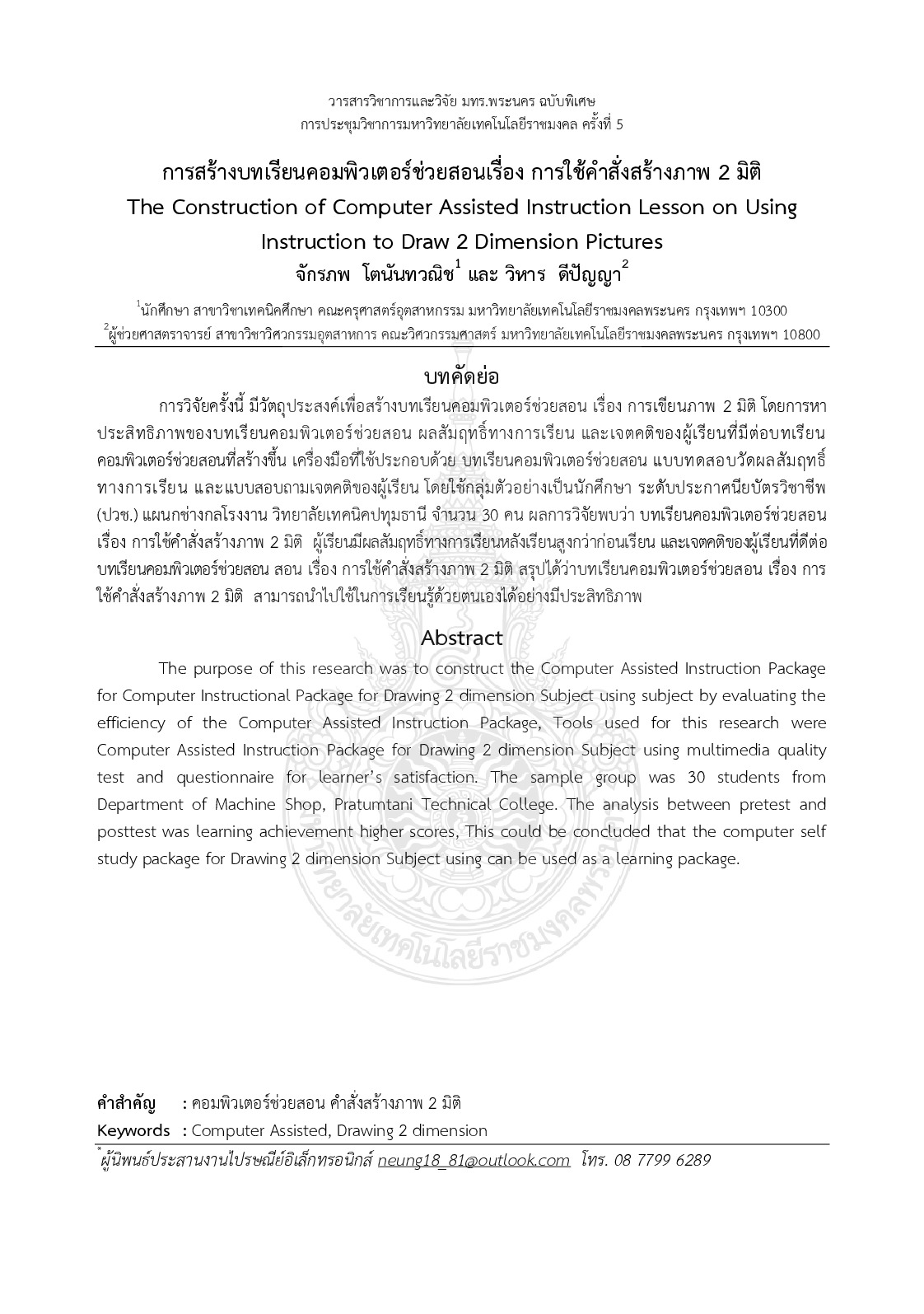
The construction of computer assisted instruction lesson on using instruction to draw 2 dimension pictures
The purpose of this research was to construct the Computer Assisted Instruction Package for Computer Instructional Package for Drawing 2 dimension Subject using subject by evaluating the efficiency of the Computer Assisted Instruction Package Tools used for this research were Computer Assisted Instruction Package for Drawing 2 dimension Subject using multimedia quality test and questionnaire for learner’s satisfaction. The sample group was 30 students from Department of Machine Shop Pratumtani Technical College. The analysis between pretest and posttest was learning achievement higher scores This could be concluded that the computer self study package for Drawing 2 dimension Subject using can be used as a learning package.
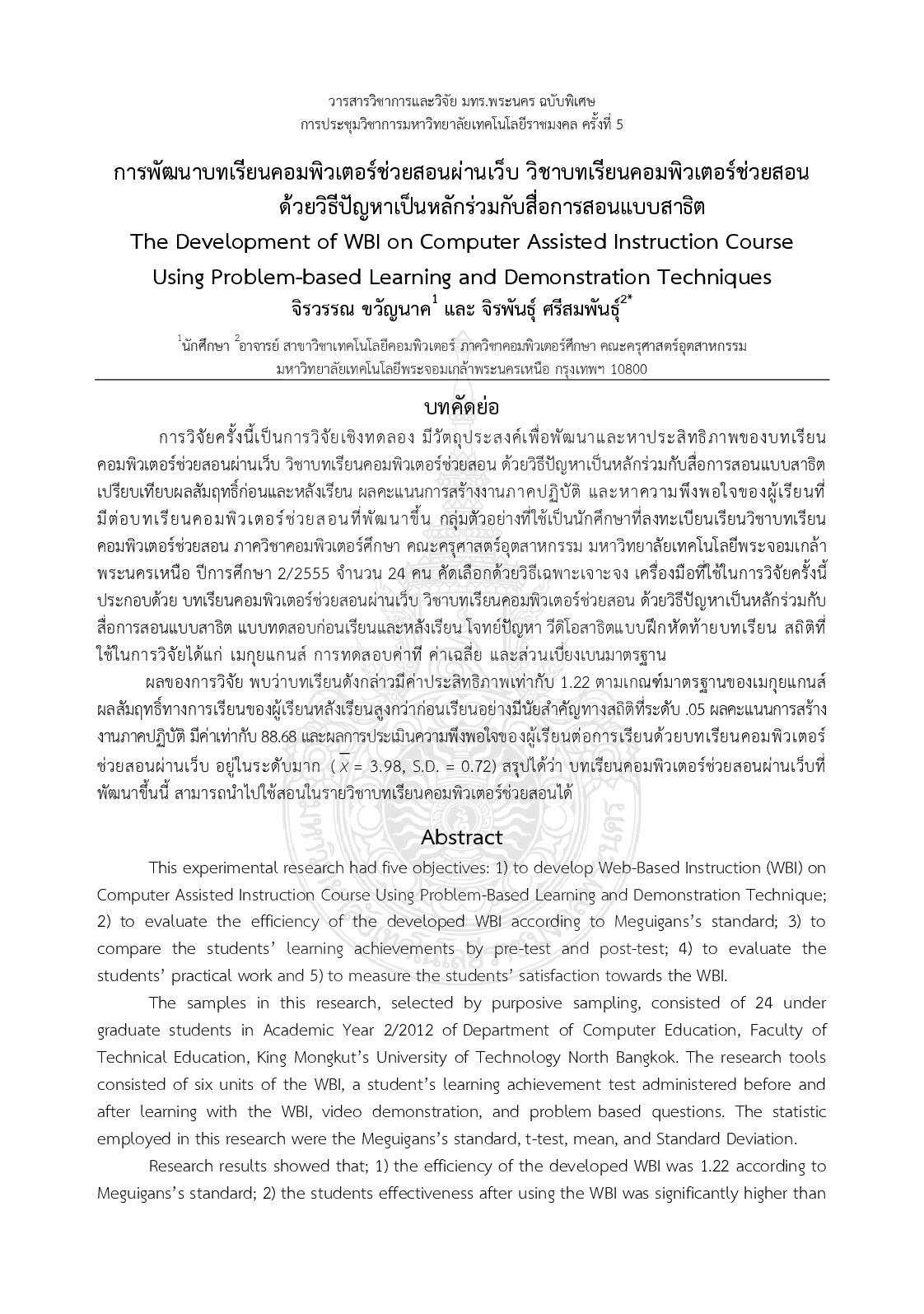
The development of wbi on computer assisted instruction course using problem-based learning and demonstration techniques
This experimental research had five objectives: 1) to develop Web-Based Instruction (WBI) on Computer Assisted Instruction Course Using Problem-Based Learning and Demonstration Technique; 2) to evaluate the efficiency of the developed WBI according to Meguigans’s standard; 3) to compare the students’ learning achievements by pre-test and post-test; 4) to evaluate the students’ practical work and 5) to measure the students’ satisfaction towards the WBI. The samples in this research selected by purposive sampling consisted of 24 under graduate students in Academic Year 2/2012 of Department of Computer Education Faculty of Technical Education King Mongkut’s University of Technology North Bangkok. The research tools consisted of six units of the WBI a student’s learning achievement test administered before and after learning with the WBI video demonstration and problem based questions. The statistic employed in this research were the Meguigans’s standard t-test mean and Standard Deviation. Research results showed that; 1) the efficiency of the developed WBI was 1.22 according to Meguigans’s standard; 2) the students effectiveness after using the WBI was significantly higher than before using it at .05; 3) the average score of the practical work was 88.68 higher than 80; 4) the students’ satisfactory was at a good level. In conclusion the developed WBI can be used for the target group properly.
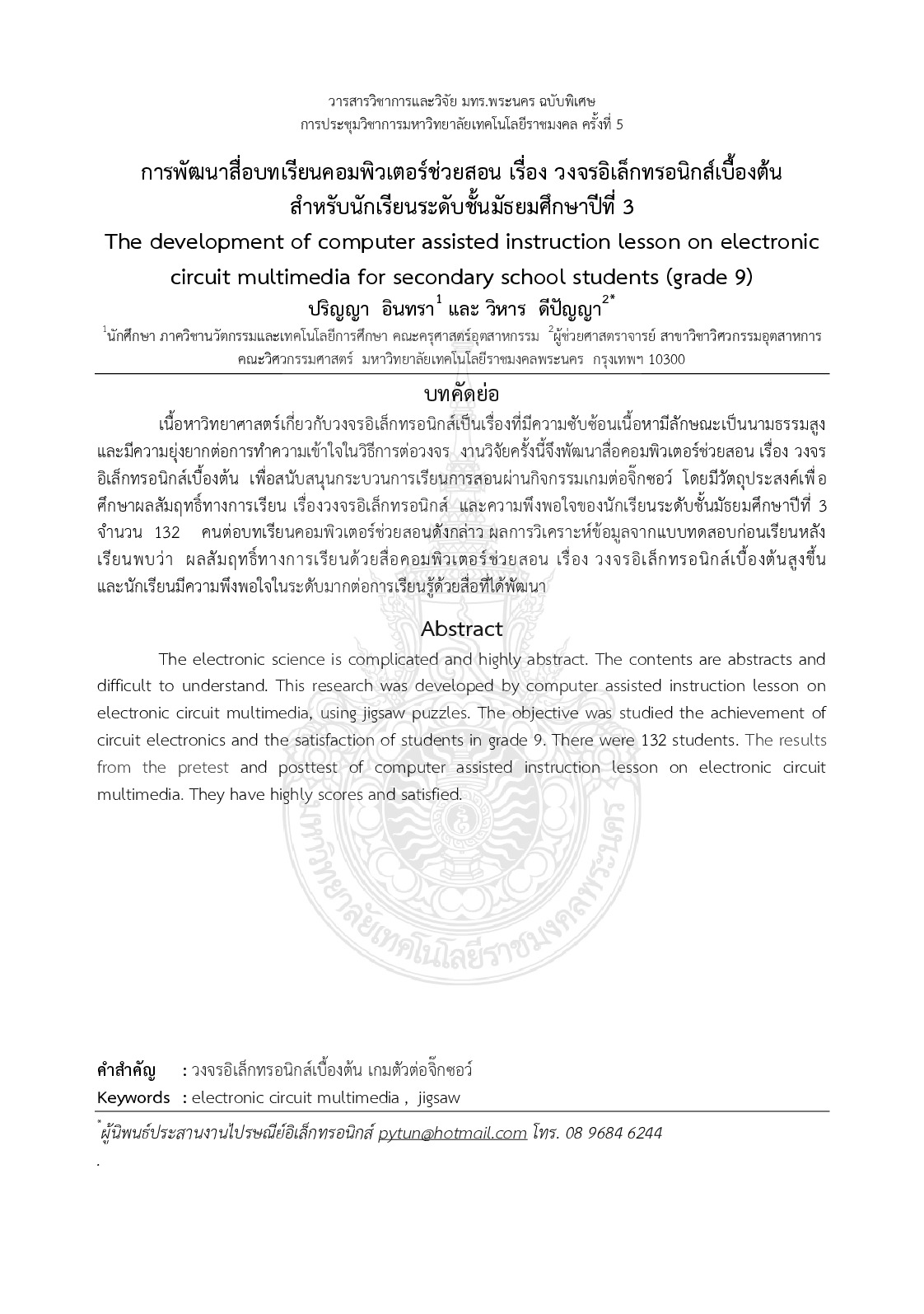
The development of computer assisted instruction lesson on electronic circuit multimedia for secondary school students (grade 9)
The electronic science is complicated and highly abstract. The contents are abstracts and difficult to understand. This research was developed by computer assisted instruction lesson on electronic circuit multimedia using jigsaw puzzles. The objective was studied the achievement of circuit electronics and the satisfaction of students in grade 9. There were 132 students. The results from the pretest and posttest of computer assisted instruction lesson on electronic circuit multimedia. They have highly scores and satisfied.