จำนวน Repository ( 2 )
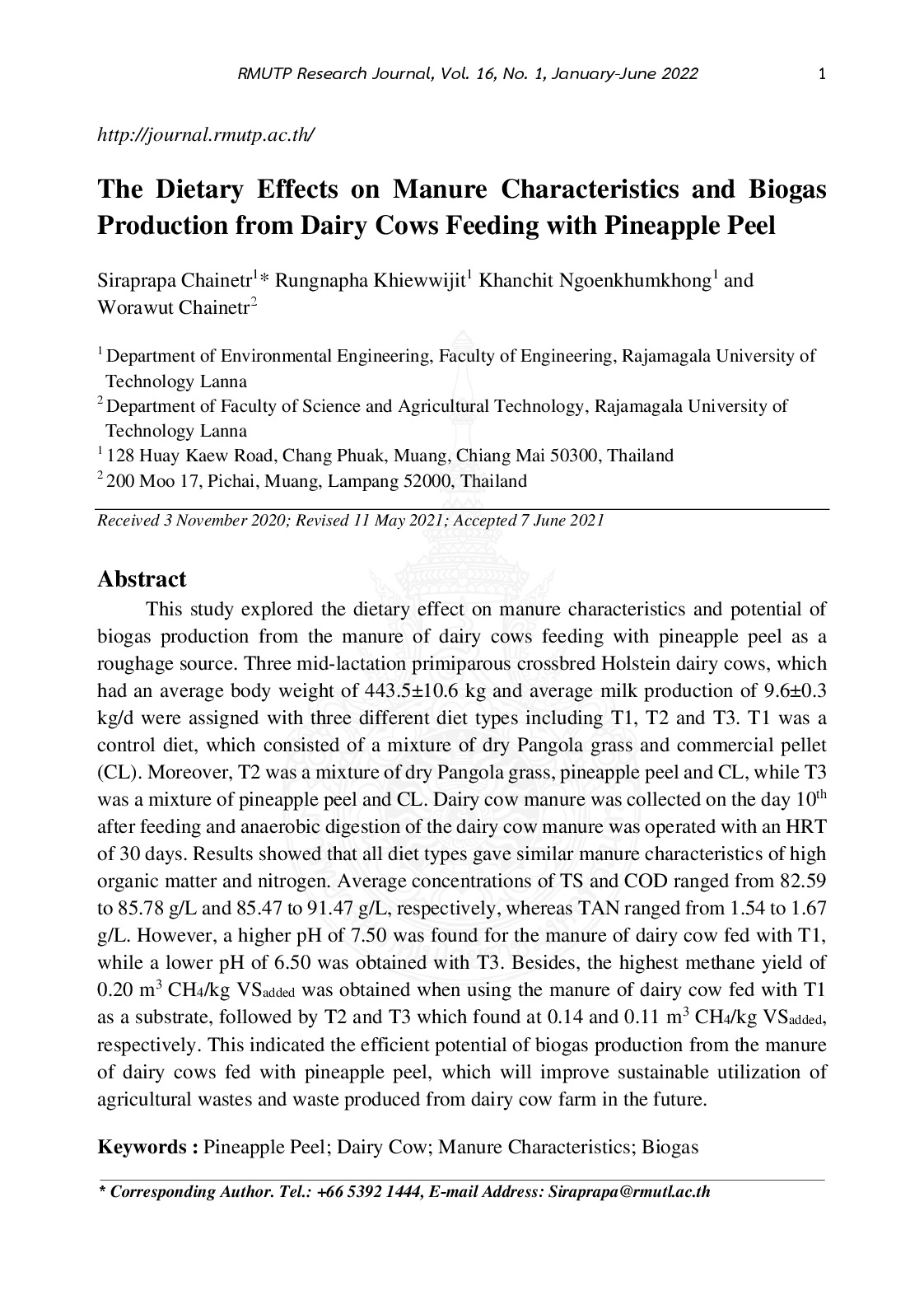
The Dietary effects on manure characteristics and biogas production from dairy cows feeding with pineapple peel
This study explored the dietary effect on manure characteristics and potential of biogas production from the manure of dairy cows feeding with pineapple peel as a roughage source. Three mid-lactation primiparous crossbred Holstein dairy cows which had an average body weight of 443.5±10.6 kg and average milk production of 9.6±0.3 kg/d were assigned with three different diet types including T1 T2 and T3. T1 was a control diet which consisted of a mixture of dry Pangola grass and commercial pellet (CL). Moreover T2 was a mixture of dry Pangola grass pineapple peel and CL while T3 was a mixture of pineapple peel and CL. Dairy cow manure was collected on the day 10th after feeding and anaerobic digestion of the dairy cow manure was operated with an HRT of 30 days. Results showed that all diet types gave similar manure characteristics of high organic matter and nitrogen. Average concentrations of TS and COD ranged from 82.59 to 85.78 g/L and 85.47 to 91.47 g/L respectively whereas TAN ranged from 1.54 to 1.67 g/L. However a higher pH of 7.50 was found for the manure of dairy cow fed with T1 while a lower pH of 6.50 was obtained with T3. Besides the highest methane yield of 0.20 m3 CH4/kg VSadded was obtained when using the manure of dairy cow fed with T1 as a substrate followed by T2 and T3 which found at 0.14 and 0.11 m3 CH4/kg VSadded respectively. This indicated the efficient potential of biogas production from the manure of dairy cows fed with pineapple peel which will improve sustainable utilization of agricultural wastes and waste produced from dairy cow farm in the future.
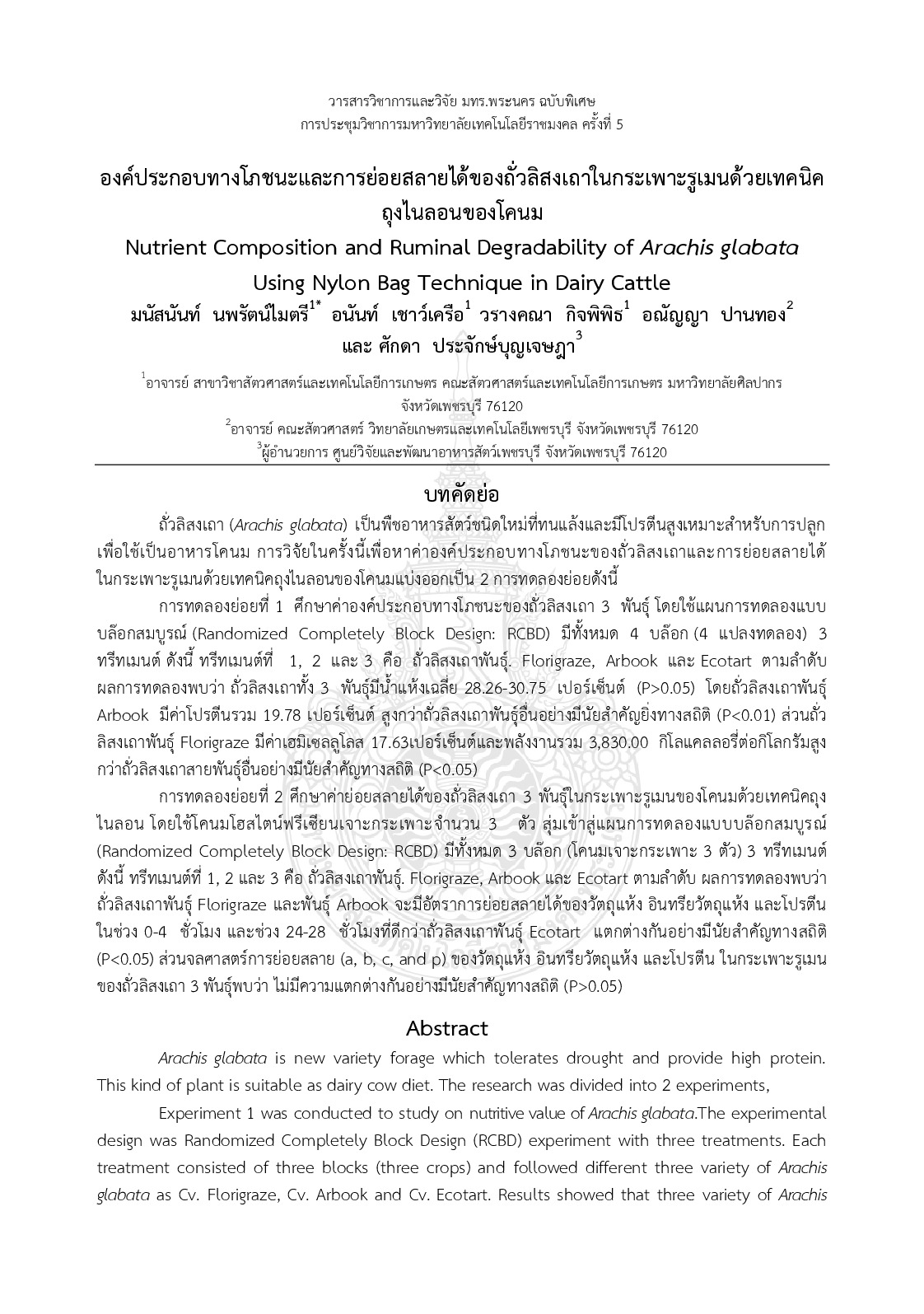
Nutrient composition and ruminal degradability of arachis glabata using nylon bag technique in dairy cattle
Arachis glabata is new variety forage which tolerates drought and provide high protein.This kind of plant is suitable as dairy cow diet. The research was divided into 2 experiments Experiment 1 was conducted to study on nutritive value of Arachis glabata.The experimental design was Randomized Completely Block Design (RCBD) experiment with three treatments. Each treatment consisted of three blocks (three crops) and followed different three variety of Arachis glabata as Cv. Florigraze Cv. Arbook and Cv. Ecotart. Results showed that three variety of Arachis glabata were 28.26-30.75 % of dry matter (P>0.05). In addition Arachis glabata Cv. Arbook was grater 19.78 % of protein than other group of Arachis glabata (P<0.01). Furthermore Arachis glabata Cv. Florigraze was grater 17.63 of hemicelluloses and 3830.00 kcal/kg of gross energy significant different among other group of Arachis glabata (P<0.05). Experiment 2 was conducted to study on ruminal degradability of Arachis glabata using In situ technique in dairy cattle. The experimental design was Randomized Completely Block Design (RCBD) experiment with three treatments. Each treatment consisted of three blocks (three ruminally fistulated dairy cattle) and followed different three variety of Arachis glabata as Cv. Florigraze Cv. Arbook and Cv. Ecotart. Results showed that Arachis glabata Cv. Florigraze and Arachis glabata Cv. Arbook was grater dry matter organic matter and protein degradability at 0-4 hour and 24-28 hour than Arachis glabata Cv Ecotart (P<0.05). In addition kinetic of degradation (a b c and p) of dry matter organic matter and protein were not significant different (P>0.05) among three variety of Arachis glabata.