จำนวน Repository ( 9 )
สมบัติการบวมตัวของพอลิเอทิลีนความหนาแน่นสูงหลอมเหลวในหัวขึ้นรูปแบบวงแหวน
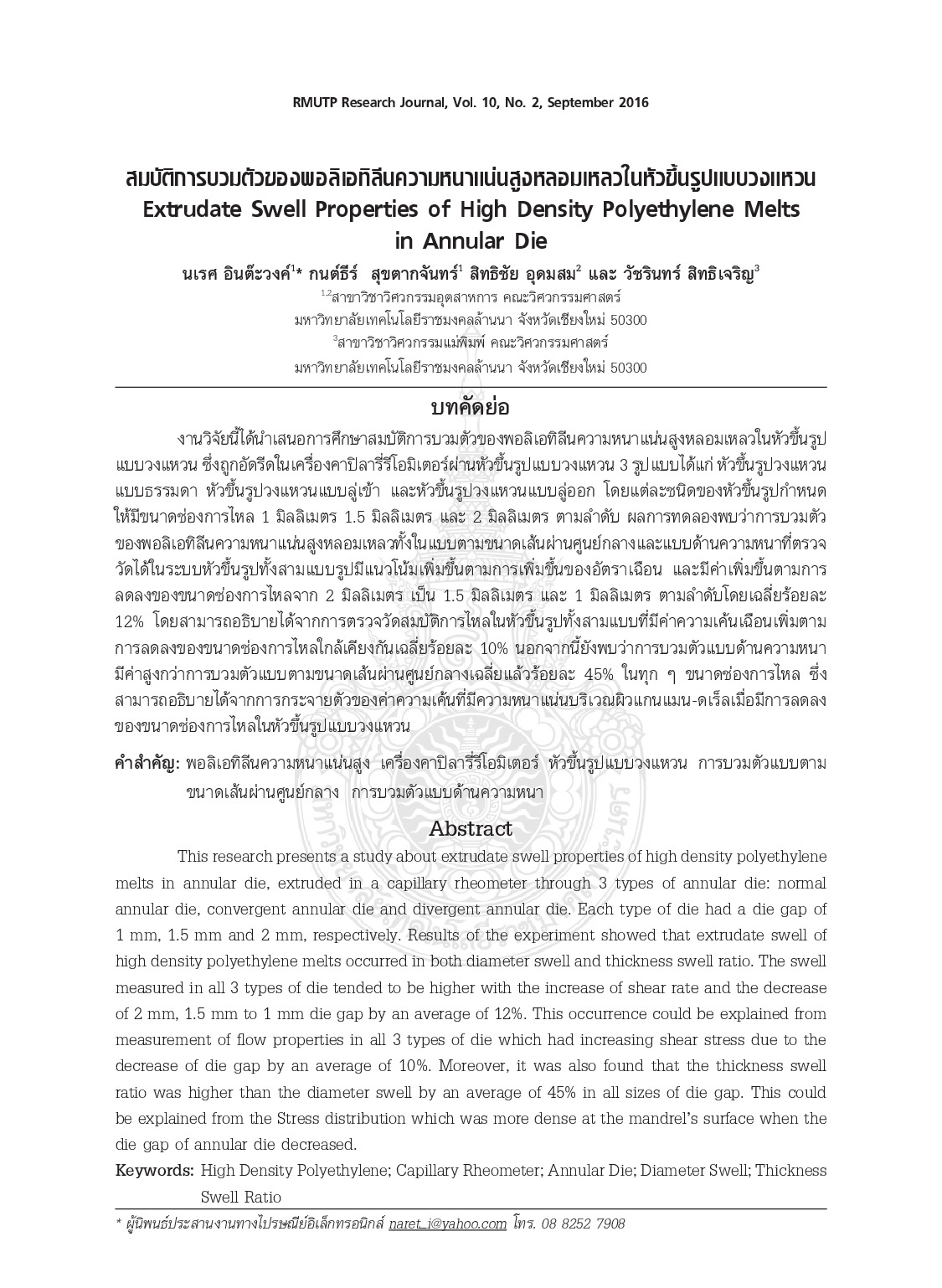
This research presents a study about extrudate swell properties of high density polyethylene melts in annular die extruded in a capillary rheometer through 3 types of annular die: normal annular die convergent annular die and divergent annular die. Each type of die had a die gap of 1mm 1.5 mm and 2 mm respectively. Results of the experiment showed that extrudate swell of high density polyethylene melts occurred in both diameter swell and thickness swell ratio. The swell measured in all 3 types of die tended to be higher with the increase of shear rate and the decrease of 2 mm 1.5 mm to 1 mm die gap by an average of 12%. This occurrence could be explained from measurement of flow properties in all 3 types of die which had increasing shear stress due to the decrease of die gap by an average of 10%. Moreover it was also found that the thickness swell ratio was higher than the diameter swell by an average of 45% in all sizes of die gap. This could be explained from the Stress distribution which was more dense at the mandrels surface when the die gap of annular die decreased.
การพัฒนาผลิตภัณฑ์ผนังคอนกรีตมวลเบาด้วยการเสริมแผ่นโฟมอัดแน่น เพื่อเป็นฉนวนความร้อน
The objectives of this research are to study the production to find the proper ratio to test the physical mechanical properties and thermal conductivity to suggest the implementation and to transfer the technology of light-weight precast concrete wall panel product with adding high density foam sheet. The light-weight precast concrete wall panel product was produced by covering the foam sheet with steel pouring the mortar (M3 ratio which was proper ratio) and curing the light-weight precast concrete wall panel product. From the testing results followed the TIS.2226-2548 and TIS.878- 2537 the general characteristic of light-weight precast concrete wall panel product was perfect. The properties of light-weight precast concrete wall panel product include 17.81 MPa of compressive strength no bending when installed in common behavior 11.38% of water absorption passed in type1 of hardness and impact test 956.03 kg/m3 of density 9.18 MPa of bending strength and 0.170 watt/m.K of thermal insulation. This light-weight precast concrete wall panel product can use as the thermal insulation wall in building. Moreover the developing product can apply to register the petty patent.
การพัฒนาผลิตภัณฑ์ผนังคอนกรีตมวลเบาด้วยการเสริมแผ่นโฟมอัดแน่นเพื่อเป็นฉนวนความร้อน
This research has objectives to study the production to find the proper size of steel wire mesh to test the properties and to study the implementation of high strength and thermal insulation cement-bonded fiberboard from coconut meal corncob fibers and steel wire mesh. The mixture ratio of cement-bonded fiberboard included Portland cement type1: sand: coconut meal fiber: corncob fiber: water: calcium chloride equal to 1: 0.2: 0.0125: 0.0375: 0.3: 0.03 by weight and 5 different sizes of steel wire mesh were reinforced. Casted by compression and sharking machine. Tested the properties follow the TIS.878-2537. From the results 1 mm of diameter and 1” of gab of steel wire mesh (? 1 mm # 1”) was the proper size to reinforce the cement-bonded fiberboard to get highest bending strength. Moreover this cement-bonded fiberboard can pass the required standard. The high strength and thermal insulation cement-bonded fiberboard from coconut meal corncob fibers and steel wire mesh has the possibility to construction as exterior building wall.
The application of coconut meal, corncob and durian peel as wood-substituted biocomposites in medium density fiberboard
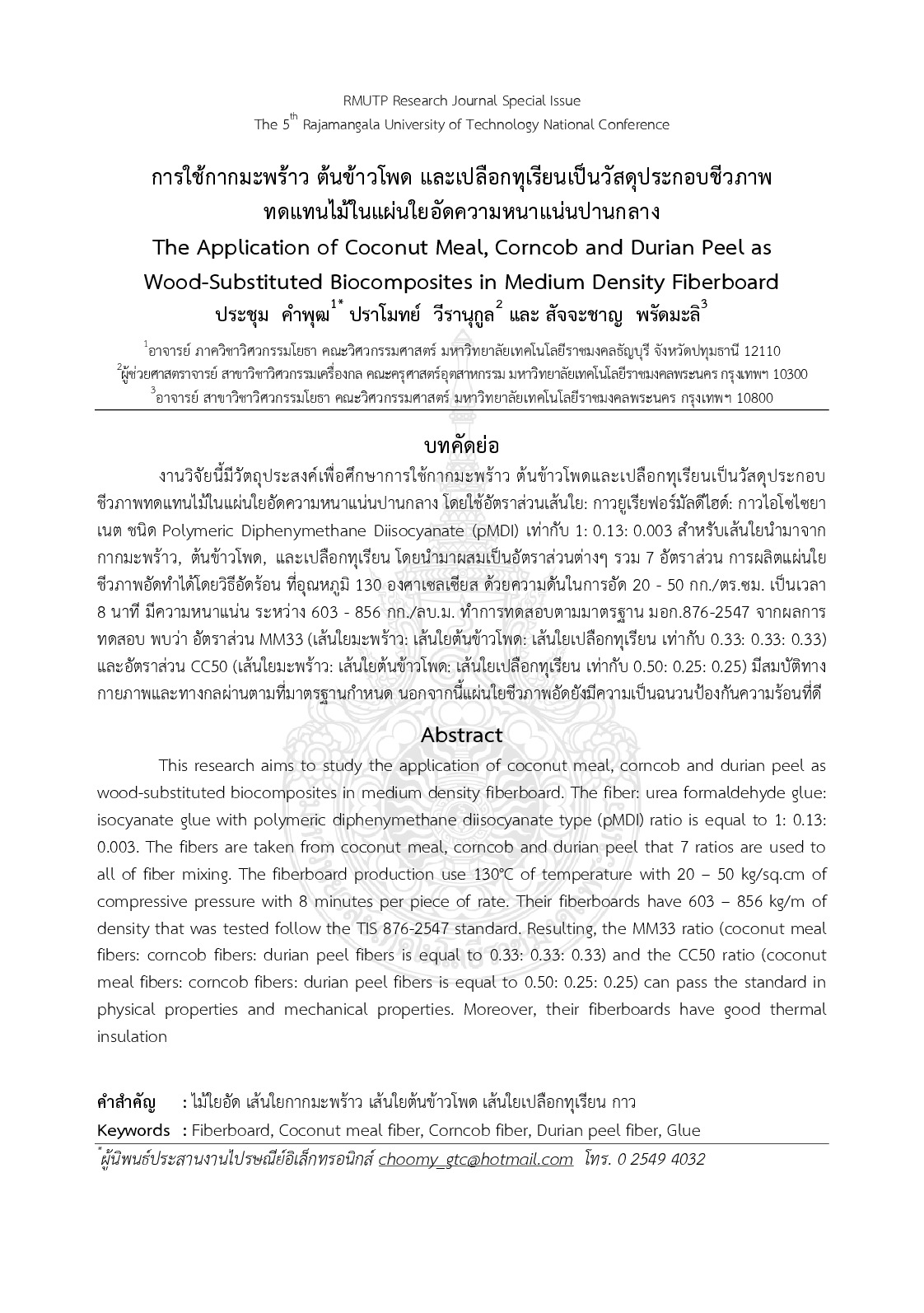
This research aims to study the application of coconut meal corncob and durian peel as wood-substituted biocomposites in medium density fiberboard. The fiber: urea formaldehyde glue: isocyanate glue with polymeric diphenymethane diisocyanate type (pMDI) ratio is equal to 1: 0.13: 0.003. The fibers are taken from coconut meal corncob and durian peel that 7 ratios are used to all of fiber mixing. The fiberboard production use 130?C of temperature with 20 – 50 kg/sq.cm of compressive pressure with 8 minutes per piece of rate. Their fiberboards have 603 – 856 kg/m of density that was tested follow the TIS 876-2547 standard. Resulting the MM33 ratio (coconut meal fibers: corncob fibers: durian peel fibers is equal to 0.33: 0.33: 0.33) and the CC50 ratio (coconut meal fibers: corncob fibers: durian peel fibers is equal to 0.50: 0.25: 0.25) can pass the standard in physical properties and mechanical properties. Moreover their fiberboards have good thermal insulation

การใช้กากมะพร้าว ตันข้าวโพดและเปลือกทุเรียนเป็นวัสดุประกอบชีวภาพทดแทนไม้ในแผ่นใยอัดความหนาแน่นปานกลาง
This research aims to study the application of coconut meal corn cob and durian peel as wood-substituted biocomposites in medium density fiberboard. The fiber: urea formaldehyde glue: isocyanate glue with polymeric diphenymethane diisocyanate type (pMDI) ratio is equal to 1: 0.13: 0.003. The fibers are taken from coconut meal corn cob and durian peel that 7 ratios are used to all of fiber mixing. The fiberboard production use 130°C of temperature with 20 – 50 kg/sq.cm of compressive pressure with 8 minutes per piece of rate. Their fiberboards have 603 – 856 kg/m of density that was tested follow the TIS 876-2547 standard. Resulting the MM33 ratio (coconut meal fibers: corn cob fibers: durian peel fibers is equal to 0.33: 0.33: 0.33) and the CC50 ratio (coconut meal fibers: corn cob fibers: durian peel fibers is equal to 0.50: 0.25: 0.25) can pass the standard in physical properties and mechanical properties. Moreover their fiberboards have good thermal insulation.