จำนวน Repository ( 5 )

การพัฒนาผลิตภัณฑ์เส้นก๋วยเตี๋ยวผัดไทยกึ่งสำเร็จรูป เพื่อคุณภาพในเชิงพาณิชย์
This research aims to study the base formulation of Pad Thai noodle to study on type and quantity of modified starch in Instant Pad-Thai noodle. To study on the amount of Pad Thai sauce to supplement in Pad Thai noodle. To study on the quality of Instant Pad Thai noodle with Pad Thai source to design the optimal packaging for Instant Pad Thai noodle and to study of consumers acceptance of Instant Pad-Thai noodle with Pad Thai source. The results of this study showed that the optimal formula of Pad Thai noodle was 80 grams of rice starch 100 grams of tapioca and 300 grams of water. The color values of L * (brightness) a * (red) and b * (Yellow) was 64.13 ± 0.01 -0.92 ± 0.02 and 14.52 ± 0.02 respectively. This Pad-Thai noodle has a slightly yellowish white color with a moisture content of 5.31 ± 0.03 %. The optimum amount of modified starch used in the semi-finished fried Thai noodle formula by replacing the tapioca starch in the basic formula was modified starch 30 per 70 grams of tapioca starch. The modified formula of Pad Thai noodle has a slightly yellowish white color with L * (brightness) a * (red) and b * (yellow) equal to 62.82 ± 0.01 -1.10 ± 0.01 13.45 ± 0.01 respectively with a moisture content of 5.66 ± 0.11 %. The amount of Thai stir-fried sauce used in the semi-finished fried Thai noodle recipe by replacing the amount of water in the recipe was 80 grams of rice flour 70 grams of tapioca flour 30 grams of modified flour and 100 grams of Thai stir-fried sauce and 200 grams of water. The color of modified Pad-Thai noodle was L * (brightness) a * (red) and b * (yellow) equal to 43.67 ± 0.01 8.25 ± 0.02 and 22.42 ± 0.10 respectively with moisture content of 2.58 ± 1.36 %. The number of microorganisms was less than 10 CFU/g. The amount of yeast and mold was less than 10 CFU/g and E. coli content was less than 3 MPN /g. Semi-finished Thai stir-fried noodles with sauce were slightly brownish. The noodle was soft and sticky and had the smell of Pad Thai sauce. There was a taste of Thai stir-fried sauce added in the Pad Thai noodle was tear more difficult than the other commercial noodle.
การพัฒนาศักยภาพสับปะรดตกเกรด ในผลิตภัณฑ์ซอสสำเร็จรูป
The objective of this research is to study the suitable production process in the production of Pad Thai sauce Crispy rice noodle sauce (Mee krob) and three mixed flavors sauce (Sam-rod) by using pineapples juice as the main ingredient. To study the quality of this finished three sauce products from pineapples. And to study the consumer test of pineapple sauce products. The results of the development of a suitable recipe for Pad Thai sauce production. From the evaluation of the sensory quality of Pad Thai sauce (9 points Hedonic scale). It was found that panelist accepted the appropriate amount of pineapple juice in the production of Pad Thai sauce at 30 % in all attributes in terms of appearance color smell taste texture and overall liking with an average score of 8.08 7.83 7.93 8.15 8.05 and 8.13 respectively which was at a high level of preference. Sensory evaluation of crispy rice noodle it was found that 75% of pineapples accepted for the source production in terms of appearance color smell taste texture and overall liking. With an average score of 7.89 7.79 7.88 8.03 7.98 and 7.93 respectively which are in the high level. Sensory evaluation of three mixed flavor sauce. It was found that panelist accepted 100 % pineapple sauce using pineapple juice in terms of appearance color aroma taste texture and overall liking. With an average score of 8.35 8.04 8.25 8.22 8.15 and 8.24 respectively which is in the high level. The results of the study of the quality of Pad Thai sauce crispy rice noodle sauce and mixed three flavors sauce that use pineapple juice as the main ingredient found that increasing the amount of pineapple juice affects the pH value of the products. All 3 types of sauce with the pH value are in the acid range. The microbial quality of all 3 types of sauces has passed the standard of community product standards set by the Ministry of Industry. The results of the consumer test on pineapple sauce products. The majority of consumers are female. Most of them are between 19-29 years old and in the age of 40-49 years. In education the majority of consumers had a bachelors degree. Regarding marital status most of the respondents are married. In a career most of them have a daily occupation and government service/state enterprise. Most of the income of the consumer is less than 20000 baht. Consumers like the characteristics of 3 types of instant pineapples sauce products at the most like to most level. And most consumers are accepting all 3 types of pineapples sauce. If available most consumers buy because of the ease of use/ reduction of the process. The price of 3 kinds of ready-made sauce products from pineapples accepted by consumers at the price of 50 baht/bottle.
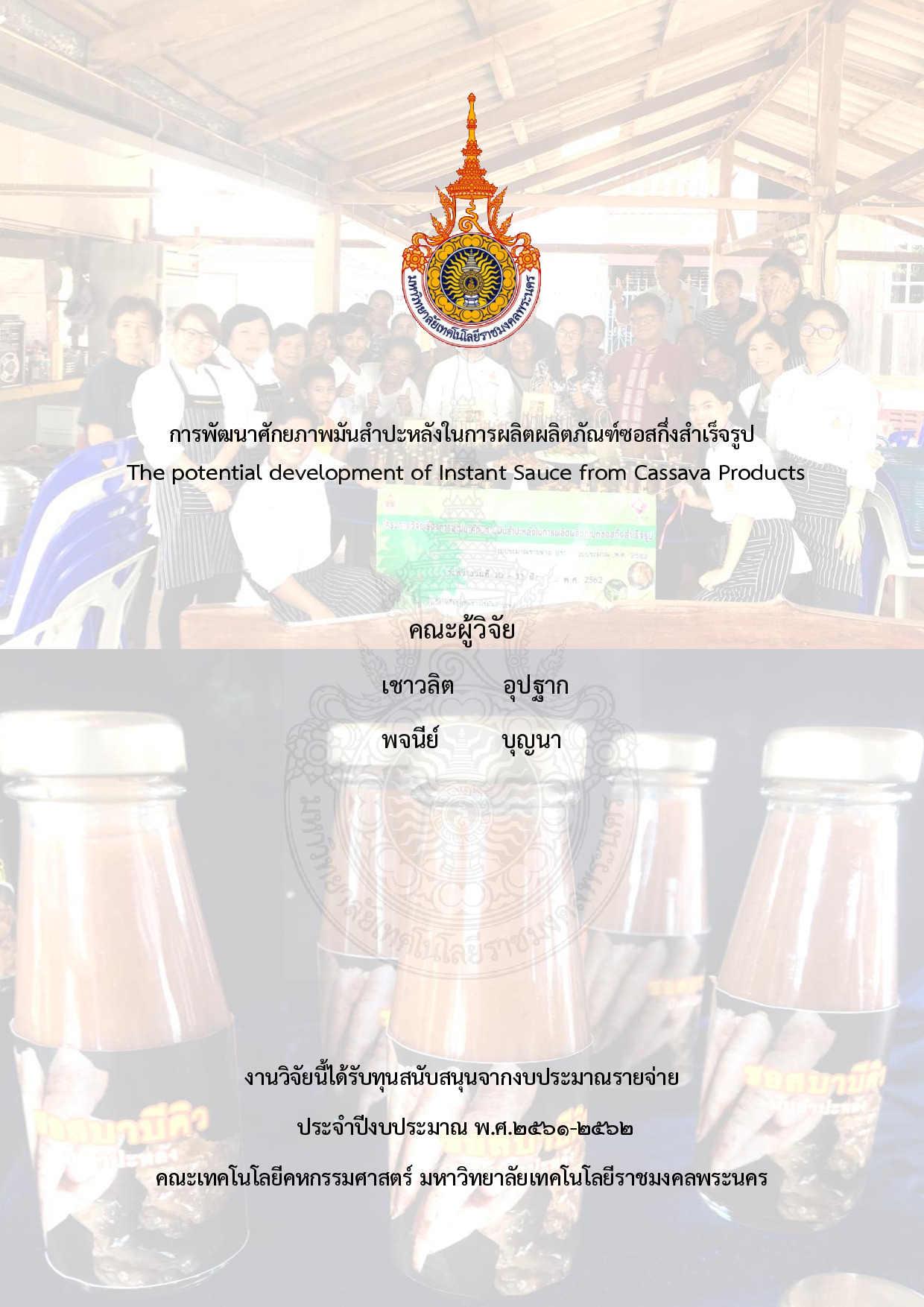
การพัฒนาศักยภาพมันสำปะหลังในการผลิตผลิตภัณฑ์ซอสกึ่งสำเร็จรูป
This research has objectives to study about production process of four types of finished sauce product made from cassava to study about quality of finished sauce product made from cassava to study about consumer test towards finished sauce product made from cassava. From the test it was found that study about quantity of suitable cassava supplement to the four types of finished cassava product by testing about acceptance of testers who were 40 instructors in field of Food and Nutrition field of Food and Nutrition Science and field of Food Service Industry. The method was to give marks for favor in type of 9-point hedonic scale by supplementing cassava into Teriyaki Sauce at levels of 0 20 40 and 60 percent of total ingredient. It was found that the testers accepted the sauce at level of 20 percent which was in the most favorite level. Semi-finished frying sauce supplemented with cassava at level of 0 40 60 and 80 percent of total ingredient; it was found that the testers accepted the level of 60 percent of Barbeque sauce supplemented with cassava at level of 0 40 60 and 80 percent of total ingredient; it was found that the testers accepted level of 40 percent in the level of much favor of semi-finished flavored fermented frying sauce supplemented with cassava at level of 0 20 40 and 60 percent of total ingredient it was found that the testers accepted the sauce at level of 40 percent which is in the level of much favor. Nutritional value of semi-finished sauce product it was found that Teriyaki sauce for 20 percent has moisture value of 78.66 percent fat value of 1.08 percent fiber for 1.36 percent ash for 2.29 percent and protein for 3.34 percent. Semi-finished frying sauce it was found that semi-finished frying sauce supplemented with cassava for 60 percent had moisture value of 80.85 percent fat value of 0.55 percent fiber for 1.35 percent ash for 3.35 and percent and protein for 3.29 percent. cassava for 60 percent it was found that chemical quality had moisture for 82.31 percent fat value for 0.75 percent fiber for 1.51 percent ash for 2.41 percent and protein for 3.37 percent. Semi-finished fermented flavored sauce it was found that semi-finished fermented flavor sauce supplemented with cassava for 40 percent it was found that chemical quality had moisture value for 83.67 percent fat value for 0.07 percent fiber 4.54 percent ash for 4.54 percent and protein for 2.42 percent. However supplementing of cassava into process of finished food products of 4 types; supplementing can be made but there shall be realizing about chemical elements of starting components for example moisture and fat quantity. These components may have effect on physical features for example smell smell and taste and texture. These features affected acceptance of products. The result of study about acceptance of consumers (Consumer test) towards product of semi-finished sauce supplemented with cassava and 100 consumers in Faculty of Home Economics Technology Rajamangala University of Technology Phra Nakhon and people in Tevet Market. Feeling towards acceptance of semi-finished sauce product supplemented with cassava it was found that consumers were satisfactory towards Teriyaki sauce product in moderate favor level having feeling on product in appearance color smell smell and taste in moderate favor level. Feeling towards acceptance of semi-finished sauce product it was found that consumers were satisfactory towards semi-finished frying sauce product 60 percent in moderate favor level having feeling on product in appearance color smell smell and taste in moderate favor level. Feeling towards acceptance of semi-finished fermented sauce product it was found that consumers were satisfactory towards semi-finished fermented sauce product 75 percent in moderate favor level having feeling on product in appearance color smell smell and taste in moderate favor level. Result of technology transfer in project of cassava potential development in production of semi-finished sauce product Tapioca Farmer Community Enterprise Group 480 Khon Buri District and Nong Bunmak District Nakhon Ratchasima Province 45 trainees; most were female having age of 36-45 years to be 96.00 percent. From evaluation it was found that 45 respondents used knowledge to be 100 percent and satisfactory of service receivers in academic aspect and professional aspect towards benefit from service of trainees in level from much to the most to be 100 percent.
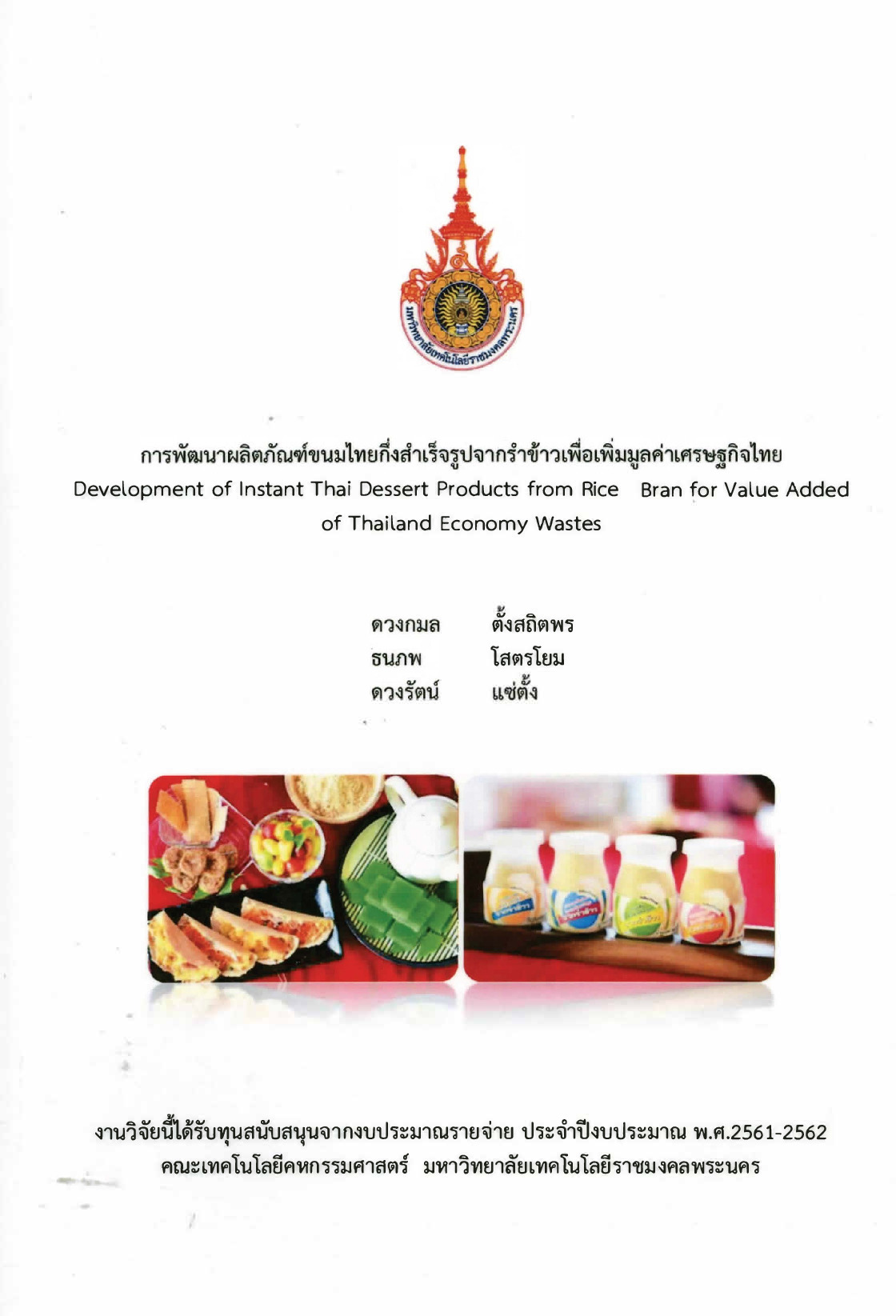
การพัฒนาผลิตภัณฑ์ขนมไทยกึ่งสำเร็จรูปจากรำข้าวเพื่อเพิ่มมูลค่าเศรษฐกิจไทย
Development of Instant Thai Dessert Products from Rice Bran for Value Added of Thailand Economy Wastes. The purpose of this study was developing formula and prototype of Thai Dessert Products from Rice Bran for 4 products such as Khanom Bueng Thai Dried Rice Ball Khonom Chan and Look-Chub. The suitable condition for Khanom Bueng Thai was using Rice Bran flour as 60% and using Mung bean flour as 40%. The result of physical analysis showed that : products have hardness cripyness brown bright color flavor and taste suitable and chemical analysis the percentage of low moisture fat and crude fiber content have more than. The suitable condition for Dried Rice Ball was using Rice Bran powder in 100% for products and drying at 70 ๐C 90 mins. The result of physical analysis showed that : products have firmness texture brown bright color and chemical analysis the percentage of the moisture protein fat crude fiber ash and carbohydrate content 7.05 ± 0.00 7.05 ± 0.00 23.98 ± 0.00 5.25 ± 0.20 10.86 ± 0.00 and 32.26 ± 0.00 respective. The protein and crude fiber content have more than. The suitable condition for Khonom Chan was using Rice Bran flour as 25%. The result of physical analysis showed that : products have after steamed mealiness texture brown bright color and chemical analysis the percentage of the moisture protein fat crude fiber ash and carbohydrate content 4.40 ± 0.05 1.97 ± 0.02 11.18 ± 0.00 2.40 ± 0.06 2.00 ± 0.00 and 77.43 ± 0.00 respective. The protein and crude fiber content have more than. The suitable condition for Look-Chub was using Rice Bran powder as 50% and using Mung bean as 50%. The result of physical analysis showed that : products have after microwave 5 sec. mealiness texture brown bright color and chemical analysis the percentage of the moisture protein fat crude fiber ash and carbohydrate content 2.00 ± 0.70 4.39 ± 0.00 8.82 ± 0.15 2.44 ± 0.492.00 ± 0.71 and 80.35 ± 0.00 respective. The shelf life of 4 products in vacuum packaging (VP) have more than 4 months and consumer acceptability like very much product.
การพัฒนาผลิตภัณฑ์พริกแกงสำเร็จรูปเพื่ออุตสาหกรรมการส่งออก
Development Project of instant Thai curry products for export industry aimed to conduct the process of making curry to have shelf-life extension and transfer this knowledge and technology to community entrepreneur and private organizations for industrial productivity with quality ready-to cook and tasty delicacy curry paste. It also helps adding value for the market and the export which is correspond with the policy of promoting Thailand as Kitchen ofthe World Since 2006 the research on curry paste process and developed recipe included 5 types of curry; red curry green curry Pha-naeng curry Tai PIa curry (Fish innards curry) and Thai Tom Yum curry. The result of the study was found that the overall satisfaction level of the consumer was accepted for curry powder because it lasted and was ready to cook. As for the research in 2007 it focused on the shelf-life extension of Thai instant curry and was developed by testing for its quality by physical chemical microbial and sensory evaluation. It was found that Thai instant curry lasted for more than 8 months. When developed to use in the factory the quality of curry was not different from the one produced in the laboratory except currys weight after drying which was less; however the result was accepted. In this case the quality of raw material temperature and drying period should be controlled constantly. The researcher transferred this knowledge and technology to the community and target private organization twice. The first time held on Instant Curry Course at the Faculty of Home Economics Technology between 30 June -1 July 2007. The second time was the training course for Organic community in Khon Kaen province between 21-22 July 2007. The result of the technology transfer was found that 94.6 % of the participants satisfaction was accepted and after the course was finished the target groups applied this knowledge and technology for their careers to increase communitys income. It is regarded that this project was accomplished according to its success in the goal and objectives.