จำนวน Repository ( 3 )

ใยอาหารที่มีสารต้านอนุมูลอิสระจากเปลือกถั่วและการประยุกต์ใช้ในผลิตภัณฑ์อาหาร
Foods rich in dietary fiber and antioxidants have attracted great attention to both of consumers and food manufacturers because of their significant health benefits. Increased consumption of dietary fiber improves lowering blood pressure and cholesterol levels. Furthermore it prevent a number of gastrointestinal disorders such as constipation and hemorrhoids. Antioxidants are bioactive compounds that can delay or inhibit the oxidation by inhibiting the initiation or propagation of oxidative chain reactions. These free radical reactions cause human diseases such as cardiovascular disease and cancer. Legumes are an excellent source of compounds having antioxidant. Hence recent research has been focused on the potential utilization of bean coat which was by-products from processing industry to the development of new functional ingredients for food nutrition enrichment. The extraction of bioactive compounds from seed coats are used as a food ingredient for various foods processing such as tofu with soybean hull fiber black bean seed coat in maize flours for the production of cookies and whole wheat bread. Therefore research and development of new functional foods from bean seed coat used as ingredient for the preparation of food products to improve food nutrition will be necessary to provide for Industrial manufacturing according to demand and sufficient for healthy food consumption in the future.
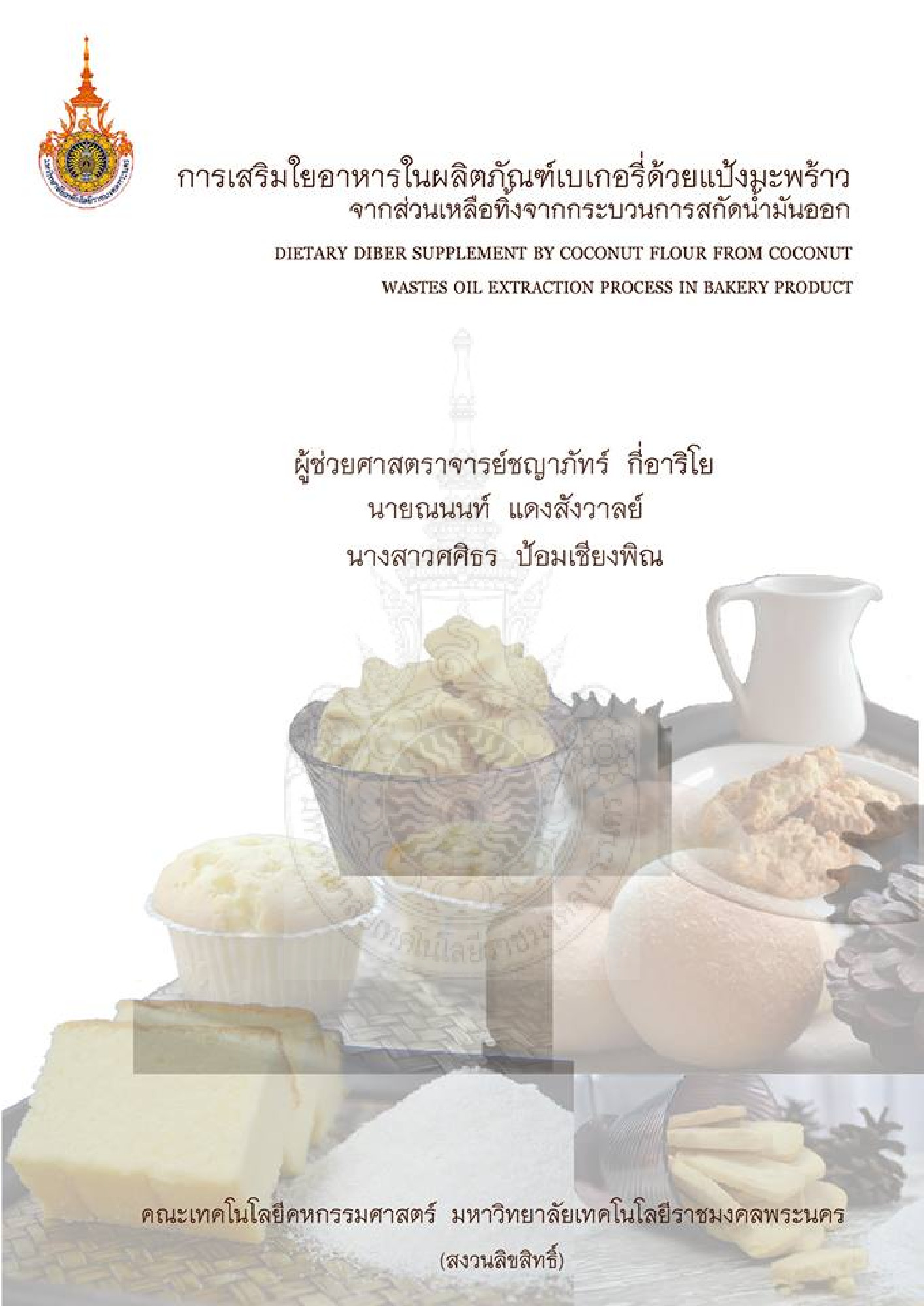
การเสริมใยอาหารในผลิตภัณฑ์เบเกอรี่ด้วยแป้งมะพร้าวจากส่วนเหลือทิ้งจากกระบวนการสกัดน้ำมันออก
The studies of Dietary Fiber Supplement by coconut flour from coconut Wastes Oil Extraction process in Bakery Product was investigated Production of coconut flour from coconut wastes oil extraction drying at 55 ° C for 12 hours and then grinding to powder gave the off-white fine powder. The chemical compositions of coconut flour were 57.70 % carbohydrate 29.4 % fat 6.23 % moisture 5.20 % protein and 1.48 % ash by dye weigh. Butter cake making experiment by substitution of wheat flour with coconut flour at 5 % of wheat flour weigh which has the highest sensory scores comparing butter cake with the control found that increase dietary fiber 1.34 g. /100 g. The majority of the tested consumers (92%) accepted butter cake with 5 % of coconut flour substitution. Muffin making experiment by substitution of wheat flour with coconut flour at 15 % of wheat flour weigh which has the highest sensory scores comparing muffin with the control found that increase dietary fiber 2.34 g /100 g. The majority of the tested consumers (81%) accepted muffin with 15 % of coconut flour substitution. Cornflake cookie making experiment by substitution of wheat flour with coconut flour at 20 % of wheat flour weigh which has the highest sensory scores comparing cornflake cookie with the control found that increase dietary fiber 3.54 g. /100 g. The majority of the tested consumers (94 %) accepted cornflake cookie with 20 % of coconut flour substitution. Butter cookie making experiment by substitution of wheat flour with coconut flour at 10 % of wheat flour weigh which has the highest sensory scorescomparing butter cookie with the control found that increase dietary fiber 3.04 g. /100 g. The majority of the tested consumers (94 %) accepted Butter cookie with 10 % of coconut flour substitution. Frozen cookie making experiment by substitution of wheat flour with coconut flour at 20 % of wheat flour weigh which has the highest sensory scores comparing cookie with the control found that increase dietary fiber 4.02g. /100 g. The majority of the tested consumers (93 %) accepted 20 % of coconut flour substitution. Butter bread making experiment by substitution of wheat flour with coconut flour at 15 % of wheat flour weigh which has the highest sensory scores comparing butter bread with the control found that increase dietary fiber 2.22 g. /100 g. The majority of the tested consumers (75 %) accepted 15% of coconut flour substitution. Whole wheat bread making experiment by substitution of wheat flour with coconut flour at 15 % of wheat flour weigh which has the highest sensory scores comparing whole wheat bread with the control found that increase dietary fiber 2.09 g. /100 g. The majority of the tested consumers (79 %) accepted 15 % of coconut flour substitution. Pie crust making experiment by substitution of wheat flour with coconut flour at 15 % of wheat flour weigh which has the highest sensory scores comparing pie crust with the control found that increase dietary fiber 2.91 g. /100 g. The majority of the tested consumers (82 %) accepted 15 % of coconut flour substitution.
การพัฒนาผลิตภัณฑ์อาหารเสริมเส้นใยอาหารจากกากมะพร้าวเหลือใช
The purpose of the development of dietary fiber supplement food from used coconut residue is to study an appropriate amount of used coconut residue from oil distillation in three food products such as steamed stuff bun deep-fried dough stick and roti. The research was planned in accordance with “Randomized Complete Block Design RCBD”. Sense test by tasting method by giving favorite scores of 9 levels (9 – Point Hedonic Scale) quality test of chemical composition and physical composition including acceptance test of 100 people towards the products were performed.