จำนวน Repository ( 58 )
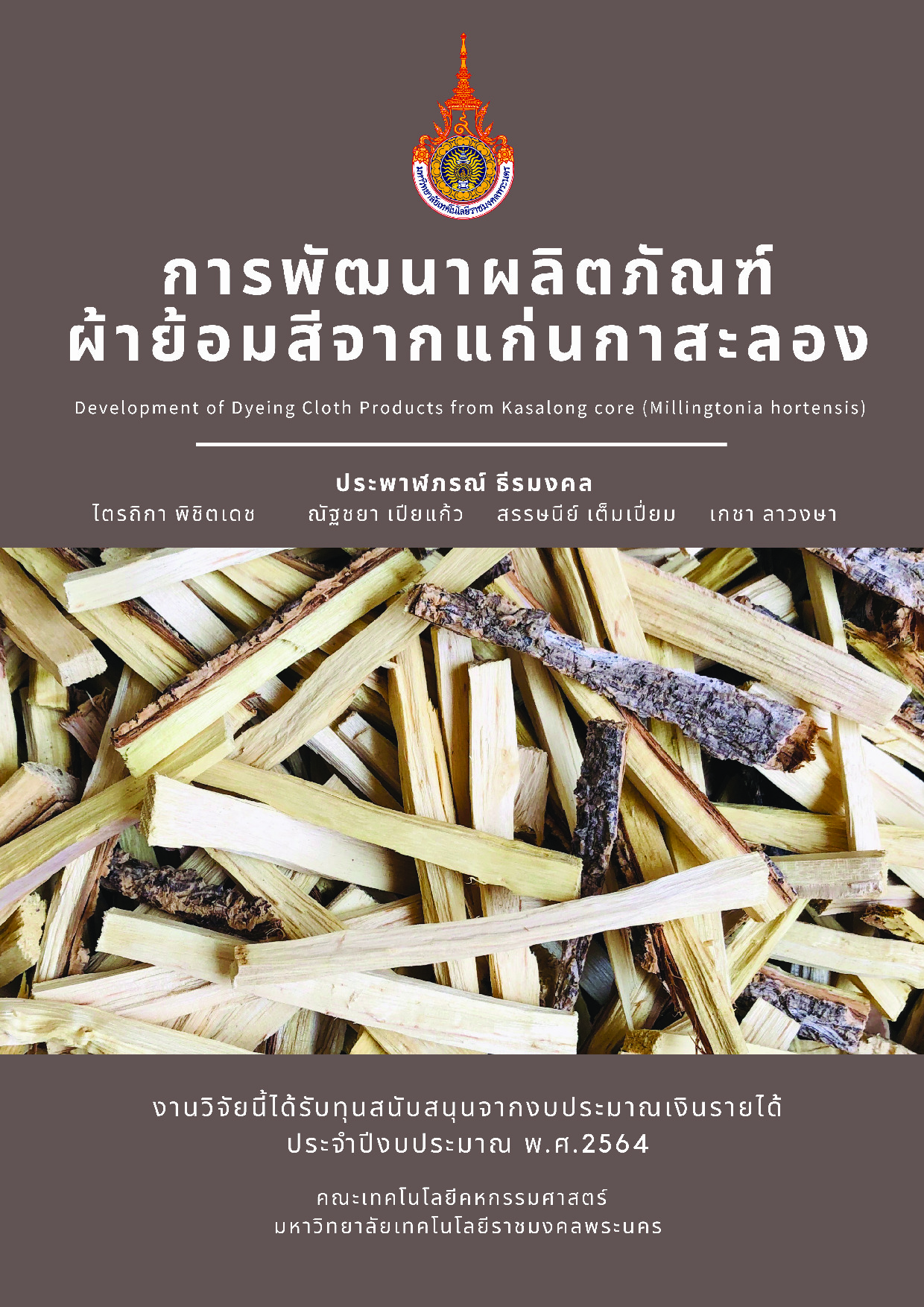
การพัฒนาผลิตภัณฑ์ผ้าย้อมสีจากแก่นกาสะลอง
Promotion of handicrafts in the field of natural dyes in the country. Increase the potential of the community and use the strengths of the cultural community. way of life and wisdom by finding ways to develop textile products by using creative textile innovations based on local wisdom in sustainable community areas To add added value to products in the ECO PRODUCT and ZERO WASTE product groups from the aforementioned concept To conserve plant genetics that exist throughout the country. The researcher therefore studied the process of dyeing fabrics by natural methods. By taking natural ingredients that are locally available and transforming them into environmentally friendly home products. This research is to study the natural dyeing of cotton fabric from Kasalong core. have a purpose Study on the effect of dyeing and the use of adjunctive agents in natural dyeing from Kasalong kernels. To develop dyed fabric products from Kasalong core and to pass on the knowledge and technology of developing dyed fabric products from Kasalong core for the general public. The result of dyeing cotton with natural dyes from Kasalong core. Four types of adhesives were used at a concentration of 20 percent as tamarind juice lime juice lime juice ash water and to test the washing fastness and sunlight resistance with the AATCC standard. The results can be summarized as follows. 1. The results of the study found that from the extraction of color from Kasalong kernels and then filtered with cloth. The color water extracted from Kasalong essence is brown. and when left for 24 hours the water color is dark brown and in this research using hot dyeing methods. 2. The result of dyeing cotton with natural dyes from Kasalong core without mordant using was found to yellow-brown but after washing the color intensity on the fabric fades slightly. 3. The result of dyeing cotton with natural color from Kasalong core. It was found that after washing the color intensity on the fabric was moderately fading. 4. The color measurement L* a* b* found that when the dye was measured in the CIELab system L* = 26.81 a* = 33.33 b* = 45.69 dL = 0.36 and dE*ab = 0.85 water. The resulting color from Kasalong will be reddish yellow. 5. Make the research prototypes as 10 of bag products. 6. Conducting technology transfer by organizing workshops dyeing course and sewing durating of the workshop for students and the general public was 1 day. Most of the participants had the highest level of satisfaction in all questions.
การศึกษาการบำบัดน้ำเสียจากการย้อมผ้าแบบเคลื่อนที่โดยใช้ถ่านกัมมันต์จากกะลามะพร้าว
The dyeing industry both of business size and household size where the remaining water from the dyeing process is dumped into pipes and flows into natural water sources causing sewage problems. Therefore a column type wastewater treatment system has been developed by using a filtration system along with an adsorption system. The materials used to treat the wastewater from dyeing are gravel sand charcoal from wood and activated carbon from coconut shell. The study was conducted on the synthesis activated carbon from coconut shell using for color and molecules adsorption. The amount of activated carbon from coconut shell was varied at 200 400 600 and 800 g applying with filter media and other adsorption materials taking 1 hour to treat the wastewater from dyeing. The parameter using to measure water quality consisted of color value pH suspended solids conductivity turbidity value COD and TKN to indicate the water quality before and after treatment evaluating the efficiency of the wastewater treatment system. The best ratio that can treat the color is the formula containing 800 g of coconut shell activated carbon. It was able to treat the color equal to 5.94 SU or 99.43 percent compared to the wastewater before treatment.
การบำบัดน้ำสีย้อมผ้าโดยกระบวนการแอดวานซ์ออกซิเดชันด้วยโอโซน ร่วมกับสารไฮโดรเจนเปอร์ออกไซด์
This research is a study on treatment of Water Dyes from textile dyeing industry by Advance oxidation process with Ozone and hydrogen peroxide (H2O2). In this study Ozone generators with a capacity of 1.0 - 3.0 mg/ hr. were used to study the appropriate factors for treatment with adjusting wastewater conditions (pH 3 pH 7 and pH 11) Ozone exposure distance 120 minute the initial COD concentration is 250 - 1000 mg/l. and adding hydrogen peroxide at 4 8 and 12 ml/l. For the study found that above mentioned factors have an effect on the efficacy of color and COD treatment which the experiment at pH 11 used to Ozone treatment and added 4 ml/l. of H2O2. It makes the highest COD treatment efficiency when compared to pH 3 pH 7 and added more H2O2. it doesn’t affect to the higher of treatment efficiency. In addition it was found that higher initial COD concentration decreased treatment efficiency which the experimental ability for COD treatment has highest value was 46 percent and the COD concentration was 250 ml/l In order that when COD concentration in synthetic color water was increased to 500 ml/l and 1000 ml/l. it was found that the COD efficiency decreased to 31% and 40% respectively. For the treatment of Water Dyes from textile dyeing industry by oxidation process with Ozone together with hydrogen peroxide (H2O2) at pH 7 will has the highest of treatment efficiency. However the consideration of suitability for pH configuration used to treat both color and COD should choose pH 11 because it can treat both color and COD that makes the waste water quality meet the standards required by law. In addition if we consider the effectiveness of turbidity and BOD found that the decrease of dirtiness tends to be in the same direction with COD both 2 parameters.
การบำบัดน้ำเสียจากสีย้อมผ้าด้วยกระบวนการโอโซนเนชัน โดยใช้ตัวกลางพลาสติก เคลือบผิวไทเทเนียมไดออกไซด์ชนิดรูไทล์เป็นตัวเร่งปฏิกิริยา
This research is to study the efficiency of treating wastewater from dyeing fabric by the ozonation process. By using rutile TiO2 coated plastic media to catalyze. Which uses O3 generators with a capacity of 2.62 - 3.10 g/hr. By studying the factors that affect the treatment efficiency of COD and color such as the pH of the water used in the treatment at pH 3 pH 7 and pH 11 the initial COD concentration of 100% 50% and 25% which have values in the range of 100 -320 mg/L. O3 exposure time 120 min. From the study it is found that the efficiency of reducing the impurities in wastewater by the ozonation process in the pH 11 state the COD concentration at 50% can reduce the COD. And the maximum color is at 33.3% and 90% from the 550 ADMI color intensity with a COD of 180 mg/L. For the study of the efficiency of reducing the impurities of wastewater by ozonation process together with 2 g. of TiO2/1 L. of wastewater in the condition of pH 11 concentration COD Beginning at 100% with the ability to reduce COD values And the maximum color is at 40% and 80% of the 270 ADMI color intensity with a COD of 190 mg/L. The amount of O3 suitable for treatment has an average value of 0.0374 g/min./10.5 L. of wastewater. The duration of O3 exposure in both processes has a similar approach to the efficiency of COD and color treatment when increasing the duration of O3 exposure.
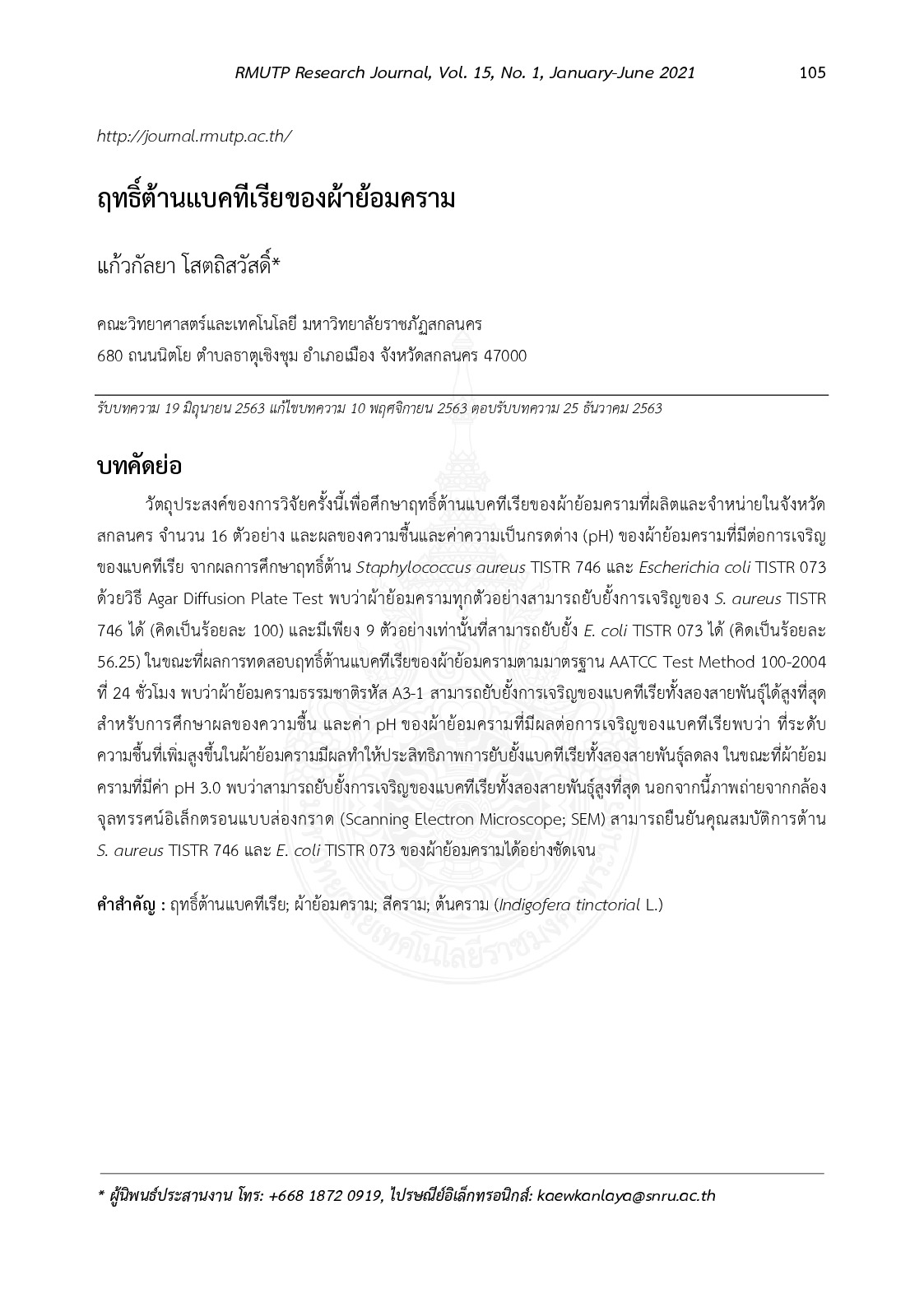
ฤทธิ์ต้านแบคทีเรียของผ้าย้อมคราม
The objective of this research was to study the antibacterial activity of 16 samples of indigo dyed fabrics that are produced and sold in Sakon Nakhon Province. Effect of moisture and pH of indigo dyed fabrics on bacterial growth were also determined. The result of the study shows inhibition of S. aureus TISTR 746 and E. coli TISTR 073 by agar diffusion plate test all samples could inhibit Saureus TISTR 746 (accounted as 100%) and only 9 samples could inhibit E. coli TISTR 073 (accounted as 56.25%). Whereas the study of antibacterial activity by AATCC test method 100-2004 at 24 hours was found that the natural indigo dyed fabrics code A3-1 could inhibit both bacterial strains in the highest level. The result also shows the effect of moisture and pH of indigo dyed fabrics on bacterial growth it was found that the increased humidity levels of indigo dyed fabrics have effect on the reduction of the inhibition efficacy of both strains. While indigo dyed fabric with pH 3.0 was found to inhibit most of the growth of both strains. In addition images obtained using a scanning electron microscope (SEM) could clearly confirm the property of indigo dyed fabric on inhibition of S. Aureus TISTR 746 and E. coli TISTR 073.