จำนวน Repository ( 5 )

ปัจจัยที่มีผลต่อความภักดีของผู้ใช้บริการระบบพาณิชย์อิเล็กทรอนิกส์ กลุ่มธุรกิจอาหาร กรณีศึกษา : อำเภอเมืองนนทบุรี จังหวัดนนทบุรี
The purposes of this research were 1) To study behavior of customer using Restaurant E-commerce in case study of Muang Nonthaburi District 2) To study customer loyalty in Restaurant E-commerce in case study of Muang Nonthaburi District 3) To study comparing personal factors affecting customer loyalty in Restaurant E-commerce in case study of Muang Nonthaburi District From those aims Researcher has collected sample data of customer using Restaurant E-commerce in case study of Muang Nonthaburi District that using sampling method of certain populations by 400 samples. Using online questionnaire types for close ended question and open ended question and analyzing social science data with statistics analysis program. Study for Percentage Mean Standard Deviation and Hypothesis Testing (t-test) by presenting results in Descriptive Statistics Table and collecting data between April-June 2016. Result of this research customer using Restaurant E-commerce in case study of Muang Nonthaburi District that found The Most is Male age 21-30 years old and have been bachelor degree Single and occupied about official/state enterprise Behavior of using Restaurant E-commerce that found The Most have knowledge/experience for using E-commerce have valued from using E-commerce with Restaurant data searching have trusted for using Restaurant E-commerce level is moderate. And Favorite using Social Media on all Channels that are Website Application and Social Media (3) Customer Loyalty in Restaurant E-commerce in Case Study of Muang Nonthaburi District are summarized 8 sides that are much (Mean=3.92 S.D.= .795)
รูปแบบการพัฒนาสมรรถนะไอซีทีสำหรับบุคลากรในธุรกิจพาณิชย์อิเล็กทรอนิกส์ของประเทศไทย
The purposes of this study were to investigate the component of information and communication technology (ICT) competency for Thai e-commerce personnel and presents The model of competency development in ICT for Thai e-Commerce personnel. The questionnaire was administered to collect quantitative data from 385 electronic business personnel samples and the in-depth interview method was applied to obtain qualitative data from 10 experts in information and communication technology from public and private sectors. The collected data were analyzed by frequency distribution percentage distribution mean standard deviation and Exploratory Factor Analysis (EFA). The results revealed three components with 47 variables of ICT competency for Thai for Thai e-commerce personnel which can describe the combined variance at 74.979 percent. Of all variables 36 variables are highly necessary to identify the competency to design and develop websites and benefit the ability to develop and improve the website according DBD Verified. Six variables refer to the competency concerning the interpersonal skill and responsibility among the personnel inside or outside the organization. Finally five other variables are responsible for the ability to carefully analyze troubles with caution.
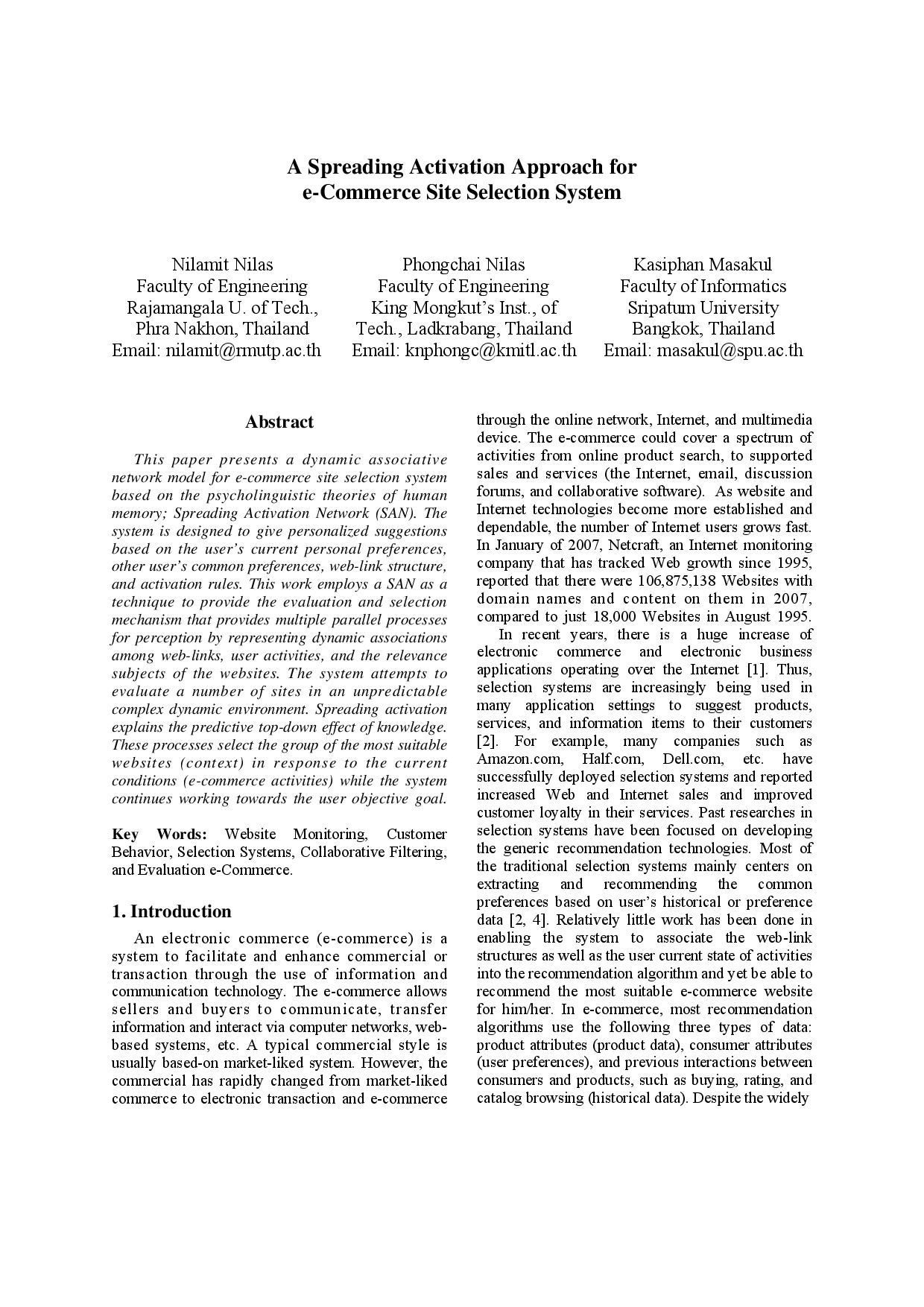
A Spreading Activation Approach for e-Commerce Site Selection System
This paper presents a dynamic associative network model for e-commerce site selection system based on the psycholinguistic theories of human memory; Spreading Activation Network (SAN). The system is designed to give personalized suggestions based on the user’s current personal preferences other user’s common preferences web-link structure and activation rules. This work employs a SAN as a technique to provide the evaluation and selection mechanism that provides multiple parallel processes for perception by representing dynamic associations among web-links user activities and the relevance subjects of the websites. The system attempts to evaluate a number of sites in an unpredictable complex dynamic environment. Spreading activation explains the predictive top-down effect of knowledge. These processes select the group of the most suitable websites (context) in response to the current conditions (e-commerce activities) while the system continues working towards the user objective goal.
The development of electronic commerce in thailand for business which lead to the ASEAN economic community
Thailand is on the way toward ASEAN Economic Community or AEC in the year 2015. The AEC aims to create one-solid base for production and distribution and concurrently seek mutual economical profits. A kind of business that may allow Thai entrepreneur to survive more easily in ASEAN is the selling and purchasing of goods and services via internet or ‘E-commerce’. The objective of this research is to study the factors that influence the development of E-commerce that will facilitate Thai entrepreneur when we enter AEC. The samples of our study are the group of E-commerce’s entrepreneurs who legitimately registered with Department of Business Development. Our research revealed that the major factors that influence the development of E-commerce is the knowledge in foreign language which is considered to be the source of major advantage for business with average at 3.9750. Follow by the opening of free trade area which will cause more obstacles in term of the increasing number of competitor with average at 3.8475. The lease is population’s preference that would directly affect business’s revenue with average at 3.7450.