จำนวน Repository ( 2 )
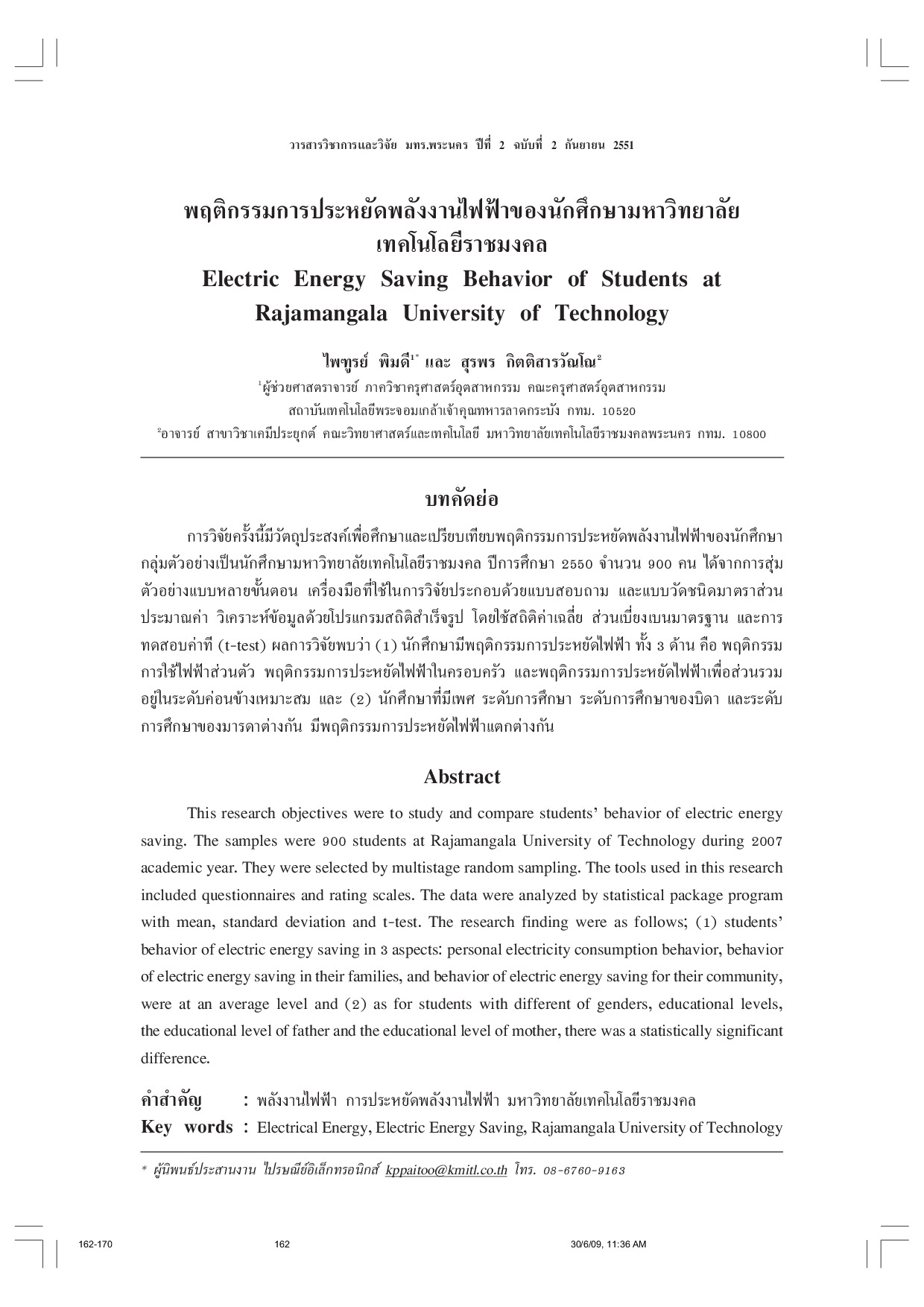
Electric Energy Saving Behavior of Students at Rajamangala University of Technology
This research objectives were to study and compare students’ behavior of electric energy saving. The samples were 900 students at Rajamangala University of Technology during 2007 academic year. They were selected by multistage random sampling. The tools used in this research included questionnaires and rating scales. The data were analyzed by statistical package program with mean standard deviation and t-test. The research finding were as follows; (1) students’ behavior of electric energy saving in 3 aspects: personal electricity consumption behavior behavior of electric energy saving in their families and behavior of electric energy saving for their community were at an average level and (2) as for students with different of genders educational levels the educational level of father and the educational level of mother there was a statistically significant difference.
การกำหนดแนวทางการลดคาร์บอนฟุตพริ้นท์ขององค์กร สำหรับโรงแรมขนาดกลางและขนาดเล็กในประเทศไทย โดยใช้การประเมินคาร์บอนฟุตพริ้นท์ขององค์กรตามแนวทางขององค์การบริหารจัดการก๊าซเรือนกระจก (องค์การมหาชน)
This study is to determine guideline to reduce carbon footprint for organization of medium and small hotels in Thailand using the Carbon Footprint for Organization (CFO) according to Thailand Greenhouse Gas Management Organization (Public Organization). Conducting with 2 represented medium and small hotels the results showed that the overall carbon footprint average of 2013 was 553t.Co2-e. Considering concentration index by number of guestrooms the carbon footprint was 18.81 kg.Co2e/room-night 221.16 kg.Co2-e/m2 by total floor area and 11.65kg.Co2- e/personby guest. The dominant source of carbon footprint was use of electricity 465t.Co2-e(83.06%). Base on this assessment to use of air conditioning was 60.09 % water heater 17.64 % lighting equipment 15.05 % and other 7.22 % of total electricity used. Therefore guidelines for carbon footprint reducing of the representative hotel were to use technology to reduce electricity consumption for air conditioning water heater and lighting respectively. Based Approach to Reducing Carbon Footprint found that small and medium sized hotels can reduce emissions per year 24.87 t.CO2-e representing the ability to reduce greenhouse gas emissions by up to 4.49% or financial projections be able to save money 171.202 baht per year.