จำนวน Repository ( 3 )
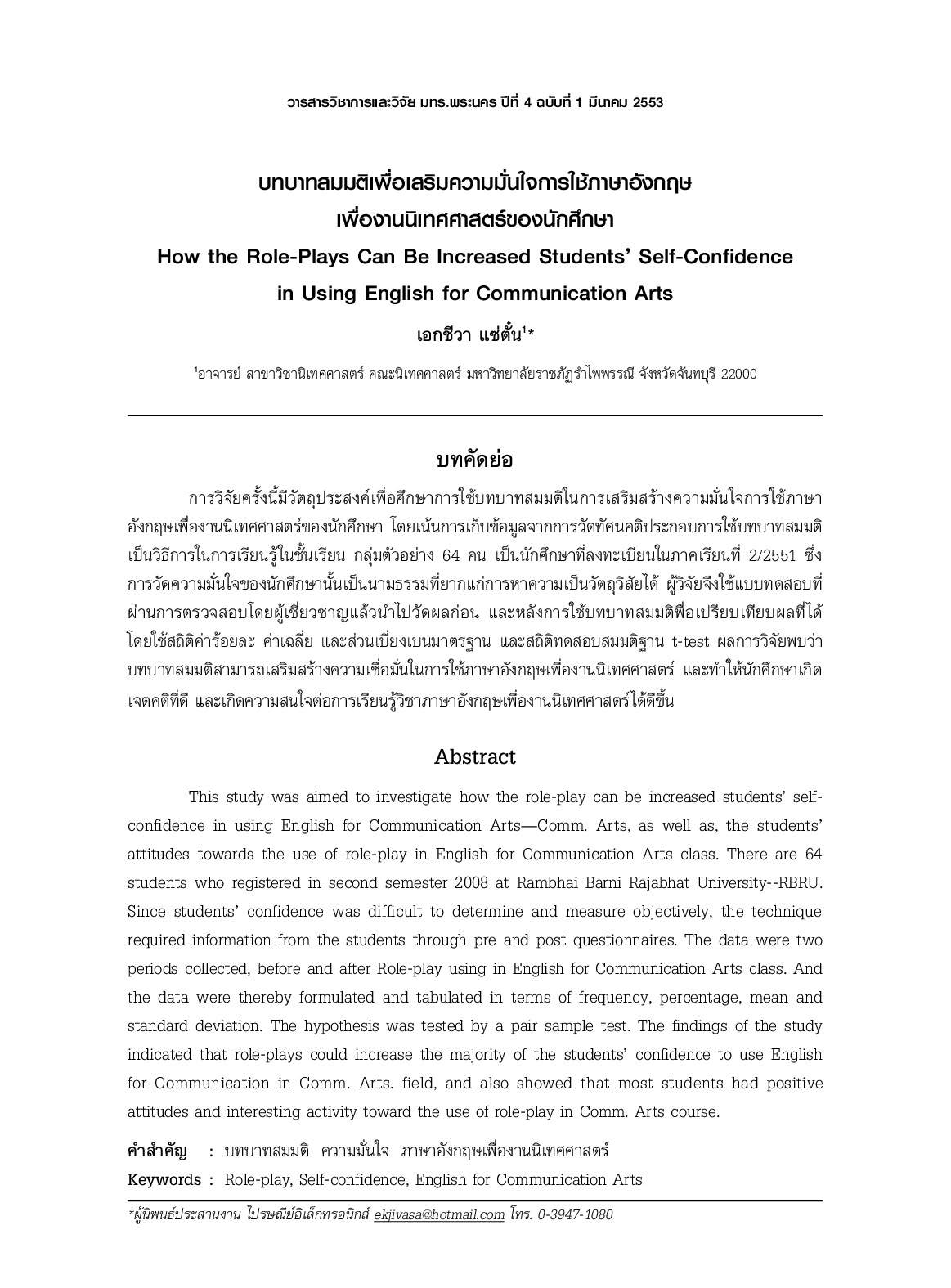
How the Role-Plays Can Be Increased Students’ Self-Confidence in Using English for Communication Arts
This study was aimed to investigate how the role-play can be increased students’ selfconfidence in using English for Communication Arts-Comm. Arts as well as the students’ attitudes towards the use of role-play in English for Communication Arts class. There are 64 students who registered in second semester 2008 at Rambhai Barni Rajabhat University--RBRU. Since students’ confidence was difficult to determine and measure objectively the technique required information from the students through pre and post questionnaires. The data were two periods collected before and after Role-play using in English for Communication Arts class. And the data were thereby formulated and tabulated in terms of frequency percentage mean and standard deviation. The hypothesis was tested by a pair sample test. The findings of the study indicated that role-plays could increase the majority of the students’ confidence to use English for Communication in Comm. Arts. field and also showed that most students had positive attitudes and interesting activity toward the use of role-play in Comm. Arts course.
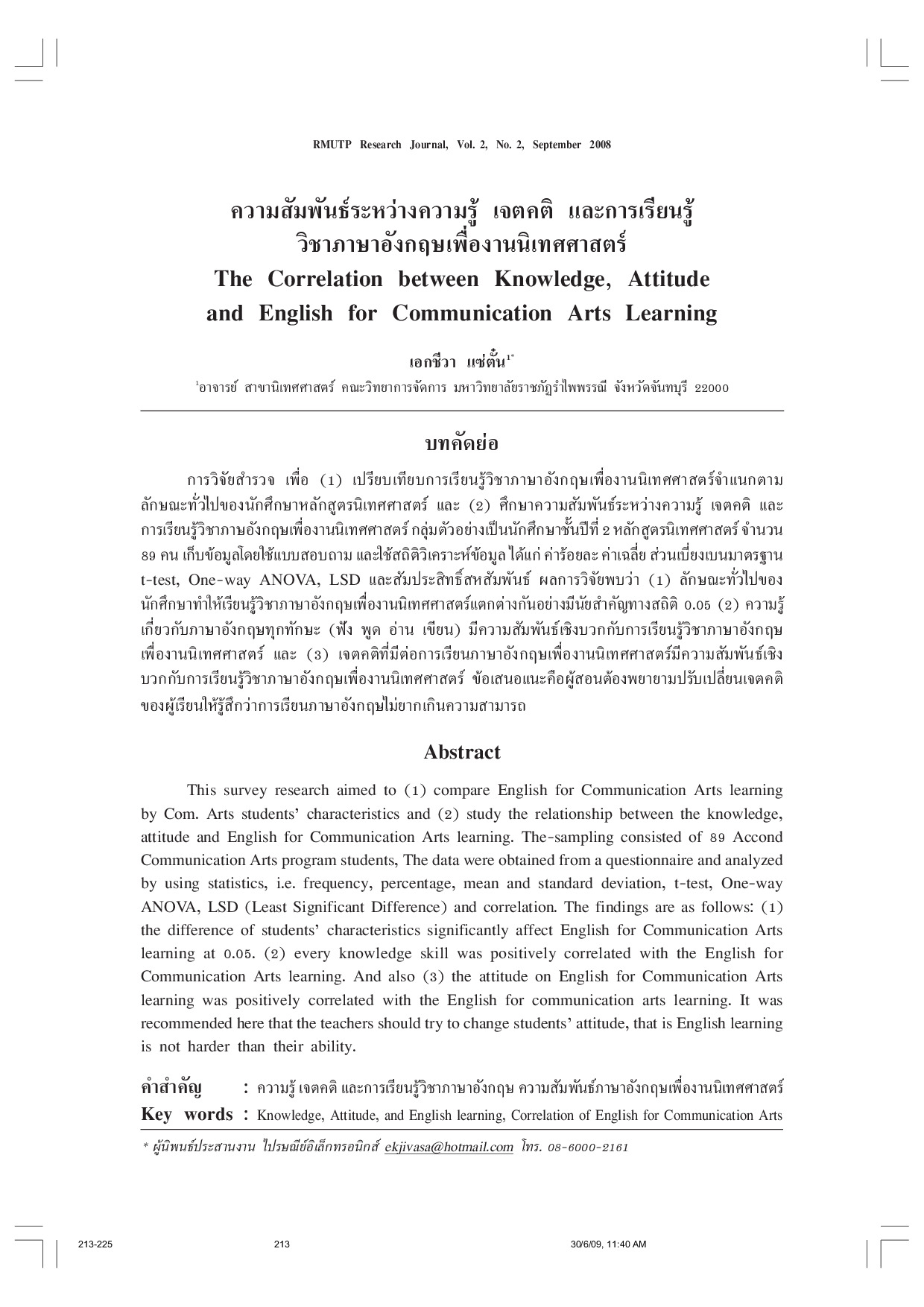
The Correlation between Knowledge, Attitude and English for Communication Arts Learning
This survey research aimed to (1) compare English for Communication Arts learning by Com. Arts students’ characteristics and (2) study the relationship between the knowledge attitude and English for Communication Arts learning. The-sampling consisted of 89 Accond Communication Arts program students The data were obtained from a questionnaire and analyzed by using statistics i.e. frequency percentage mean and standard deviation t-test One-way ANOVA LSD (Least Significant Difference) and correlation. The findings are as follows: (1) the difference of students’ characteristics significantly affect English for Communication Arts learning at 0.05. (2) every knowledge skill was positively correlated with the English for Communication Arts learning. And also (3) the attitude on English for Communication Arts learning was positively correlated with the English for communication arts learning. It was recommended here that the teachers should try to change students’ attitude that is English learning is not harder than their ability.
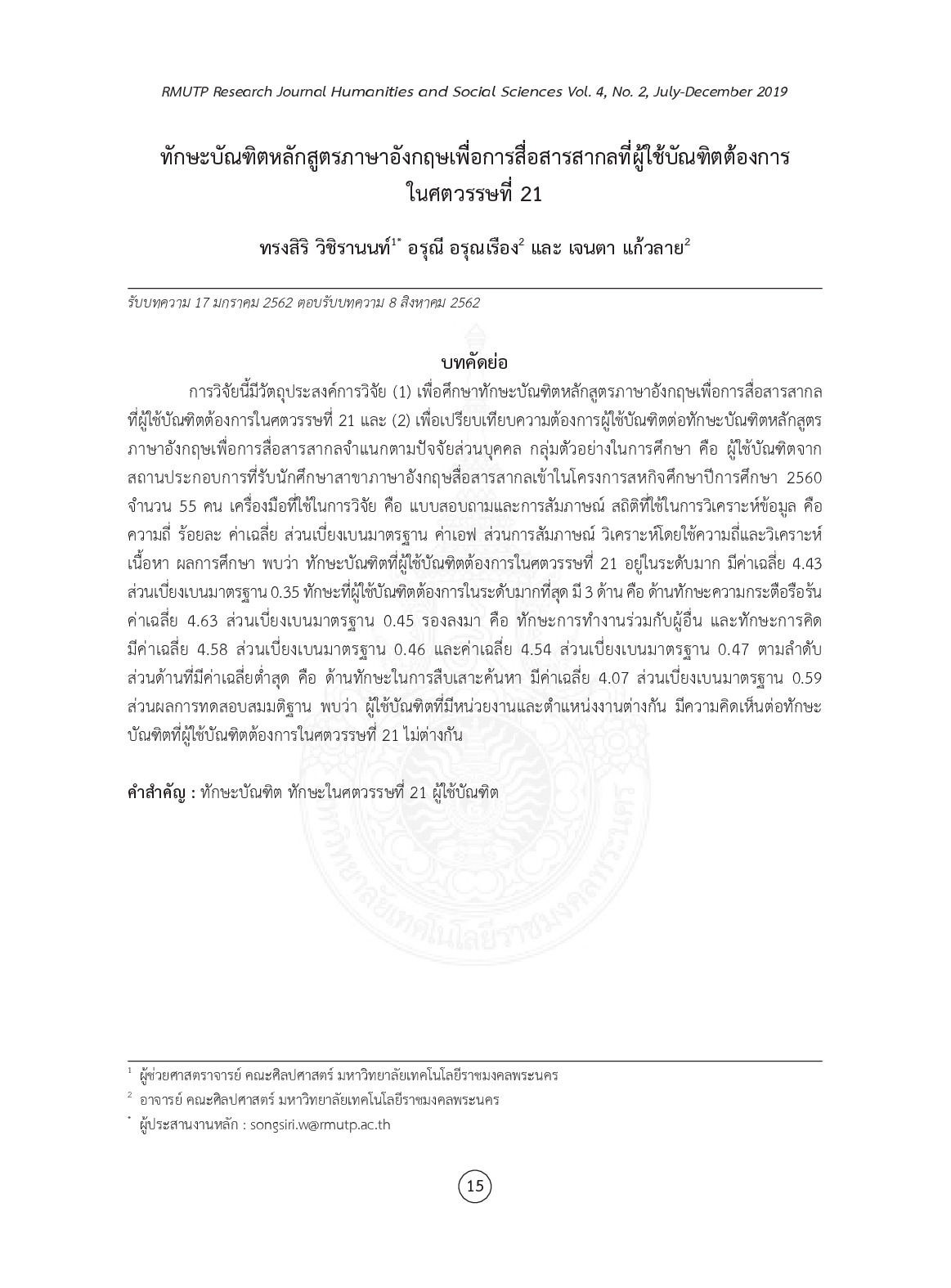
ทักษะบัณฑิตหลักสูตรภาษาอังกฤษเพื่อการสื่อสารสากลที่ผู้ใช้บัณฑิตต้องการในศตวรรษที่ 21
The purposes of the research were to 1) study the 21st century skills of English for International Communication graduates desired by employers and 2) compare the employers’ requirements to skills of English for International Communication graduates categorized by the individual factors. The sample were 55 employers participating in the cooperative education project in the academic year 2017. The research tools were questionnaires and interviews. The statistical data analysis was performed by frequency percentage mean standard deviation and F distribution and the interview data analysis was performed by frequency and content analysis. It was found that the overall requirement of the employers for the 21st century skills of the graduates was at the high level (χ = 4.43 S.D = .35). As for each attribute the highest level was enthusiasm (χ = 4.63 S.D = .45) followed by collaboration (χ = 4.58 S.D = .46) and thinking skills (χ = 4.54 S.D = .47) respectively. The lowest level was the inquiry skills (χ = 4.07 S.D = .59). The result of the research hypothesis revealed that there is no significant difference between the employers with different employment sectors and working status and the requirement of the graduates’ attributes.