จำนวน Repository ( 4 )
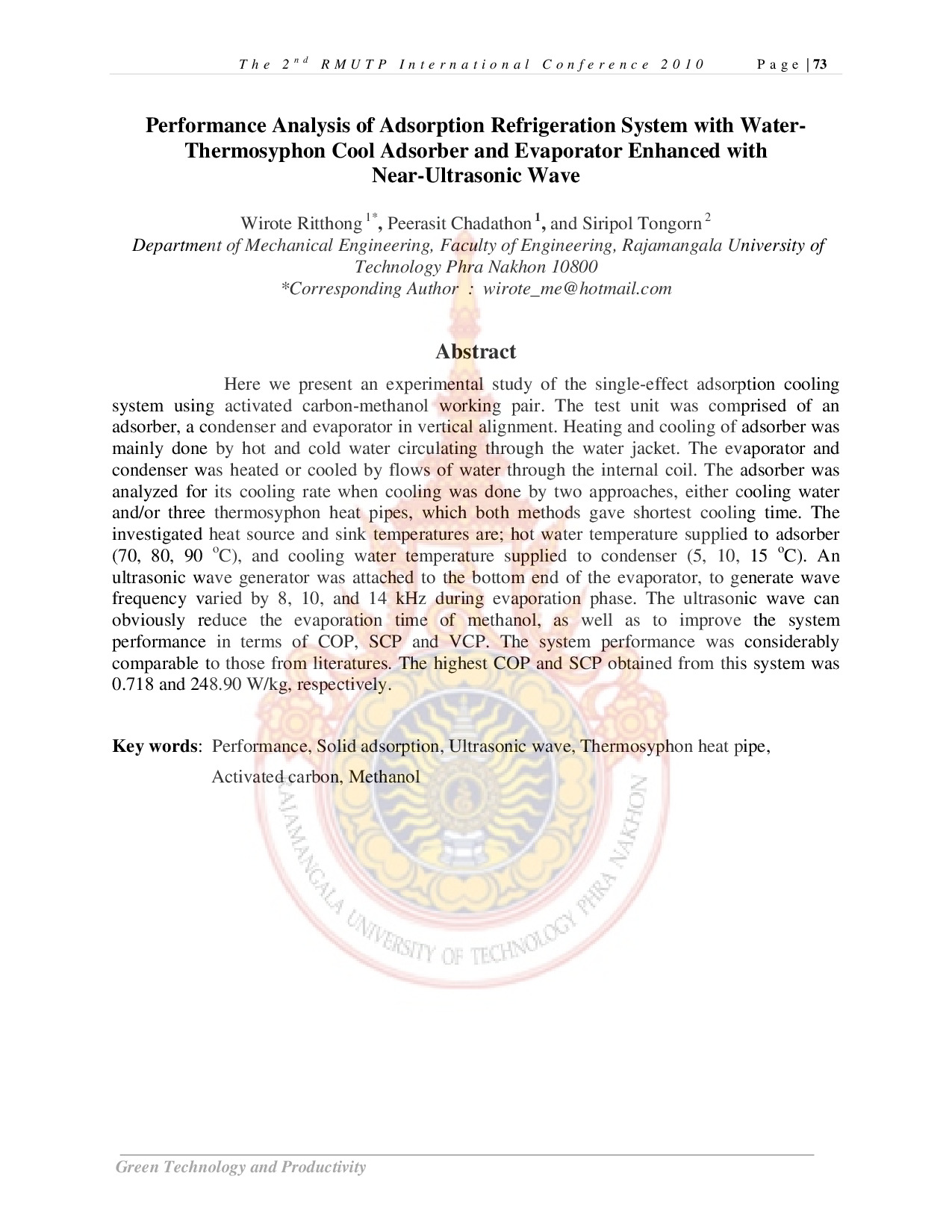
Performance Analysis of Adsorption Refrigeration System with Water-Thermosyphon Cool Adsorber and Evaporator Enhanced with Near-Ultrasonic Wave
Here we present an experimental study of the single-effect adsorption cooling system using activated carbon-methanol working pair. The test unit was comprised of an adsorber a condenser and evaporator in vertical alignment. Heating and cooling of adsorber was mainly done by hot and cold water circulating through the water jacket. The evaporator and condenser was heated or cooled by flows of water through the internal coil. The adsorber was analyzed for its cooling rate when cooling was done by two approaches either cooling water and/or three thermosyphon heat pipes which both methods gave shortest cooling time. The investigated heat source and sink temperatures are; hot water temperature supplied to adsorber (70 80 90 oC) and cooling water temperature supplied to condenser (5 10 15 oC). An ultrasonic wave generator was attached to the bottom end of the evaporator to generate wave frequency varied by 8 10 and 14 kHz during evaporation phase. The ultrasonic wave can obviously reduce the evaporation time of methanol as well as to improve the system performance in terms of COP SCP and VCP. The system performance was considerably comparable to those from literatures. The highest COP and SCP obtained from this system was 0.718 and 248.90 W/kg respectively.
กลยุทธ์การประหยัดพลังงานในระบบทำความเย็นด้วยการจัดการระบบละลายน้ำแข็ง
Defrosting at evaporator panel is one of working cycles in freezer. Power consumption in defrosting does not meet the objective of using freezer therefore the approach to decrease power consumption in defrosting is one strategy for energy saving. Normally the cycle of defrosting in freezer is a constant time that specify by referring to the highest humidity period. With this control concept the problem of temperature exchange is not occurred from ice accumulation at evaporator panel but it makes the over necessity of defrosting process in the low humidity season and cause the unnecessary power usage in freezer. This thesis presents the control approach for defrosting by using the difference of the temperature at evaporator and the temperature at chilling area. By using this approach the defrosting process is operated depend on load and the fan is on or off relate to defrosting time. Test results demonstrate that about 12% of power can be saved by this control approach when compared to constant time control.

The feasibility study of recovery N-Methyl-Pyrrolidone and Acetone
The objective of this work was to study the feasibility of recovery N-Methyl-Pyrrolidone (NMP) and acetone solution in cleaning the slider fabrication process in the manufacturing process of hard disk drive by distillation. The operating parameters such as pressure (50 - 500 mbar) temperature (60 - 110 C) and time (20 - 70 minutes) were investigated. The highest purity of solution was ca 98.12 %of N-Methyl-Pyrrolidone at 110 C 200 mbar with 30 minutes that it is sufficiently purity to be re-used. This solution could be produced with 0.33 Liter/hour with 405 Baht/Liter (excluding investment cost) that would be saved 565 Baht/Liter and environmentally friendly with clean technology.
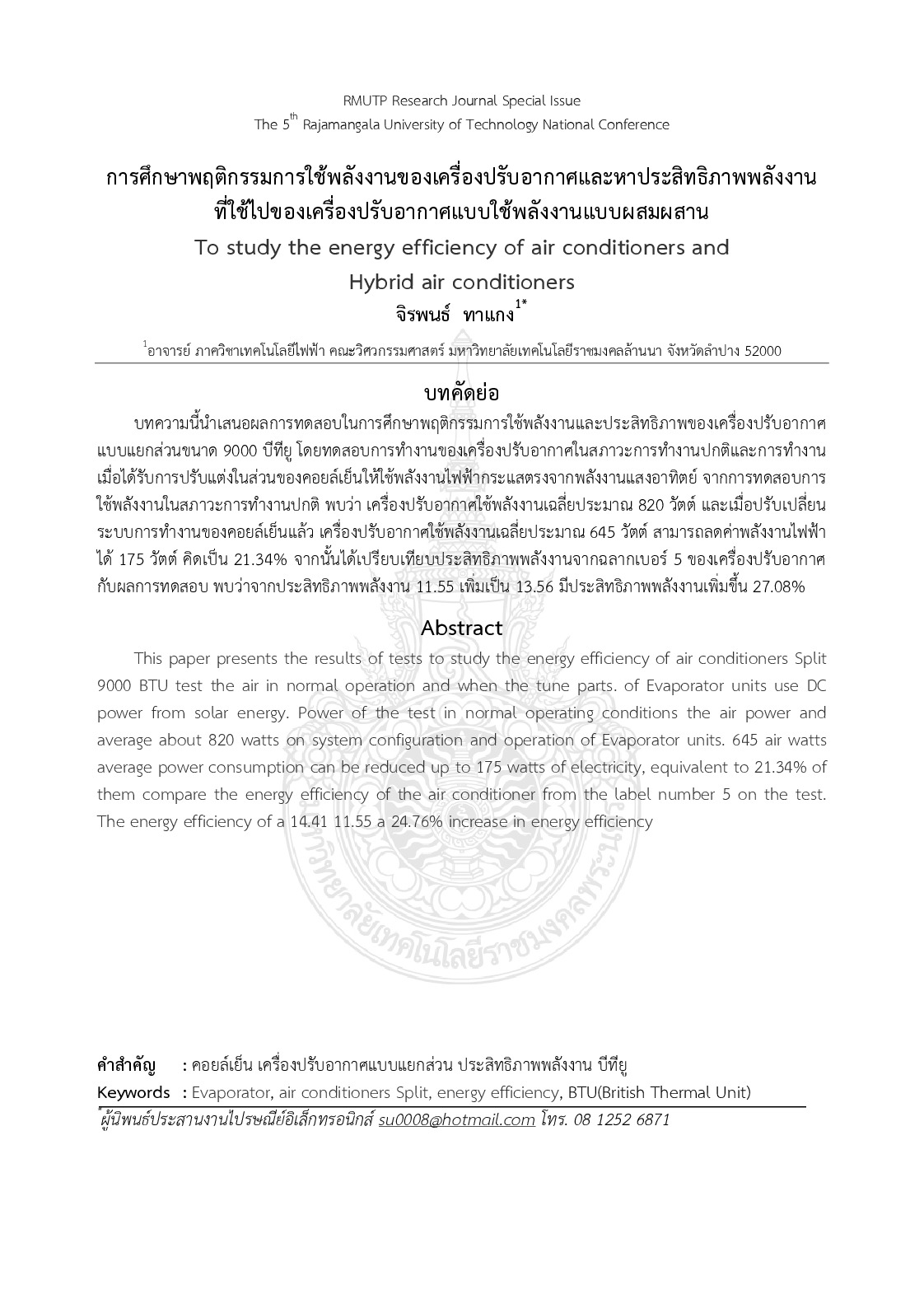
To study the energy efficiency of air conditioners and hybrid air conditioners
This paper presents the results of tests to study the energy efficiency of air conditioners Split 9000 BTU test the air in normal operation and when the tune parts. of Evaporator units use DC power from solar energy. Power of the test in normal operating conditions the air power and average about 820 watts on system configuration and operation of Evaporator units. 645 air watts average power consumption can be reduced up to 175 watts of electricity equivalent to 21.34% of them compare the energy efficiency of the air conditioner from the label number 5 on the test. The energy efficiency of a 14.41 11.55 a 24.76% increase in energy efficiency