จำนวน Repository ( 5 )

การวิเคราะห์ปัจจัยที่มีผลต่อปริมาณน้ำมันตะไคร้หอมจากเครื่องกลั่นด้วยการออกแบบการทดลอง
The purposes of this research were to investigate the factors consisted of a temperature different parts of the lemongrass and a size of chopped lemongrass that affected to distillation of lemongrass essential oils. There are two experiments in this work. The first experiment investigated the factors by defining 1) temperature at 105 oC and 110 oC 2) different parts of the lemongrass (Leaves and trunk) and 3) sizes of chopped lemongrass at 1-2 cm and 15-20 cm respectively. 2k Factorial designs method was used for this experiment. In the second experiment the appropriate parameters from experiment 1 were used for 3 replicates to find an average of lemongrass essential oils. The results of first experimental analysis showed that the appropriate parameters were temperature parts of the lemongrass and sizes of chopped lemongrass at 110 oC leaves and 1-2 cm respectively. For the result of experiment 2 it was found that the average of lemongrass essential oils was 30.36 ml.
Optimization for sewing machine setup using experimental design technique
The objective of the research was to identify the optimized thread tensile values for the setup of Model D – We 1218-55 computerized 18-needles sewing machine in order to minimize a number of times the machine halts. The cause of the sewing machine halting which reduced the efficiencies of the machine was found to be torn threads. In order to maximize the efficiencies the experimental design technique was utilized to find the optimal values for five types of cloth: polo tc-cool cotton jacket and shirt. The method involved three nested designs which are the type of thread number of sewing layers and thread-hole size. The three thread tensile levels experimented were low (2 oz.) medium (5 oz.) and high (8 oz.) and the response was the number of times the machine halted in the span of 30 minutes. The ANOVA (Analysis of Variance) used for the experimental design showed that the three factors significantly affected the machine’s halt. The number of times the machine halted was used to create Surface Plot with polynomial trend-lines and the quadratic equation was applied to determine the optimal value for each type of thread number of sewing layers and thread-hole size. The values obtained were then set for another experiment the results of which were that the sewing machine halted less frequently and the efficiencies thus increased about by 77.01%.
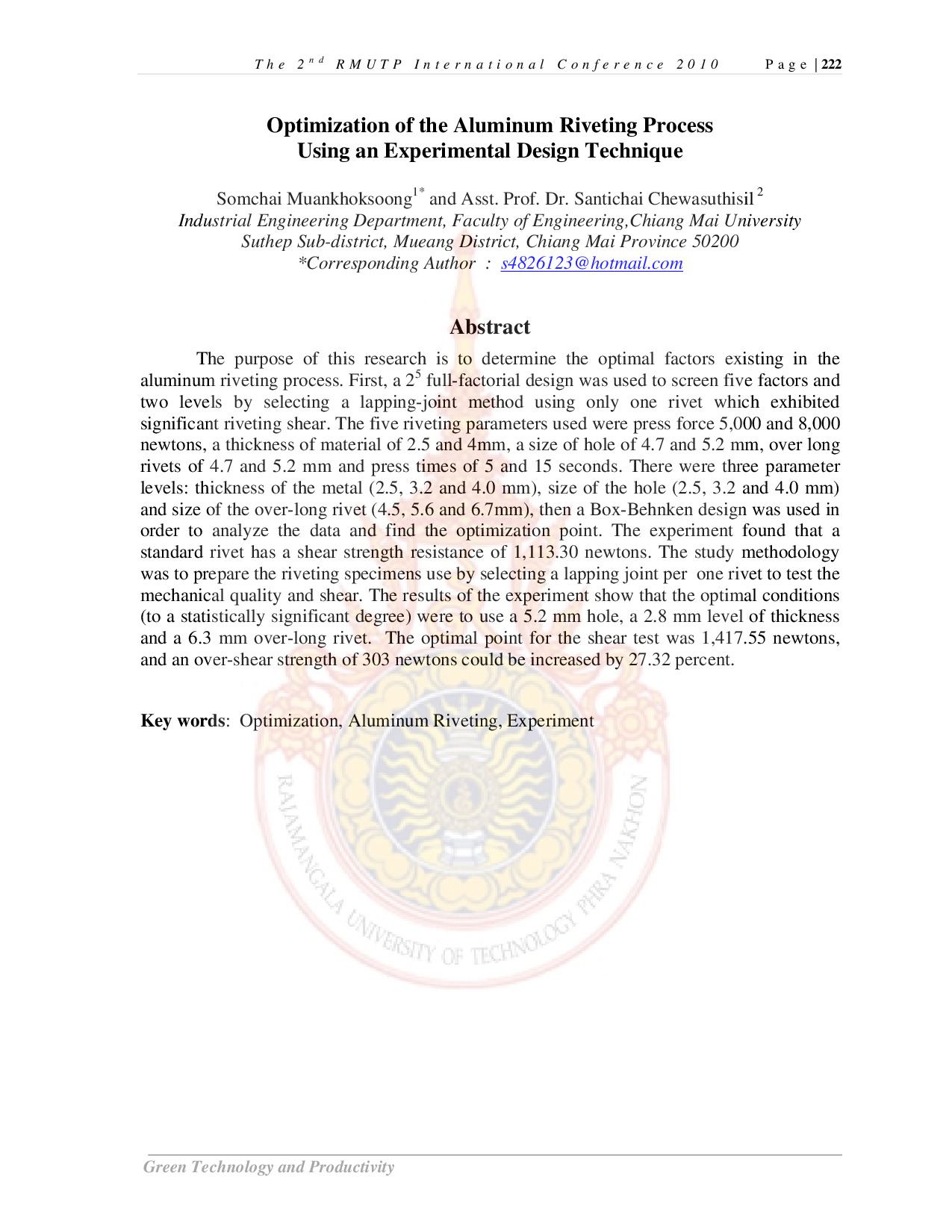
Optimization of the Aluminum Riveting Process Using an Experimental Design Technique
The purpose of this research is to determine the optimal factors existing in the aluminum riveting process. First a 25 full-factorial design was used to screen five factors and two levels by selecting a lapping-joint method using only one rivet which exhibited significant riveting shear. The five riveting parameters used were press force 5000 and 8000 newtons a thickness of material of 2.5 and 4mm a size of hole of 4.7 and 5.2 mm over long rivets of 4.7 and 5.2 mm and press times of 5 and 15 seconds. There were three parameter levels: thickness of the metal (2.5 3.2 and 4.0 mm) size of the hole (2.5 3.2 and 4.0 mm) and size of the over-long rivet (4.5 5.6 and 6.7mm) then a Box-Behnken design was used in order to analyze the data and find the optimization point. The experiment found that a standard rivet has a shear strength resistance of 1113.30 newtons. The study methodology was to prepare the riveting specimens use by selecting a lapping joint per one rivet to test the mechanical quality and shear. The results of the experiment show that the optimal conditions (to a statistically significant degree) were to use a 5.2 mm hole a 2.8 mm level of thickness and a 6.3 mm over-long rivet. The optimal point for the shear test was 1417.55 newtons and an over-shear strength of 303 newtons could be increased by 27.32 percent.

การออกแบบชุดปีกหน้า และปีกหลัง สำหรับรถแข่งสูตรนักศึกษา
Problem with the development of performance for racing cars. When a car is without a front wing and rear wing it will affect the racing car unstable. So we had an idea to study and design the front wing and rear wing for installation on a student formula racing car to increase efficiency the racing car turning when is compared with the racing car without front wing and rear wing. In operation. First plan the implementation of the project. Then study subject content such as Computational Fluid Dynamics Fluid Mechanics Aerodynamics TSAE competition rules and steps to using the SOLIDWORKS Program. We use SOLIDWORKS to compare the aerodynamic performance of each front and rear wing and analyze the results. Flow Simulation using the SOLIDWORKS Program We have got Flow Simulation performed on the front wing and rear wing of 1 2 and 3 elements. In terms of flow simulation we use a 50 km/h wind speed to hit the front and rear wings. The results showed that the front wing and rear wing when assembled with a car. We have studied and selected the angle of attack that has the highest life coefficient to be assembled on the Student Formula Racing Car. The Front Wing and Rear Wing are 2 elements of the Front Wing and 2 elements of the Rear Wing. They have a Drag Coefficient of 0.38 and a Lift Coefficient of 0.30.
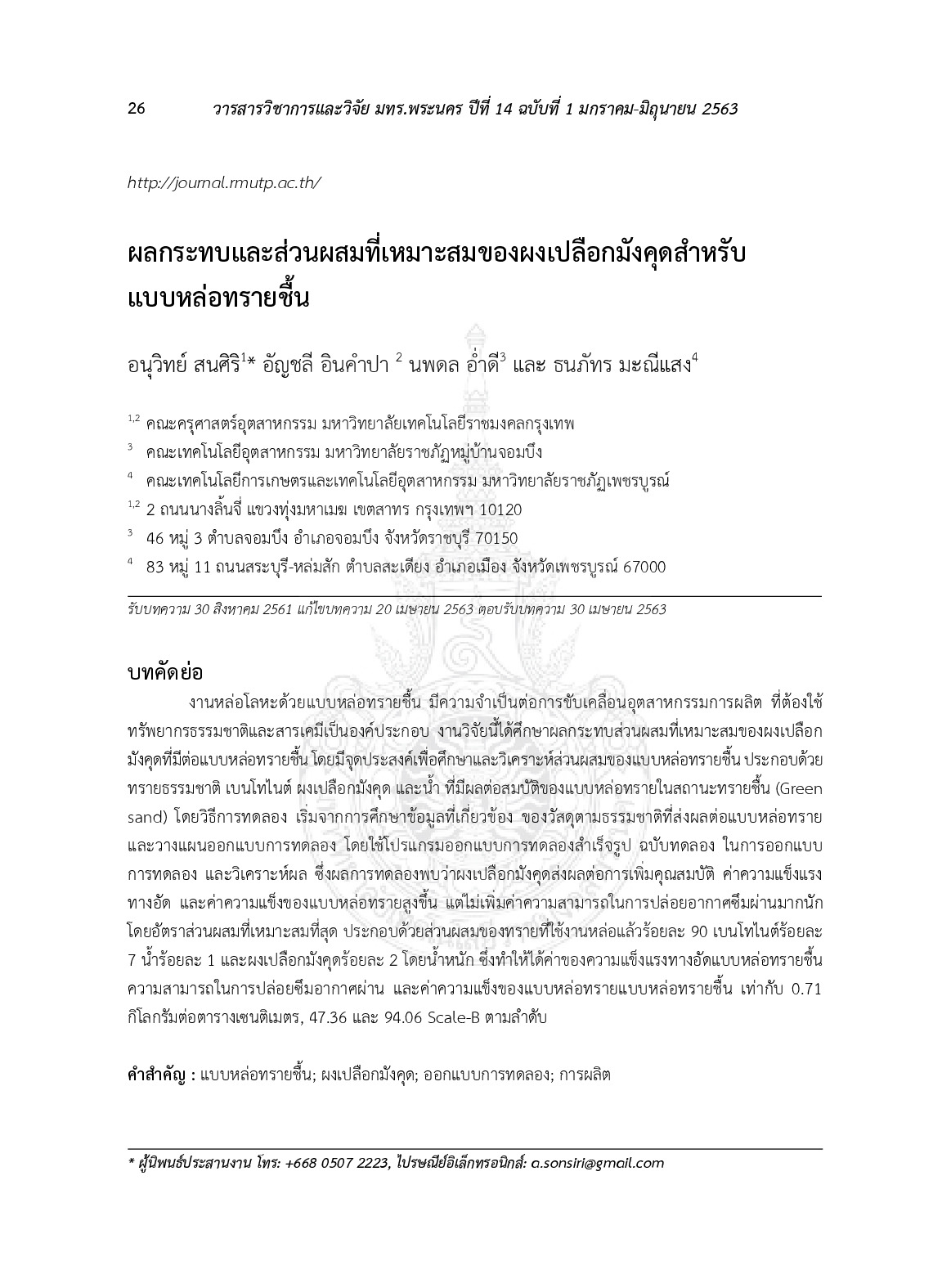
ผลกระทบและส่วนผสมที่เหมาะสมของผงเปลือกมังคุดสำหรับแบบหล่อทรายชื้น
Metal casting with Green sand mold is essential for participation in the manufacturing industry that requires natural resources and chemicals as an element. This research studied the effects of the right mix of mangosteen shell powder on green sand mold. The objective is to study and analyze the mixture of moist sand formations consisting of natural sand bentonite mangosteen shell powder and water affecting the properties of green sand mold by experiment method. Starting from studying relevant information of natural materials that affect sand mold and planning experimental design by using the experimental design program for the trial version in the experimental design and analyze results. The results showed that mangosteen peel powder had an effect on the properties Compression strength and higher hardness of sand mold but does not increase the ability to release a lot of air permeability The optimum blend ratio was composed of 90% reused sand 7% bentonite 1% water and 2% mangosteen powder by weight air permeability. The hardness of the sand casting was 0.71 kg/cm2 47.36 and 94.06 Scale B respectively.