จำนวน Repository ( 5 )

Fuel consumption monitoring system using control signal and characteristic correlations of fuel injector
Objectives of this study are (i) to investigate characteristics of a fuel injector and to establish the characteristic correlation for correcting the fuel injection rate calculated from the control signal of a fuel injector and (ii) to design and fabricate the fuel consumption monitoring system by measuring the control signal of fuel injector in conjunction with considering the obtained characteristic correlation to enhance accuracy of the measured fuel consumption rate. The characteristics of a fuel injector (maximum fuel injection rate of 270 cm3/min) e.g. engine speeds percentages of injector’s duty cycle and pressure differences between fuel rail and intake manifold were experimentally investigated on a test set in the laboratory. The study found that when the engine speed increased the fuel injection rate increased. When the percentages of infector’s duty cycle increased the increasing ratio was less than the one-to-one increasing ratio as a case of the ideal. Moreover when the pressure difference increased the fuel injection rate increased. After that the fuel consumption monitoring system was designed and fabricated based on the Arduino Mega 2560 microcontroller. Trip distance was measured by a GPS module. The real-time fuel consumption rate could be shown on a LCD display. All recorded data were stored onto a SD card for further data analysis. Finally the on-road-test validation was conducted by on the 2011 Mitsubishi Triton installed with the 4-cylinder gasoline engine with total displacement of 2351 cm3. It was found from that the average discrepancy of the measured fuel volume was ± 1.88% compared to the actual fuel volume obtained by measuring a decreasing volume of consumed fuel.
การศึกษาระดับความดันลมยางและปริมาตรกระบะที่ส่งผลต่ออัตราสิ้นเปลืองเชื้อเพลิง
The aim of this project is to study the fuel consumption from the effect of tire pressure and tray volume. In order to tire pressure is consist of 2 conditions by: Road test and Roller test Bench. Their test is classified by 3 cases: standard tire pressure lower standard tire pressure and upper standard tire pressure. Furthermore the lower and upper standard tire pressure was compared with standard tire pressure. In case of seal and unseal of the tray volume was test with 2 postulates by Road test and water tunnel (model). The results of experiment with 3 cases of tire pressure found that the lower standard tire pressure (25/37 psi) given to the maximum fuel consumption when compare with standard tire pressure 4.6%. While the minimum fuel consumption is upper standard tire pressure (33/45 psi) or 1.29%. Furthermore the trend of those conditions was in the same direction. For the result of test in term of seal and unseal of the tray volume discovered to the fuel consumption in case of seal is lower than unseal of the tray volume 1.63%. And the result of test of the water tunnel has been the same direction with the Road test.
การศึกษาเทคโนโลยีที่เหมาะสมกับการลดมลพิษและอัตราการสิ้นเปลืองเชื้อเพลิงของหัวรถจักร เพื่อความคุ้มค่าต่อการลงทุน
Presently the rail transit system plays a major role in the commercial world that they currently use diesel engine not only causing to a lot of fuel consumption but also generating numerously pollution. Therefore this project aims to study the break-even point of investment under comparison of brake specific fuel consumption and pollution of locomotive engines. By experimental works there are 3 types of locomotive engine: Pielstick M.T.U. and Caterpillar which are the difference of the combustion chamber and the fuel injection systems. The simulation load on the static tests (Dynamometer) was used following the regulation characteristic curve which is standard of State Railway of Thailand. As a result of testing the engine using common rail type of fuel injection system M.T.U. was the lowest brake specific fuel consumption at all of engine by the average of all engine speed 206 g/kW-h of brake specific fuel consumption. It is lower than Caterpillar (Semi common rail with direct injection) which is 314 g/kW-h equivalent 34.39 % while Pielstick engine a mechanism fuel injection system is 389 g/kW-h equivalent 47.04 % For pollution area there are Hydrocarbon (HC) Nitrogen Oxide (NOX) and black smut. The engine with direct injection system relieved the previous substance less than the pre-combustion engine. Moreover the compound of carbon monoxide (CO) was found that the pre-combustion engine (Pielstick) discharged carbon monoxide (CO) less than the direct injection engine (Caterpillar) whereas the common rail engine emancipated same substan cenear by with the pre-combustion engine (Pielstick). However the new technology of the engines is high maintenance costs. Therefore a number of applications have to be needed to make a quantitative value for the investment.
The design and construction of remote control lawn mower by radio wave
Thesis is the development of radio-controlled lawn mower which can move and cut the grass in the desired environment and dangerous to human. The objective is to develop a radio-controlled lawn mower. The results showed that the rate of fuel consumption of controlled lawn mower in to cutting grass. The height of the grass at 6 8 and 10 cm. It has the average fuel consumption is 113 117 and 123 ml. The average time in the mowing is 6.6 8.01 and 9.69 minutes
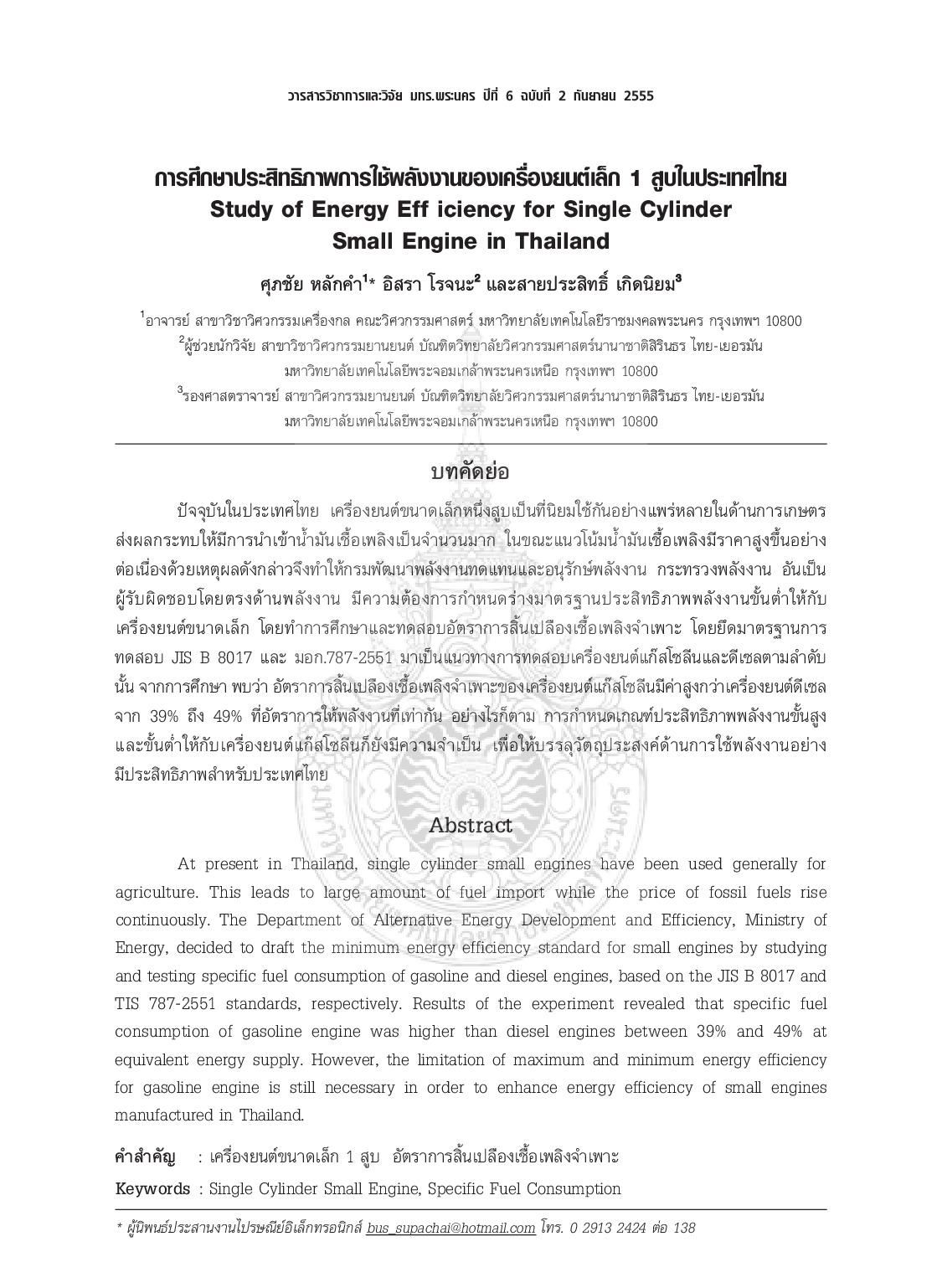
Study of Energy Efficiency for Single Cylinder Small Engine in Thailand
At present in Thailand single cylinder small engines have been used generally for agriculture. This leads to large amount of fuel import while the price of fossil fuels rise continuously. The Department of Alternative Energy Development and Eff iciency Ministry of Energy decided to draft the minimum energy eff iciency standard for small engines by studying and testing specif ic fuel consumption of gasoline and diesel engines based on the JIS B 8017 and TIS 787-2551 standards respectively. Results of the experiment revealed that specif ic fuel consumption of gasoline engine was higher than diesel engines between 39% and 49% at equivalent energy supply. However the limitation of maximum and minimum energy eff iciency for gasoline engine is still necessary in order to enhance energy eff iciency of small engines manufactured in Thailand