จำนวน Repository ( 46 )

การศึกษาความพร้อมด้านการผลิตบัณฑิต ของคณะบริหารธุรกิจ มหาวิทยาลัยเทคโนโลยีราชมงคลพระนคร เพื่อรองรับการก้าวเข้าสู่ประเทศไทย 4.0
This research aims to study the readiness of graduates to match the labor market and the development of graduates to adapt and develop themselves to meet the policy of Thailand 4.0 by quantitative study. The quantitative method was used by the Faculty of Business Administration. Establishment A total of 20 establishments. The statistics used for data analysis were Frequency Percentage Mean. The research found that the surveyed enterprises were divided into private government and state enterprises. There are 7 government agencies 33.3% 11 enterprises 52.4% and 14.3% of state enterprises. There are 61.90476 and the duration of the establishment is 0-11 years. The availability of students for cooperative education is 3.4762 at the moderate level. The average score of 3.5218 was moderate. The overall composition of computer languages and programs is also the current popular SQL and Photoshop languages of the establishments. Findings from research on the readiness of graduate production. Of the Faculty of Business Administration Rajamangala University of Technology Phra Nakhon to support the move to Thailand 4.0 the current technology has changed dramatically. The curriculum and the academic development should be in line with the changes. Students should always develop themselves.
การพัฒนรูปแบบการเรียนการสอนแบบบูรณาการโดยวิธีการจัดประสบการณ์ตามแนวคิดคอนสตรัคติวิสต์รายวิชาทักษะการรู้สารสนเทศของนักศึกษา มหาวิทยาลัยเทคโนโลยีราชมงคลพระนคร
This research aimed to : 1) study the constructivist teaching method through cooperative learning activities to enable students’ self-instruction 2) to design the cooperative teaching and learning model based on the constructivism for the information literacy and research skills course for the students at Rajamangala University of Technology Phra Nakhon and 3) to develop the constructivist-cooperative teaching and learning instruction to develop critical thinking and learning achievement for the information literacy and research skills course at Rajamangala University of Technology Phra Nakhon. This research used a mixed-method between quantitative research and qualitative research. The data were collected from 30 students using the questionnaire approved by the experts. The in-depth interviewed data from five students who were fast acute and adept learners were analyzed and processed. The computerized statistics were percentage mean and standard deviation. The qualitative data were analyzed for content (Content Analysis). The findings showed that the students had the opinion at a high level about the model of constructivist-cooperative teaching and learning model in the information literacy skills course. Regarding each aspect it was found that the students were extremely satisfied with the constructivist-cooperative teaching and learning model. The following satisfaction lied in the development of the teaching and learning model and the trial of the model conducted with real students to see any potential flaws for further improvement and development of appropriate and effective instruction models. In addition the opinions of the informants were accordant with those of the students. The model should focus on the content and the instruction design. Group works should be used so that students can help each other. Experts in constructivism should play a main role in the development of a constructivist-cooperative instruction model. The constructivist-cooperative instruction model should be implemented with real students. The results can be further used for improvement and development of appropriate and effective instruction models.
ความคิดเห็นของสถานประกอบการที่มีต่อทักษะบัณฑิตสาขาวิชาภาษาอังกฤษเพื่อการสื่อสารสากลในศตวรรษที่ 21
The purposes of the research were to 1) study the attributes of the graduates according to standards of learning outcome 2) study the 21st century skills of English for International Communication graduates desired by employers 3) compare the attributes of the graduates according to standards of learning outcome categorized by the individual factors and 4) compare the employers’ requirements to skills of English for International Communication graduates categorized by the individual factors. The population were 55 employers participating in the cooperative education project in the academic year 2017. The research tools were questionnaires and interviews which were analyzed by the SPSS program. The statistical data analysis was performed by frequency percentage mean standard deviation and Fdistribution and the interview data analysis was performed by frequency and content analysis. The results were found as follows. 1. As for the employers information33emoloyets were from private and service businesses (60%) and 14 employets were from government sectors (25.50%).As for the working statuses29 employers were the officers (53.70%) 20 employer were the supervisors (37.00%) and 5 employers weie mangers (9.30%) 2. The overall requirement of hte employers for the attrbutes of the graduates according to standandards of learning outcome was at the high level (=4.48). As for each attribute morals and ethcs were the most desirable (=4.75) the second highest level was interpersonal skils and accountabiliy (4.57) and the last one was the intellectual skills (=4.25) 3. The overall requirement of the ernptoyers for the 21st century skills of the graduates was at the high level (=4.43). As for each attribute the highest level was enthusiasm collaboration and thinking skills respectivrty (=4.634.58 and 4.54) The lowest tevel was the inquiry skills (=4.07). 4.The results of the research hypothesis were; 4.1 There was a significant difference between the employers with different employrment sectors (government and service business sectors) and the requirement of the graduates attributes. There was no significant difference between the employers with different working status and the requirement of the graduates attributes. 4.2 There is no significant difference between the employers with diferent employent sectors and working status and the requirement of the graduates attributes.
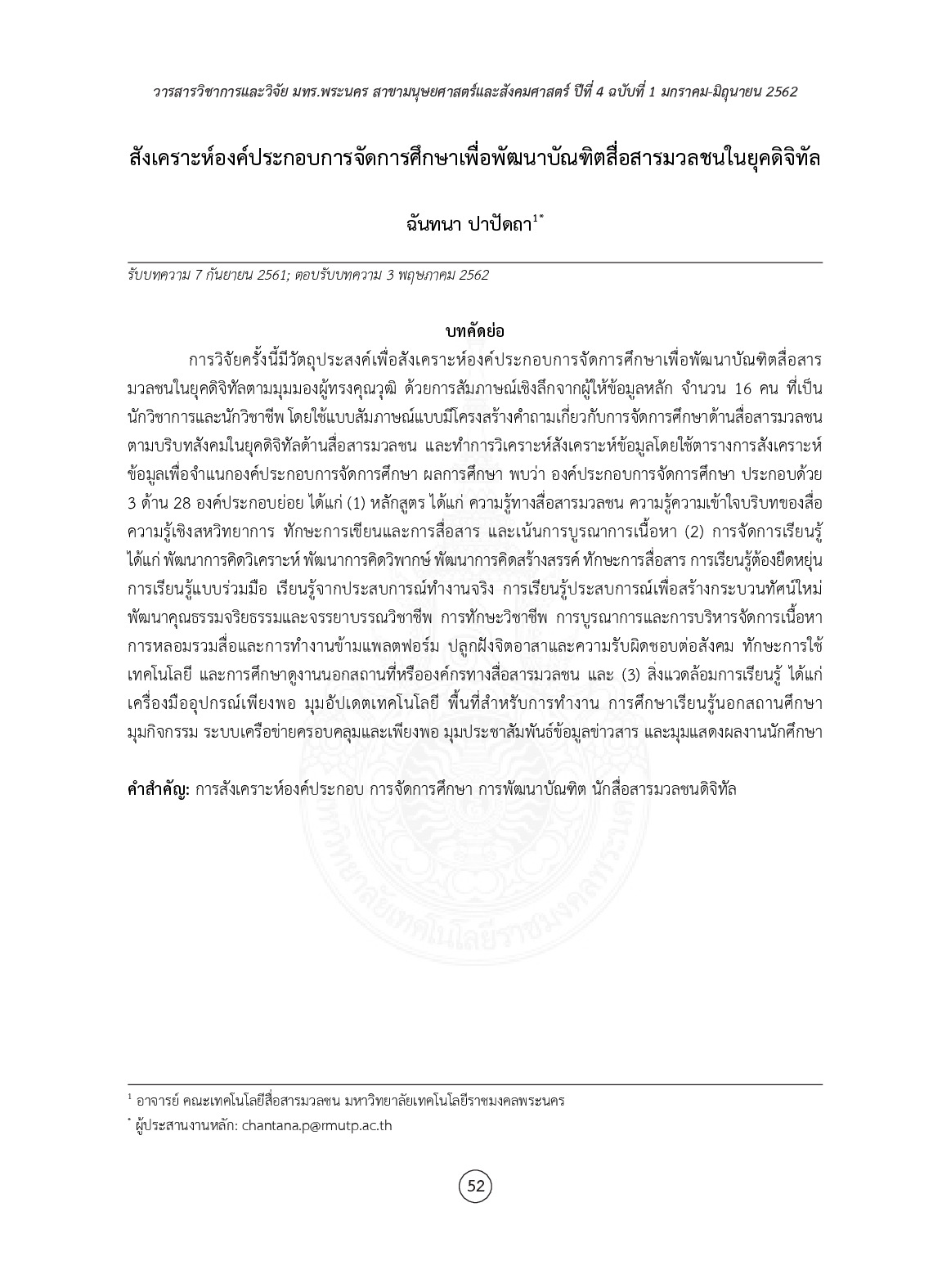
สังเคราะห์องค์ประกอบการจัดการศึกษาเพื่อพัฒนาบัณฑิตสื่อสารมวลชนในยุคดิจิทัล
The purpose of the study was to synthesize the element of educational management to develop graduates of mass communication in digital era according to the views of experts. The data were collected by an in-depth interview using structured interview about of mass communication education in social context and digital era from 16 experts who were academics and professionals in mass commmunication. Data analysis and synthesis by using data synthesis tables to classify elements of education. It was found that: There were three main elements and 28 minor ones of educational management forms as follows: (1) Curriculum: knowledge of mass communication perception of media contexts interdisciplinary knowledge writing and communication skill and the integration of contents. (2) Learning management: analysis thinking development critical thinking development creative thinking development communication skill flexible learning cooperative learning action learning experiential learning to build new paradigm development of morals and work ethics professional skills integration and content management media convergence and cross-platform media nurturing of volunteering spirit and social responsibility technology literacy skills technical visits to mass communication organization. (3) Learning environment: sufficient equipment updated technology work space sightseeing activity corner covered network and accessibility news and information cornerand student work exhibition corner.
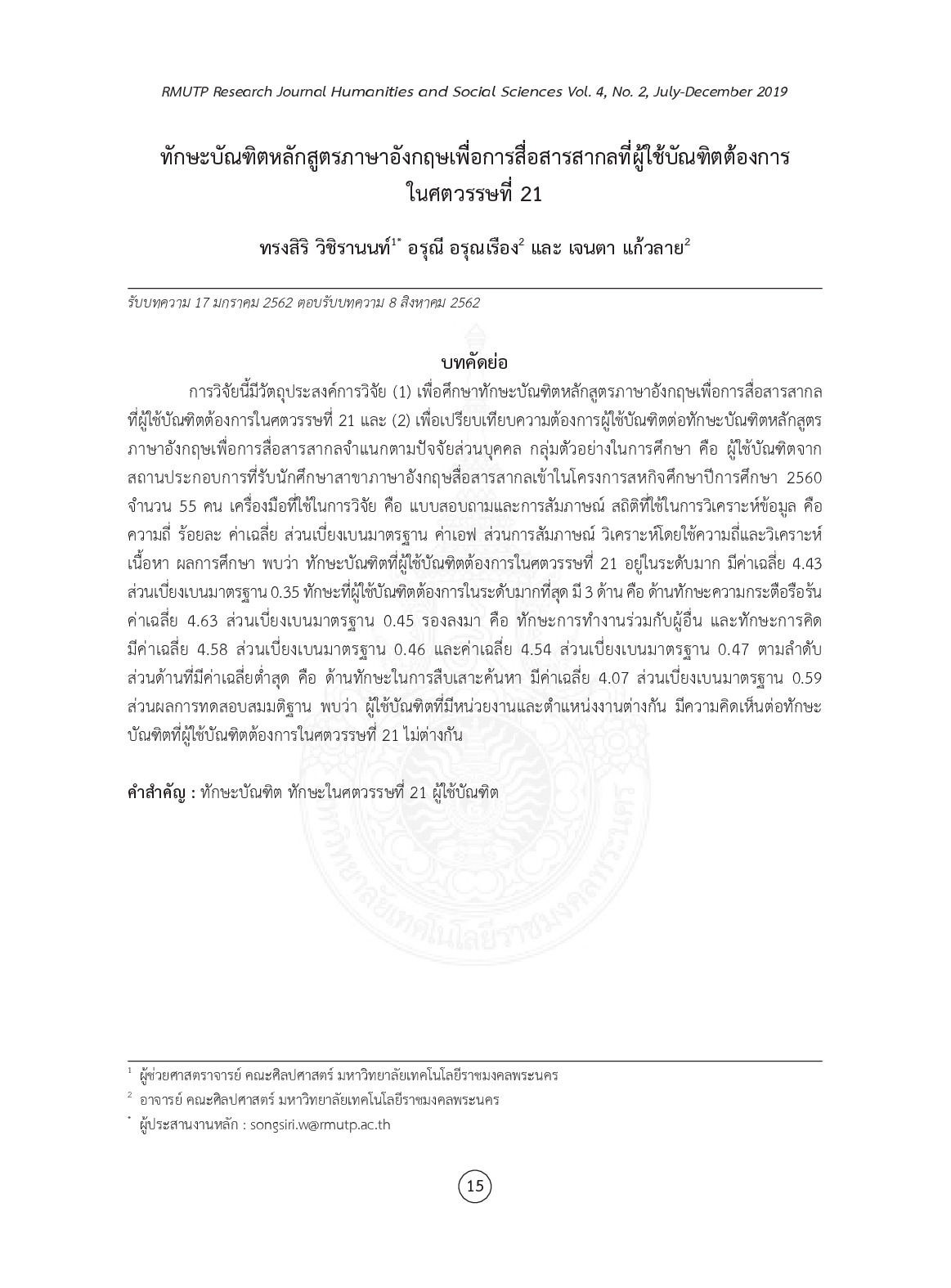
ทักษะบัณฑิตหลักสูตรภาษาอังกฤษเพื่อการสื่อสารสากลที่ผู้ใช้บัณฑิตต้องการในศตวรรษที่ 21
The purposes of the research were to 1) study the 21st century skills of English for International Communication graduates desired by employers and 2) compare the employers’ requirements to skills of English for International Communication graduates categorized by the individual factors. The sample were 55 employers participating in the cooperative education project in the academic year 2017. The research tools were questionnaires and interviews. The statistical data analysis was performed by frequency percentage mean standard deviation and F distribution and the interview data analysis was performed by frequency and content analysis. It was found that the overall requirement of the employers for the 21st century skills of the graduates was at the high level (χ = 4.43 S.D = .35). As for each attribute the highest level was enthusiasm (χ = 4.63 S.D = .45) followed by collaboration (χ = 4.58 S.D = .46) and thinking skills (χ = 4.54 S.D = .47) respectively. The lowest level was the inquiry skills (χ = 4.07 S.D = .59). The result of the research hypothesis revealed that there is no significant difference between the employers with different employment sectors and working status and the requirement of the graduates’ attributes.