จำนวน Repository ( 2 )
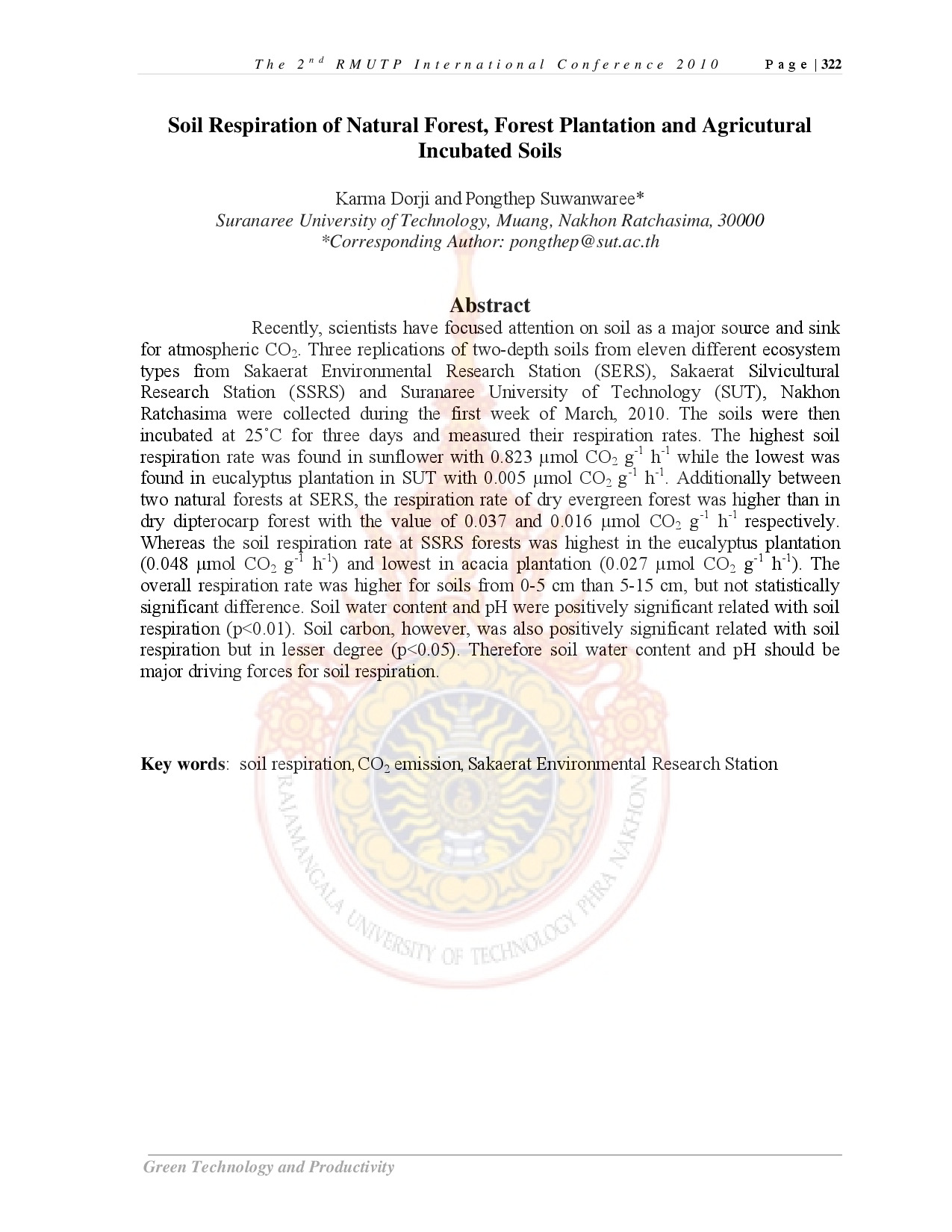
Soil Respiration of Natural Forest, Forest Plantation and Agricutural Incubated Soils
Recently scientists have focused attention on soil as a major source and sink for atmospheric CO2. Three replications of two-depth soils from eleven different ecosystem types from Sakaerat Environmental Research Station (SERS) Sakaerat Silvicultural Research Station (SSRS) and Suranaree University of Technology (SUT) Nakhon Ratchasima were collected during the first week of March 2010. The soils were then incubated at 25°C for three days and measured their respiration rates. The highest soil respiration rate was found in sunflower with 0.823 μmol CO2 g-1 h-1 while the lowest was found in eucalyptus plantation in SUT with 0.005 μmol CO2 g-1 h-1. Additionally between two natural forests at SERS the respiration rate of dry evergreen forest was higher than in dry dipterocarp forest with the value of 0.037 and 0.016 μmol CO2 g-1 h-1 respectively. Whereas the soil respiration rate at SSRS forests was highest in the eucalyptus plantation (0.048 μmol CO2 g-1 h-1) and lowest in acacia plantation (0.027 μmol CO2 g-1 h-1). The overall respiration rate was higher for soils from 0-5 cm than 5-15 cm but not statistically significant difference. Soil water content and pH were positively significant related with soil respiration (p<0.01). Soil carbon however was also positively significant related with soil respiration but in lesser degree (p<0.05). Therefore soil water content and pH should be major driving forces for soil respiration.

การตรวจสอบความเป็นสารปอซโซลานของเถ้าแกลบผสมเถ้าลอยโดยวิธีการบ่มเร่งกำลัง
This paper presents the investigation of pozzolanic reaction of rice husk ash blended with fly ash by accelerated curing. The compressive strength of cement paste containing rice husk ash blended with fly ash at 30% by weight of cementitious material (PBA-30) was studied. The temperature curing at 60 70 and 80oC were parameter of test in order to determine the suitable temperature and curing period on strength development of cement paste. The ratio of rice husk ash to fly ash was 1:1 by weight and the ratio of water-to-binder (w/b) was 0.38. The test results found that the accelerated curing of PBA-30 at temperature of 60oC for 5 10 and 45 hours had comparable compressive strength to PBA-30 with normal curing at the age of 37 and 28 days respectively. As a result of accelerated curing the calcium silicate (CS) which effect on strength development of cement paste was increased. According to the X-ray diffraction analysis the calcium silicate content in cement paste was comparable. Therefore it can be use accelerated curing to investigate the poozolanic reaction of rice husk ash blended with fly ash within 48 hours.