จำนวน Repository ( 4 )
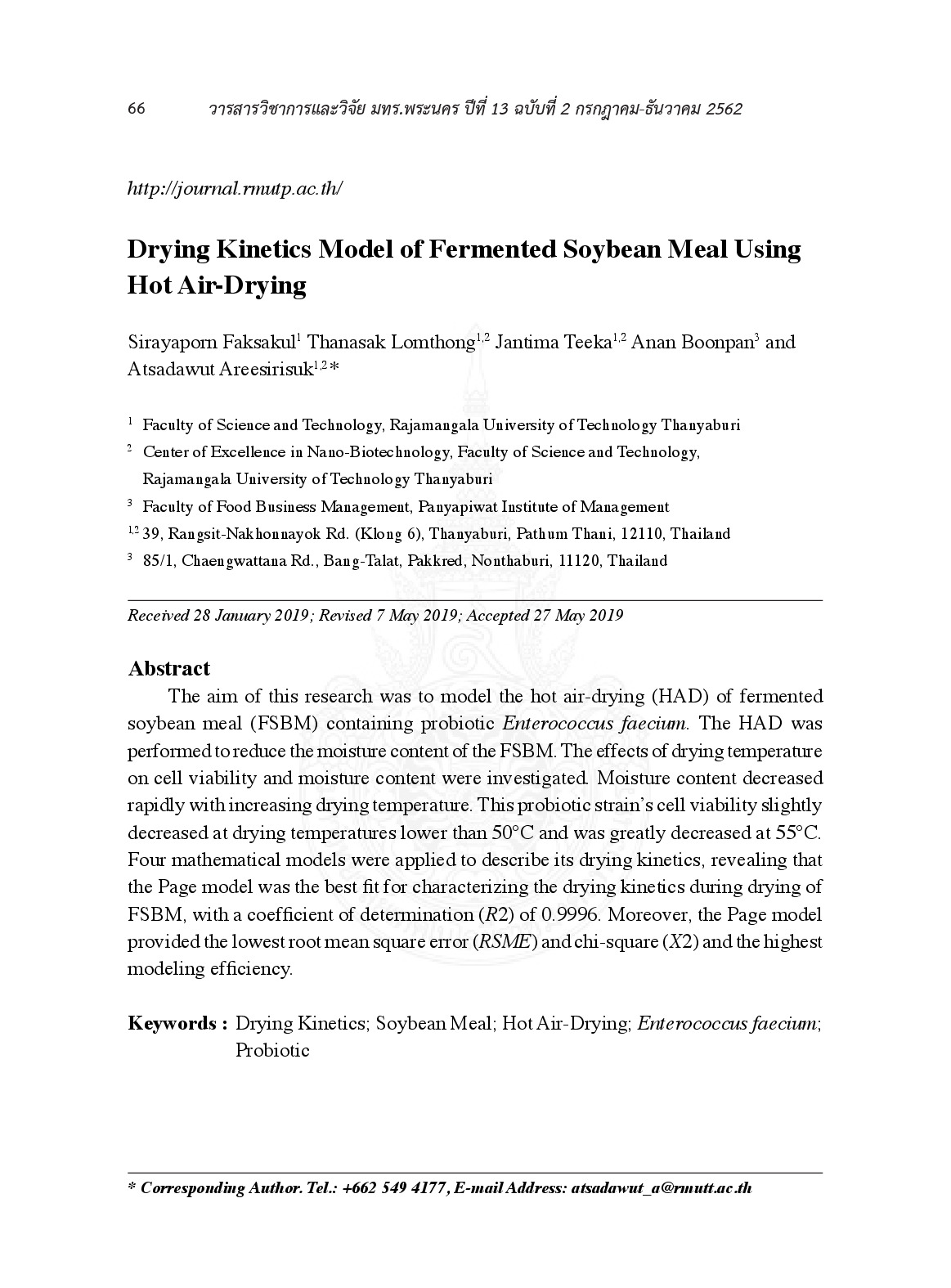
Drying kinetics model of fermented soybean meal using hot air-drying
The aim of this research was to model the hot air-drying (HAD) of fermented soybean meal (FSBM) containing probiotic Enterococcus faecium . The HAD was performed to reduce the moisture content of the FSBM. The effects of drying temperature on cell viability and moisture content were investigated. Moisture content decreased rapidly with increasing drying temperature. This probiotic strain’s cell viability slightly decreased at drying temperatures lower than 50°C and was greatly decreased at 55°C. Four mathematical models were applied to describe its drying kinetics revealing that the Page model was the best fit for characterizing the drying kinetics during drying of FSBM with a coefficient of determination (R2) of 0.9996. Moreover the Page model provided the lowest root mean square error (RSME) and chi-square (X2) and the highest modeling efficiency
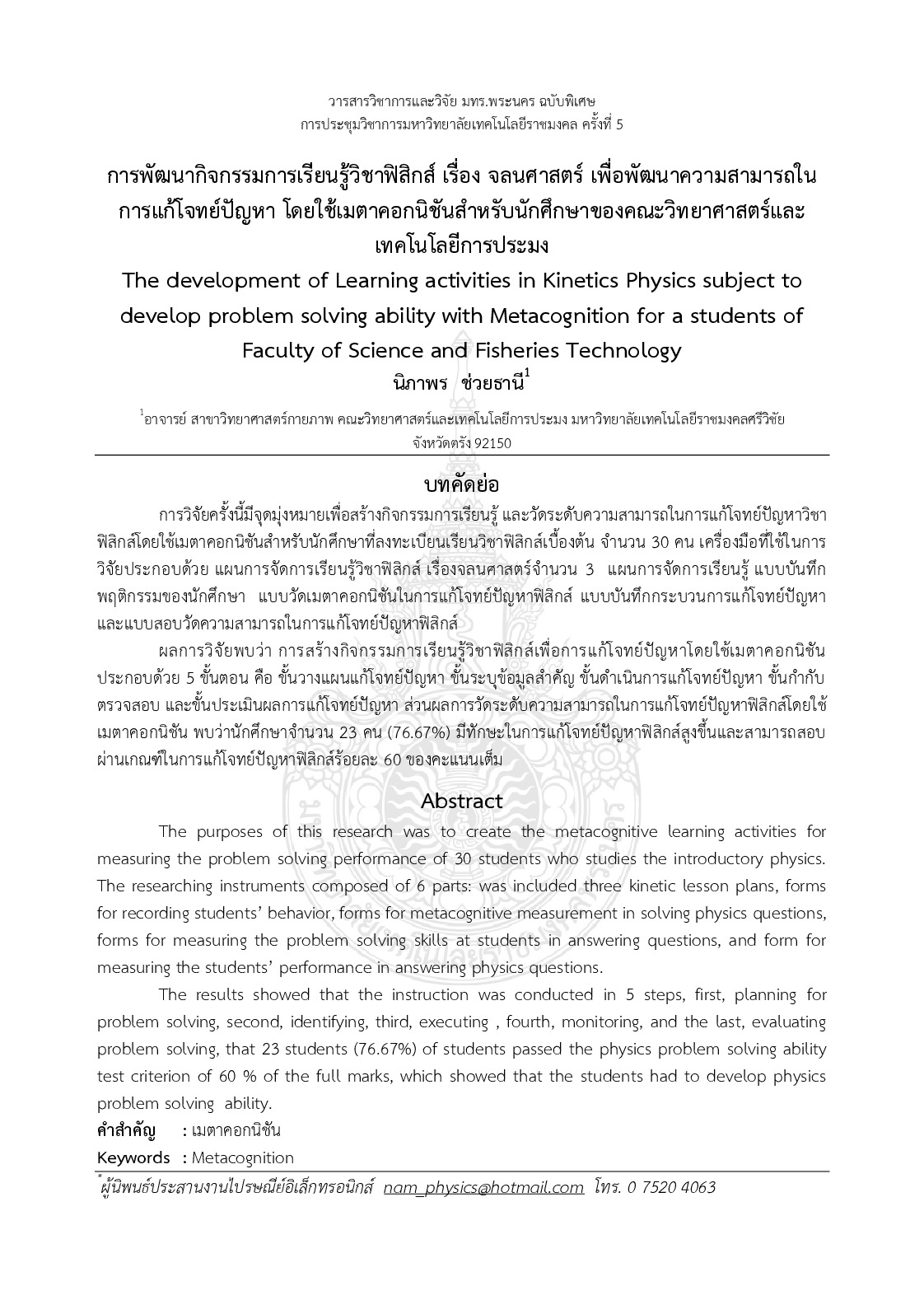
The development of learning activities in kinetics physics subject to develop problem solving ability with metacognition for a students of faculty of science and fisheries technology
The purposes of this research was to create the metacognitive learning activities for measuring the problem solving performance of 30 students who studies the introductory physics. The researching instruments composed of 6 parts: was included three kinetic lesson plans forms for recording students’ behavior forms for metacognitive measurement in solving physics questions forms for measuring the problem solving skills at students in answering questions and form for measuring the students’ performance in answering physics questions. The results showed that the instruction was conducted in 5 steps first planning for problem solving second identifying third executing fourth monitoring and the last evaluating problem solving that 23 students (76.67%) of students passed the physics problem solving ability test criterion of 60 % of the full marks which showed that the students had to develop physics problem solving ability.
การพัฒนาผลิตภัณฑ์เห็ดหอมอบแห้งด้วยไมโครเวฟร่วมกับลมร้อนแบบสายพานลำเลียง
Drying an agricultural product with hot air (HA) method causes a long drying time and results in high specific drying energy consumption (SEC). The dried product has high shrinkage percentage and low rehydration. Therefore this research aims to develop dried shiitake mushroom using belt-conveyor combined microwave-hot air drying method (MHB). The shiitake mushroom was dried by MHB at microwave power of 300 W 400 W 500 W and 600 W and air temperature of 65 oC with air velocity of 0.3 m/s and recycled air of 80% and by the HA drying method at air temperature of 65 oC. The samples were dried until their final moisture content less than 11.1% dry basis. The drying kinetics SEC of drying process and quality of dried shiitake mushroom were evaluated. The quality of dried product was considered in terms of color shrinkage rehydration texture water activity and microstructure. The results showed that the shiitake mushroom drying using MHB gave higher drying rate than that of HA drying method leading to short drying time and resulting in low SEC. The drying rate of un-blanched shiitake mushroom was higher than that of blanched shiitake mushroom. Dried shiitake mushroom from MHB drying gave lower values in shrinkage percentages and hardness but higher rehydration and larger pore size than that dried by HA drying. However the color values (L* +a* and +b*) of dried shiitake mushroom in all cases were not significantly different. Meanwhile dried shiitake mushroom from un-blanched case gave lower values in shrinkage percentage and hardness but higher values in all colors and rehydration and larger pore size than those of blanched case.
ประสิทธิภาพการดูดซับไอออนตะกั่วจากสารละลายโดยใช้อิฐมวลเบาเป็นตัวดูดซับ
In this study autoclaved aerated concrete (ACC) were investigated as low-cost andsimple adsorbents for removal of Pb(II) from aqueous solution. The adsorption of Pb(II) wascarried out by batch experiments as a function of solution pH adsorbent dosage contacttime initial Pb(II) concentration and temperature. The experimental data were analyzed bythe Langmuir Freundlich Temkin and D-R isotherm models. The Langmuir isotherm modelis more suitable. The monolayer adsorption capacity of ACC was found to be 3.99 mg g−1.The adsorption of Pb(II) onto ACC was physical in nature. The kinetic studies of Pb(II)demonstrated that the adsorption of Pb(II) onto ACC adsorbents followed a pseudosecond-order model with a good correlation.