จำนวน Repository ( 3 )
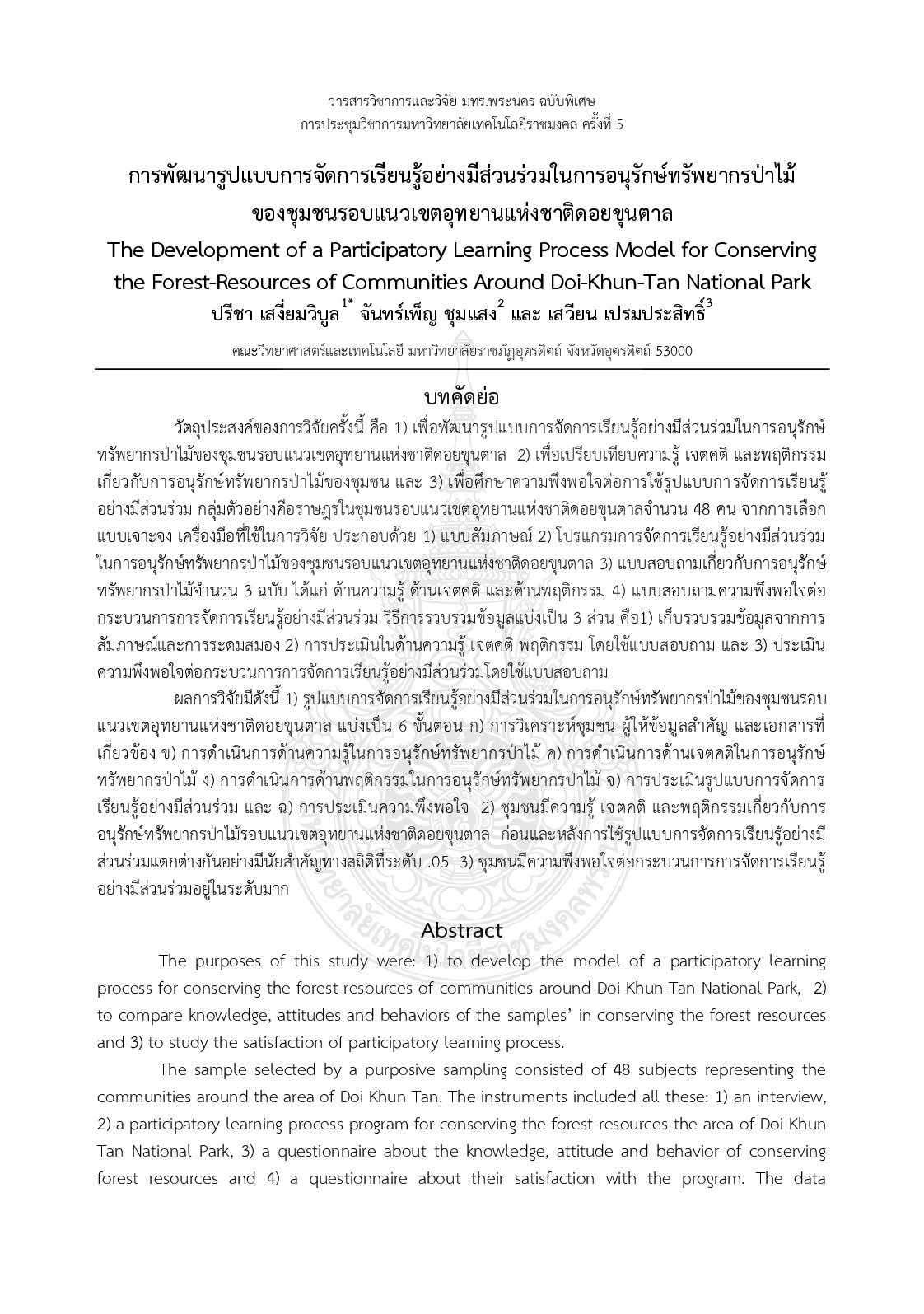
The development of a participatory learning process model for conserving the forest-resources of communities around doi-khun-tan national park
The purposes of this study were: 1) to develop the model of a participatory learning process for conserving the forest-resources of communities around Doi-Khun-Tan National Park 2) to compare knowledge attitudes and behaviors of the samples’ in conserving the forest resources and 3) to study the satisfaction of participatory learning process. The sample selected by a purposive sampling consisted of 48 subjects representing the communities around the area of Doi Khun Tan. The instruments included all these: 1) an interview 2) a participatory learning process program for conserving the forest-resources the area of Doi Khun Tan National Park 3) a questionnaire about the knowledge attitude and behavior of conserving forest resources and 4) a questionnaire about their satisfaction with the program. The data elicitation was drawn from three sources: 1) interviews and brainstorming 2) the assessment of the knowledge attitudes behaviors by the questionnaire and 3) the assessment of the satisfaction with the participatory learning process by the questionnaire. The study revealed these findings: 1) the participatory learning process of model fell into 6 steps consisting of a) the analysis of communities key informants and literature reviews b) the implementation of the knowledge to conserve the forest resources c) the implementation of the attitude towards conserving the forest resources d) the implementation of the behaviors of conserving the forest resources e) the assessment of the participatory learning process and f) the evaluation of satisfaction with the program; 2) the subjects’ knowledge attitudes and behaviors regarding forest conservation at the boundary of Doi Khun Tan before and after the participatory learning process are statistically different at the significance level of .05; and 3) the level of their satisfaction with the participatory learning process was high.
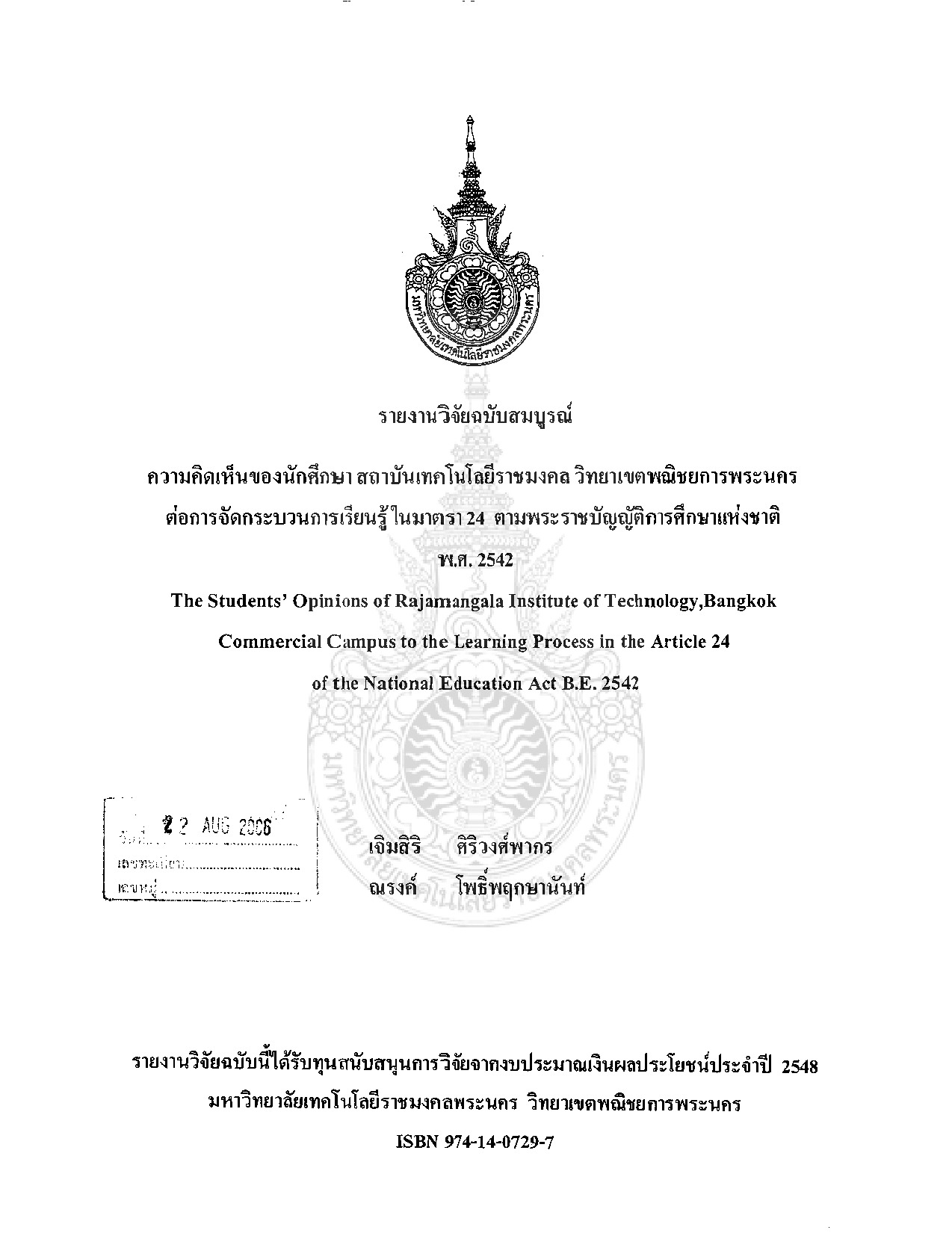
The Students' Opinions of Rajamangala Institute of TechnologY,Bangkok Commercial Campus to the Learning Process in the Article 24of the National Education Act B.E. 2542
The two purpose of this study were as 1.To study the students opinions of Rajamangala Institute of Technology Bangkok Commercial Campus to the learning process according to the Article 24 of the National Education Act B.E. 2542. 2.To compare the students opinions of Rajamangala Institute of Technology Bangkok Commercial Campus to the Article 24 of the National Education Act B.E. 2542 perception by sex and field of study. The 300 samples used in this study were the undergraduate students of Rajamangala Institute of Technology Bangkok Commercial Campus in 8 fields of study from the faculties of Business Administration Mass Communication and Arts. The findings found that most of the samples were in the medium level of opinions to the learning process. It was also found that the accounting field was in the highest level of opinions in the contents of learning given and the business english field was in the highest level of opinion in the activities of learning atmosphere environment of learning and materials of learning. It was found that sex was no statistical significance and field of study was statistical significance at .05

The participatory learning process of leaung rice 11 production without toxic substance case study : khoklam village kamalasai district kalasin provice
This research aims to study participatory learning process to strengthen rural communities through Leaung Rice 11 production which promotes self-reliability and capability of the communities. This is a participatory action research (PAR) with farm experimental methods. It demonstrates a model to empower community which allows members to identify problems discuss find commitment and approve incoming development. Researchers here are therefore facilitators helping people in the community to achieve effective production of Yellow Rice 11. After providing sufficient information about Leaung Rice 11 production the main problems identified is a high production cost with chemical fertilizer being abundantly used causing health and environment problems to the community. This results in a solution of choosing organic Yellow Rice 11 production that is harmless and friendly to the environment. Despite co-operative learning and problems identification locals also get an opportunity to plant Leaung Rice 11 with organic fertilizer and Effective Microorganisms (EM) as a model to safe cost. It is obvious that rice production is also increased (737.69 Kilogram per Rai). Moreover production cost decreases to 1227.50 Baht per Rai per family. This research provides the community ability to analyze self-problems and potentiality under modern research methodology; problems identification solution identification experiment process co-operative learning data collection data discrimination data analysis and data application.