จำนวน Repository ( 8 )

คุณสมบัติเชิงกลของคอนกรีตมวลเบาผสมวัสดุปอซโซลาน
This research study the effect of pozzolanic materials on light weight concrete by replacement cement with fly ash and Meta kaolin which affect the properties of concrete by using pumics aggregate. Coarse in aerated concrete and consider mechanical properties. Aerated concrete replacement cement by fly ash 20% 35% and 50% respectively and meta-kaolin is replaced. From the results it was found that the compressive strength of light weight concrete at 28 days w/b = 0.55 was higher than that of every 14 days of cement and cement cement replacement by fly ash 50% highest value compressive strength. More than all the ingredients replaced with fly ash and Meta kaolin. When considering the flexural strength of replacement cement with 10% by Meta kaolin the maximum flexural strength of 80 ksc was higher than that of control concrete and all other ingradient. Experimental tensile strength at 28 days result found that replacement cement by fly ash at 35% gave the highest tensile strength of 28 ksc and gave higher tensile strength than all other ingradient. From the impact strength test at age 28 days it was found that the replacement cement 35% by fly ash gave the highest impact strength of 92.00 joule than the 20% and 50% respectively and higher impact strength than that of all kaolin. Except for control concrete.
นวัตกรรมเถ้าแกลบ-เปลือกไม้ในคอนกรีตมวลเบาที่เป็นมิตรกับสิ่งแวดล้อม
This research presents a study of the compressive strength tensile strength flexural strength and water absorption of Cellular Lightweight Concrete containing fine rice hush-bark ash. Portland cement (CT) is partially replaced with pozzolans 20 30 and 40% by weight of the cementitious materials. The results show that the compressive strength tensile strength flexural strength and low water absorption of Cellular Lightweight Concrete improves substantially with partial replacement of Portland cement with rice hush-bark ash. Cellular Lightweight Concrete mix cement containing 20 and 30% of pozzolans can be used to make cementitious materials
นวัตกรรมคอนกรีตมวลเบาแบบเซลลูล่าด้วยการใช้วัสดุเหลือทิ้ง
This research presents a study of the compressive strength tensile strength flexural strength and water absorption of Cellular Lightweight Concrete containing fine fly ash and ground bagasse ash. Portland cement (CT) is partially replaced with pozzolans 20 30 and 40% by weight of the cementitious materials. The results show that the compressive strength tensile strength flexural strength and low water absorption of Cellular Lightweight Concrete improves substantially with partial replacement of Portland cement with fly ash and bagasse ash. Cellular Lightweight Concrete mix cement containing 20 and 30% of pozzolans can be used to make cementitious materials. In addition the use of fly ash and ground bagasse ash produces Cellular Lightweight Concrete mix with good compressive strength tensile strength flexural strength and water absorption.
Development of concrete boat by using lightweight concrete
The objective of this study aims to develop a concrete boat by using lightweight concrete. The use of granular foam replaced the aggregate in various quantities to reduce the weight of boat. The replacement ratios of aggregate by the granular foam were 0 25 50 75 and 100% by volume of aggregate. The test results of compressive strength tensile strength modulus of rupture and unit weight of concrete were used to find out the appropriate mixture for producing the concrete boat. The results indicated that the appropriate mixture for producing concrete boat was the replacement of aggregate by granular foam at 100% which had the compressive strength at 28 days of 50.59 kg/cm2 and the unit weight was 949.71 kg/m3. The weight of lightweight concrete was lighter than the normal concrete about 57%. The prototype of lightweight concrete boat which had 1.04 m wide 2.20 m long and 0.38 m height had about 50 kg of weight. The maximum weight capacity of the boat was 240 kg. The cost of a lightweight concrete boat was about 650 baht
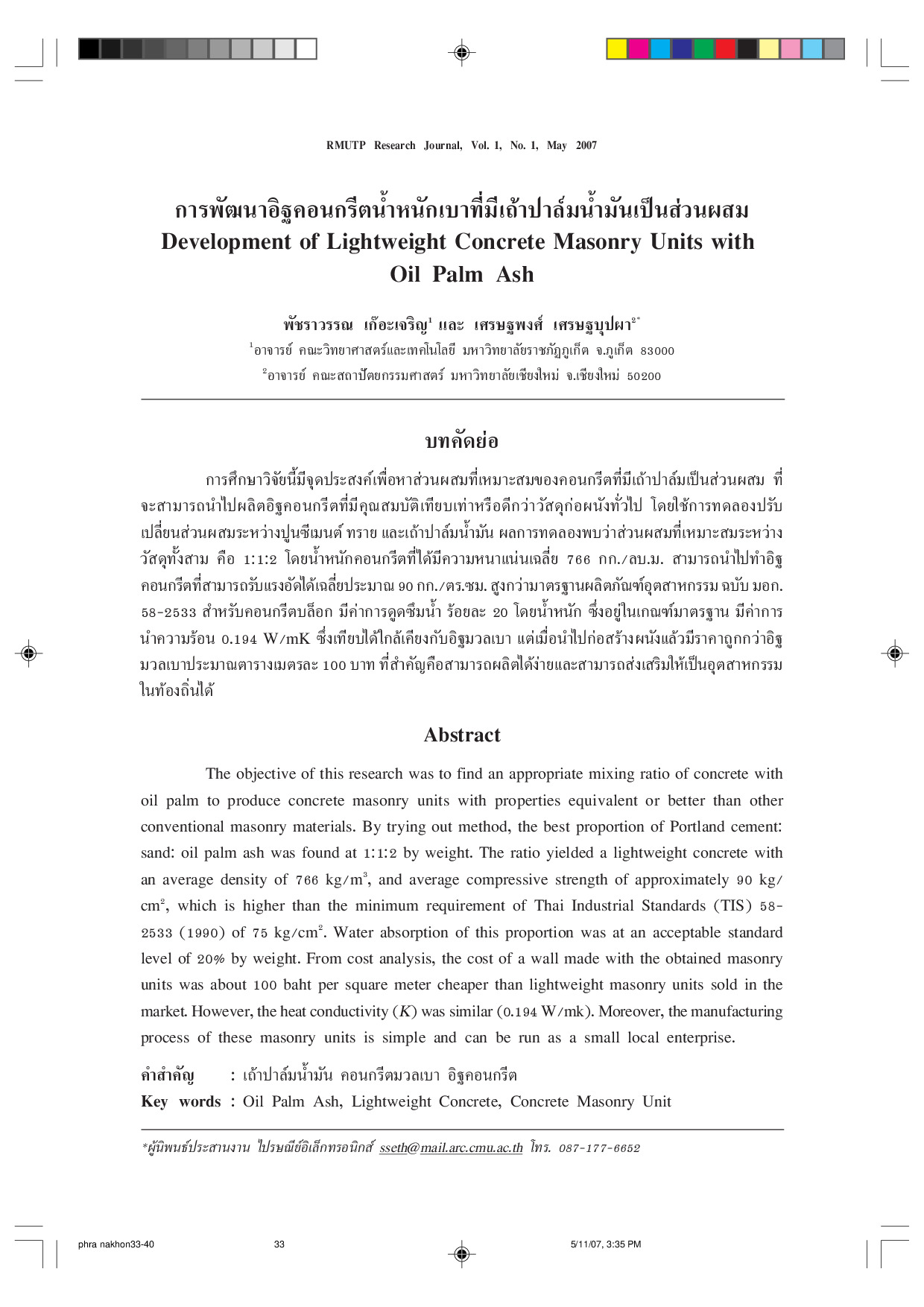
Development of Lightweight Concrete Masonry Units with Oil Palm Ash
The objective of this research was to find an appropriate mixing ratio of concrete with oil palm to produce concrete masonry units with properties equivalent or better than other conventional masonry materials. By trying out method the best proportion of Portland cement: sand: oil palm ash was found at 1:1:2 by weight. The ratio yielded a lightweight concrete with an average density of 766 kg/m3 and average compressive strength of approximately 90 kg/ cm2 which is higher than the minimum requirement of Thai Industrial Standards (TIS) 58- 2533 (1990) of 75 kg/cm2. Water absorption of this proportion was at an acceptable standard level of 20% by weight. From cost analysis the cost of a wall made with the obtained masonry units was about 100 baht per square meter cheaper than lightweight masonry units sold in the market. However the heat conductivity (K) was similar (0.194 W/mk). Moreover the manufacturing process of these masonry units is simple and can be run as a small local enterprise.