จำนวน Repository ( 13 )
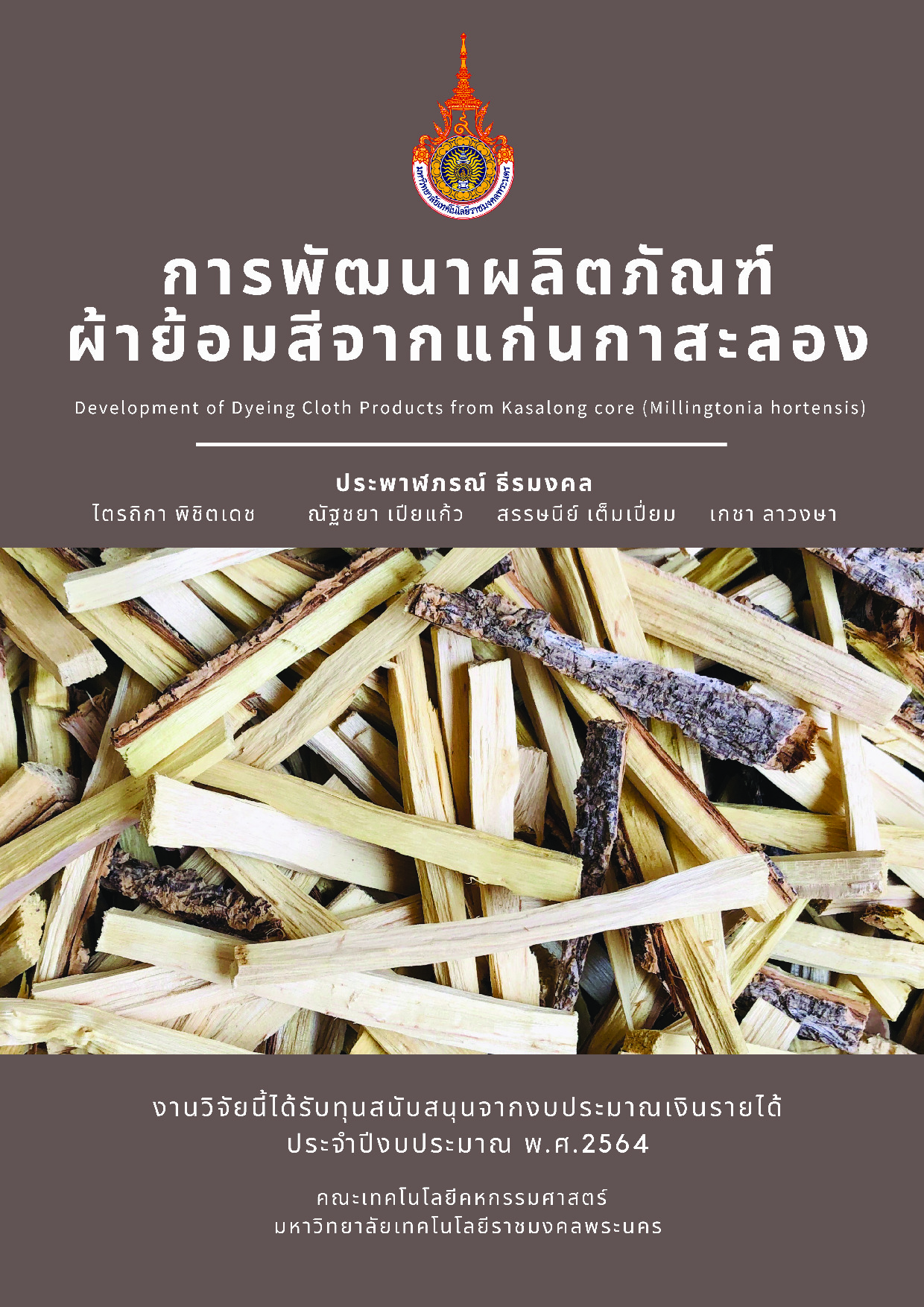
การพัฒนาผลิตภัณฑ์ผ้าย้อมสีจากแก่นกาสะลอง
Promotion of handicrafts in the field of natural dyes in the country. Increase the potential of the community and use the strengths of the cultural community. way of life and wisdom by finding ways to develop textile products by using creative textile innovations based on local wisdom in sustainable community areas To add added value to products in the ECO PRODUCT and ZERO WASTE product groups from the aforementioned concept To conserve plant genetics that exist throughout the country. The researcher therefore studied the process of dyeing fabrics by natural methods. By taking natural ingredients that are locally available and transforming them into environmentally friendly home products. This research is to study the natural dyeing of cotton fabric from Kasalong core. have a purpose Study on the effect of dyeing and the use of adjunctive agents in natural dyeing from Kasalong kernels. To develop dyed fabric products from Kasalong core and to pass on the knowledge and technology of developing dyed fabric products from Kasalong core for the general public. The result of dyeing cotton with natural dyes from Kasalong core. Four types of adhesives were used at a concentration of 20 percent as tamarind juice lime juice lime juice ash water and to test the washing fastness and sunlight resistance with the AATCC standard. The results can be summarized as follows. 1. The results of the study found that from the extraction of color from Kasalong kernels and then filtered with cloth. The color water extracted from Kasalong essence is brown. and when left for 24 hours the water color is dark brown and in this research using hot dyeing methods. 2. The result of dyeing cotton with natural dyes from Kasalong core without mordant using was found to yellow-brown but after washing the color intensity on the fabric fades slightly. 3. The result of dyeing cotton with natural color from Kasalong core. It was found that after washing the color intensity on the fabric was moderately fading. 4. The color measurement L* a* b* found that when the dye was measured in the CIELab system L* = 26.81 a* = 33.33 b* = 45.69 dL = 0.36 and dE*ab = 0.85 water. The resulting color from Kasalong will be reddish yellow. 5. Make the research prototypes as 10 of bag products. 6. Conducting technology transfer by organizing workshops dyeing course and sewing durating of the workshop for students and the general public was 1 day. Most of the participants had the highest level of satisfaction in all questions.
การพัฒนาประสิทธิภาพแผ่นมีดซีเมนต์ทังสเตนคาร์ไบด์สำหรับการตัดปาดผิวหยาบในงานกัด
Carbide Insert efficiency development of this research equivalent to standard insert type : SEKN1203AFTN. For the higher operating efficiency is the machining time by the tool life increased for rough machine of face milling machine. Flank designed to have a flow slot coolant flow rate of coolant to have a incrased convenient flow as a result the surface and cutting edges less heat. The machining ability is different compared to the unslot in flank. The flank slot reduces the contact and slot which to have coolant flow and friction force milling machining. As a result the milling time was 26.31% the vibration was reduced by 35% and the workpiece surface Roughness was reduced 62.79%. As a result to development the phototype product is performance in using and cutting edge increased. It can be apply in using Cement Tungsten Carbide in sustainable industries.

การศึกษาประสิทธิภาพทิศทางการกัดงานที่มีผลต่อความหยาบผิวโดยวิธีการทากุชิ
A Study direction milling affecting surface roughness by the Taguchi method with a 10 mm. bite milling cutter the direction of milling is clockwise G41 and counter clockwise milling. G42 is intended to measure the milling direction of the workpiece by testing with brass and aluminum materials. By measuring the milling direction the feed rate is 100 mm / min the speed is 1500 rpm and the depth of milling is 3 mm. The clockwise and counterclockwise hands provide better surface roughness and from the test the factors that affect the roughness of the surface are brass and aluminum. The coefficient of variation in surface roughness of the test specimens was 4 factors namely feed rate of 80 100 and 120 mm/min speed of 1200 1500 and 1800 rpm. The 3 4 and 5 mm workpieces are machined and the milling direction is divided into two parts: G41 clockwise bite counterclockwise G42 brass and brass material testing. It is found that the correct direction for brass milling is the direction of machining G41 with a cutting speed of 1200 rpm. The feed rate is 120 mm/min. And the depth of bite is 4 mm. The surface roughness of the workpiece is minimal. The surface roughness is 0.84 ?m. The optimum direction for aluminum milling is G42 cutting direction. The cutting speed is 1200 m/min. The feed rate is 120 mm/min. And the depth of biting is 5 mm. The surface roughness of the workpiece is minimal. The surface roughness was 0.75 ?m.
The Mechanical strength of white rice kernel related to milling quality
The processes of rough rice milling for increase head rice yield are depending on several factors. The paddy rigidities are the one of these is effect to head rice yield. In the past research papers were showed that the qualities of milling were measuring from head rice yield and rigidities of rough rice were rerated to head rice yields. In this research aim to test the rigidities of the white rice with the bending test and showing the relation between white rice rigidities and head rice yield. The PTT1 RD41 RD31 and RD49 rice varieties were used in the experiment. The result showed that the high relation between the brown rice yield and head rice yield with determination coefficient was 0.81and the brown rice yield was heavy weight more than the head rice yield about 20%. The determination coefficient between the white rice rigidities and head rice yield was 0.16 showed that the less relation.
Mechanical properties of concrete mixed with reused ceramic tiles reinforced with steel fiber from milling processed
This research study the mechanical properties of concrete mixed with reused ceramic tiles reinforced with steel fiber from milling processed. The compressive strength of all concretes were designed at 300 ksc at 28 days and control slump in the range of 10 ? 2.5 cm. The steel fiber from milling processed was reinforced at 0.50 1.00 and 1.50 by the weight of cement content. The compressive strength Flexural and tensile splitting for all concrete samples were tested compare with control concrete which it as concrete mixed with reused ceramic tiles not reinforced with steel fiber. The results shown that the reinforcing with steel fiber from milling process at 0.5 and 1.0% was affect to the higher compressive strength than control concrete of 2 and 7% but increasing steel fiber at 1.5% was affect to lower compressive strength than control concrete of 6%. Concrete mixed with steel fiber from milling processed at 1.0% have higher splitting tensile strength than control concrete of 16% while concrete mixed with steel fiber at 0.5 and 1.5% have splitting tensile strength equal with control concrete. The flexural strength of these concretes have higher more than control concrete about 9 17 and 11% for reinforcing with steel fiber at 0.50 1.00 and 1.50 respectively. In addition the water permeability of concretes were increased when the steel fiber were reinforced increases too.