จำนวน Repository ( 2 )

การเลือกฟังก์ชันการแจกแจงความน่าจะเป็นสะสมสำหรับแนวโน้มเพื่อสร้างตัวแบบสำหรับวิเคราะห์ข้อมูลอนุกรมเวลาหลายๆตัวพร้อมกันที่มีค่า อัตตสหสัมพันธ์แนวโน้ม และค่าผิดปกติ ด้วยวิธีของเบย์: กรณีศึกษาราคาหุ้นที่มีความผันผวนของตลาดหลักทรัพย์แห่งประเทศไทย
The objective of this research is to select a proper cumulative function for trend in an analysis of simultaneous multiple time series data with autocorrelation trend and outliers using a Bayesian method. The proposed model is applied to fluctuate stock price data in the stock exchange of Thailand. The data consist of the closing prices of 5 stocks. The algorithms are written in OpenBUGS and the performance of the model is evaluated via a simulation study in R. The cumulative distribution functions considered here are a Weibull cumulative distribution function and an exponential cumulative distribution. They are compared using RMSE MAPE and MAE as criteria. The research found that an exponential cumulative function for trends gives smaller values of the three criteria in both model fitting and model validation for the4 stocks EA NWR and KTB. However a Weibull cumulative distribution function gives smaller values of three criteria for the PTT in both model fitting and model validation.
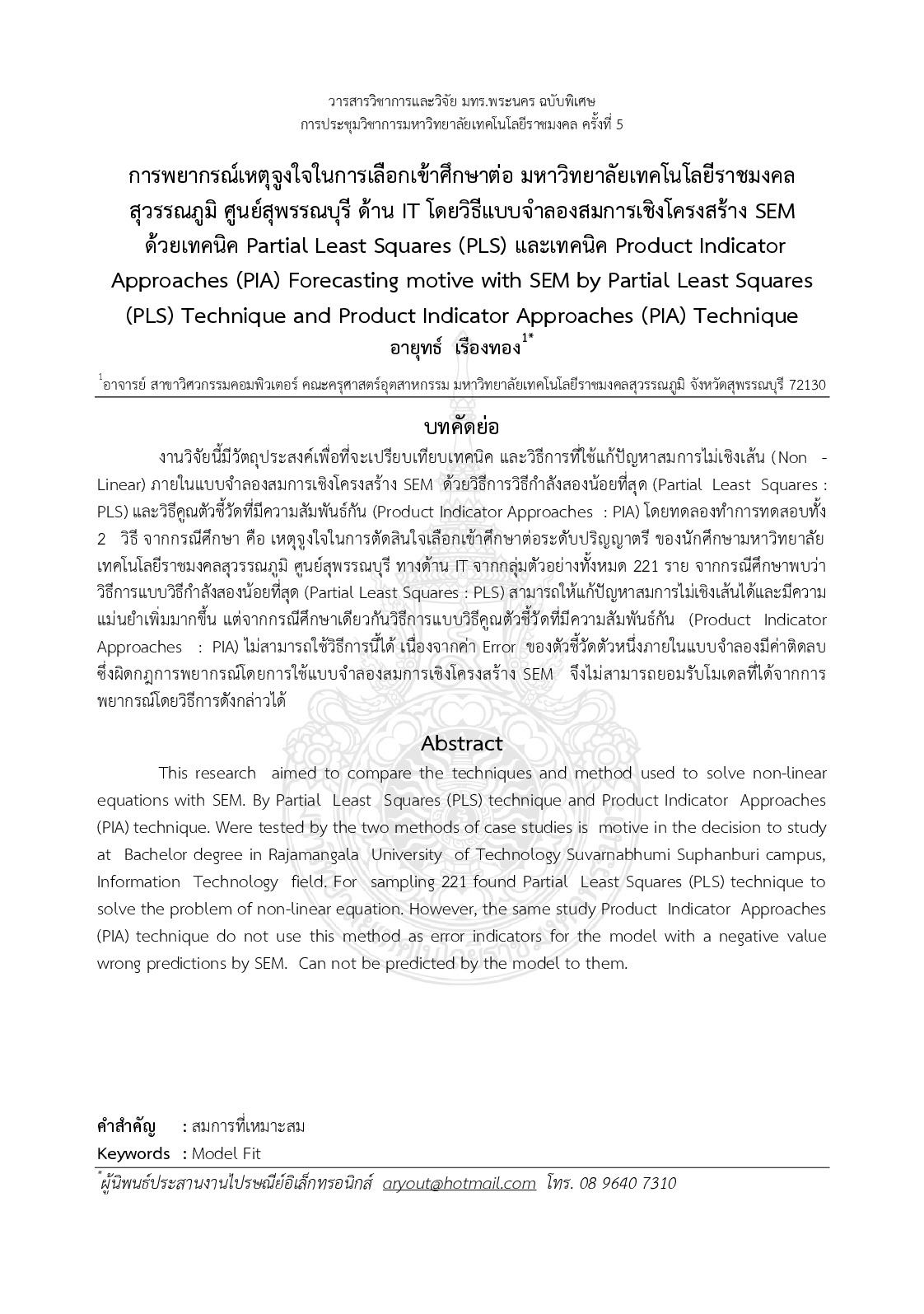
Approaches (PIA) forecasting motive with SEM by partial least squares (PLS) tchnique and product indicator approaches (PIA) technique
This research aimed to compare the techniques and method used to solve non-linear equations with SEM. By Partial Least Squares (PLS) technique and Product Indicator Approaches (PIA) technique. Were tested by the two methods of case studies is motive in the decision to study at Bachelor degree in Rajamangala University of Technology Suvarnabhumi Suphanburi campus Information Technology field. For sampling 221 found Partial Least Squares (PLS) technique to solve the problem of non-linear equation. However the same study Product Indicator Approaches (PIA) technique do not use this method as error indicators for the model with a negative value wrong predictions by SEM. Can not be predicted by the model to them.