จำนวน Repository ( 10 )
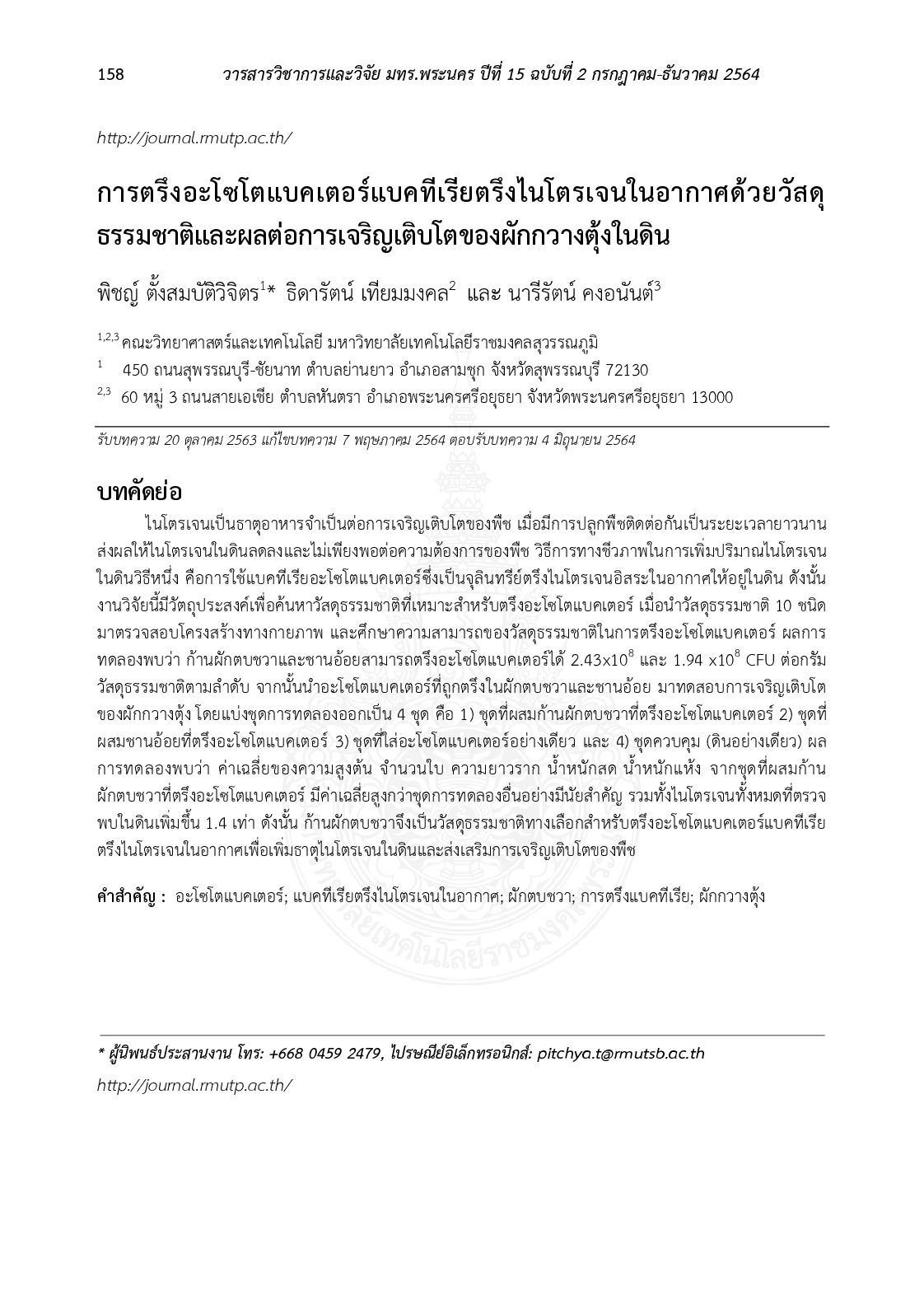
การตรึงอะโซโตแบคเตอร์แบคทีเรียตรึงไนโตรเจนในอากาศด้วยวัสดุธรรมชาติและผลต่อการเจริญเติบโตของผักกวางตุ้งในดิน
Nitrogen is an essential nutrient for plant growth. When the plants have been grown for a long-term effect to decreased nitrogen in soil and insufficiency of the plant growth. One biological method for increasing the nitrogen content in soil is utilize of free nitrogen-fixing bacteria Azotobacter. Therefore the objective of this research was to search natural material suitable for Azotobacter fixation. The 10 natural materials were observed physical structure and investigated the ability of natural materials for Azotobacter fixation. The results showed that water hyacinth and bagasse stalks were fixed the Azotobacter of 2.43x10⁸ and 1.94 x10⁸ CFU per gram of each natural material respectively. After that the selected fixed Azotobacter of water hyacinth and bagasse stalks were studied the growth of Brassica Chinensis. This experiment was designed to 4 treatments. The first treatment was mixed of water hyacinth stalks and the Azotobacter. Second treatment was mixed of bagasse stalks and the Azotobacter. The third treatment was the Azotobacter only. The last treatment was soil only. The results indicated that the average of plant growth include height leaf number root length fresh weight and dry weight of the mixed of water hyacinth stalks and the Azotobacter had significantly higher growth rates than other treatments. The total nitrogen was also increased 1.4 fold in the soil. All results suggest that the water hyacinth stalk is alternative for the fixation of the free nitrogen-fixing bacteria Azotobacter as induce nitrogen in the soil and plant growth promotion.
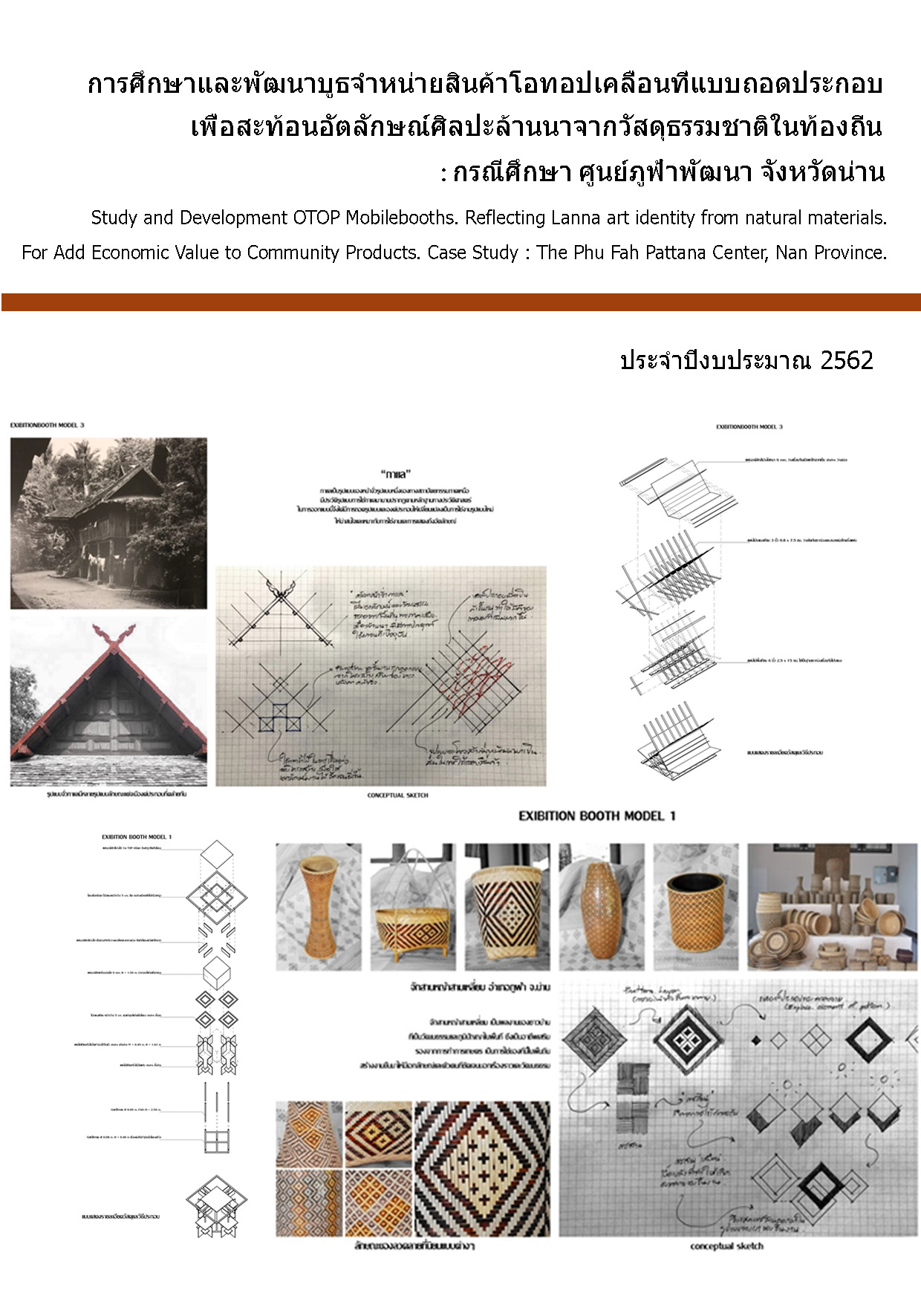
การศึกษาและพัฒนาบูธจำหน่ายสินค้าโอทอปเคลื่อนที่แบบถอดประกอบ สะท้อนอัตลักษณ์ศิลปะล้านนาจากวัสดุธรรมชาติในท้องถิ่นเพื่อเพิ่มมูลค่าทางเศรษฐกิจให้กับผลิตภัณฑ์ในชุมชน : กรณีศึกษา ศูนย์ภูฟ้าพัฒนา จังหวัดน่าน
This research aims to improve the booth model of OTOP products from Phu Fah Pattana Center Nan Province. To increase marketing channels by distributing products to various locations in order to increase sales to community products. The design must take into account the convenience of rapid assembly and dismantling for a limited time. The characteristics of the booth must be disassembled interesting in looks that reflect the identity of Lanna art. There is a beautiful strong structure to support the weight of the product. The size and proportion are suitable for the usage habits of consumers. Which will help promote products in the community that have higher sales stronger communities. Able to divide the product market in the country and can create marketing channels to other countries. It is a good result for the villagers in the community that will have the guarantee of self-sufficiency and sustainably sufficient lives. From the analysis of the Lanna Wisdom Identity Model there are 4 types of concepts which are The concept of the components of the house GalaeThe concept from the barn Concept of the components of the house Kwan Concept of triangular pattern woven grass. After that it was developed to the stage to interpret the meaning of space in form of booth. And then lead to the design of 4 booths. And conducted a questionnaire to find satisfaction with each type of booths that responded to various usability benefits including satisfaction with the appearance and usage characteristics that responded to the behavior of Most users. Conclusion Booths from the concept of Lanna house components called galae have the highest percentage of satisfaction in 3 aspects which are Percentage of satisfaction with the layout of the booth Percentage satisfaction with workpiece assembly and disassembling storage and transportation Percentage of satisfaction with the perception of Lanna identity. For the satisfaction with the size the proportion of use and the convenience of use the booth from the concept of the components of the house Kwan with the highest rate of percentage satisfaction.
การประยุกต์กระบวนการการขึ้นรูปด้วยเทคนิคการขึ้นรูปยางผลิตต้นแบบภาชนะด้วยวัสดุธรรมชาติ
Most of the current containers that we put food are made of plastic or foam boxes. After the use is finished the container becomes rubbish and will greatly affect the environment. Due to slow degradation Plus informal disposal And higher consumption The use of natural products is in great demand. Because it is beautiful and natural-looking pleasing to consumers Therefore the basic processes forming patterns were studied by rubber product molding techniques. Determine the material to be molded into the sample container. Design and build a small molding set. Provide binders used for the stabilization of natural materials. Experiment for forming and the Conclusion of the experiment From the results of operations and experiments it was found that the study of the prototype extrusion set Using a rubber molding technique Can be applied by various elements The process of rubber molding can be used in the development of natural container molding and the process can produce prototype containers from natural materials. Under the suitable size of the mold the area of the mold is smaller than the mold plate area of the machine or the size of the mold area the area of no more than 60-70% of the mold holder plate.

การศึกษาวัสดุธรรมชาติ เพื่อการออกแบบผลิตภัณฑ์สำหรับปลูกต้นไม้
The Study Natural Materials to Product Design for Tree Planting. Studying natural materials To design a product for a tree Study on utilization of natural materials. Study and development of natural materials and ratios of various materials suitable for planting products. And compare the properties of natural materials. Made to plant products. To achieve the objectives of the research. Researchers conducted various researches. And present the results of data analysis. The best ratio is natural material: cement: 1: 1.5: 2 water: 695 kg / m 3 Water absorption test of various materials mixed with all three types of materials. Water absorption of soil and glue mixture is best absorbed. The absorption was 88%. Experiment on the swelling of natural materials mixed with all three types of materials. The test results showed that the swelling rate of cement mixed materials. The smallest swelling was 0.332 millimeters (0.08 millimeters). The questionnaire was used to collect data from 150 questionnaires. Statistical analysis is used to determine frequency. Of the 150 respondents about 94.7% of the rubber tree structure was found. 65.3% of the products obtained from the rubber leaves were 49.3%. There were 5 - 10 types of rubber leaves. The 80 respondents commented that most of the products of the rubber leaves were flowers (53.3%). The answer was 132 respondents representing 88%. On the durability of natural products 49.3% said that the products of natural materials are durable medium. There were 10 - 50 species of natural materials 52.7% of them had opinions about 51% of natural plant products. 59% had good quality 53% were good in natural materials 53% satisfied with the color of natural plant products 60% satisfied with the products. At the same time 47% of the products were planted in natural materials 47% of which were of good quality. 98% of tree planting products. The research found that people are interested in products for planting trees from natural materials. It is a combination of natural materials to create a new material with unique patterns. It can also be developed into more products.
การพัฒนาคุณภาพของภาพนูนต่ำที่ทำจากวัสดุธรรมชาติชนิดต่างๆ
Based on the research on creation of bas-relief molds for production of bas-reliefs made from boiled pineapple leafs conducted by Rachadasak Pengcum of which purpose was to help generate income for members of Pineapple Leaf Paper Community Enterprise Ban Pasang Wiwat Mueang District Chiang Rai Province it was found that the bas-reliefs need further improvements in terms of appearance and durability as well as the use of other natural raw materials to produce them. The researcher therefore has considered developing the previous research by applying other 3 valueless natural materials which include rice straw water hyacinth and banana stem skin to make bas-reliefs for different beautiful surfaces of the products. Also the quality of bas-reliefs has been comparatively investigated by surveying satisfactions of members of the Community Enterprise and visitors to the project towards the bas-reliefs made from rice straw water hyacinth and banana stem skin. The total period of questionnaire distribution was 3 months. There are 59 respondents administering the questionnaires most of whom (43 persons) are female which accounts for 72.88 per cent. The majority of the respondents (25 persons) obtained junior/senior secondary school diplomas or equivalent accounting for 42.37 per cent. 16 respondents or 27.12 percent are 60 years of age. As for satisfactions towards the bas-reliefs made from rice straw 89 times of “strongly agree” was selected whereas 126 times of “pretty much agree” 75 times of “fairly agree” and 5 times of “disagree” were marked by the respondents. Concerning the bas-reliefs made from water hyacinth 87 times of “strongly agree” was selected while 97 times of “pretty much agree” 110 times of “fairly agree” and 1 time of “disagree” were chosen. When asked about the bas-reliefs made from banana stem skin the respondents selected 77 times of “strongly agree” 99 times of “pretty much agree” 110 times of “fairly agree” and 8 times of “disagree”.