จำนวน Repository ( 12 )
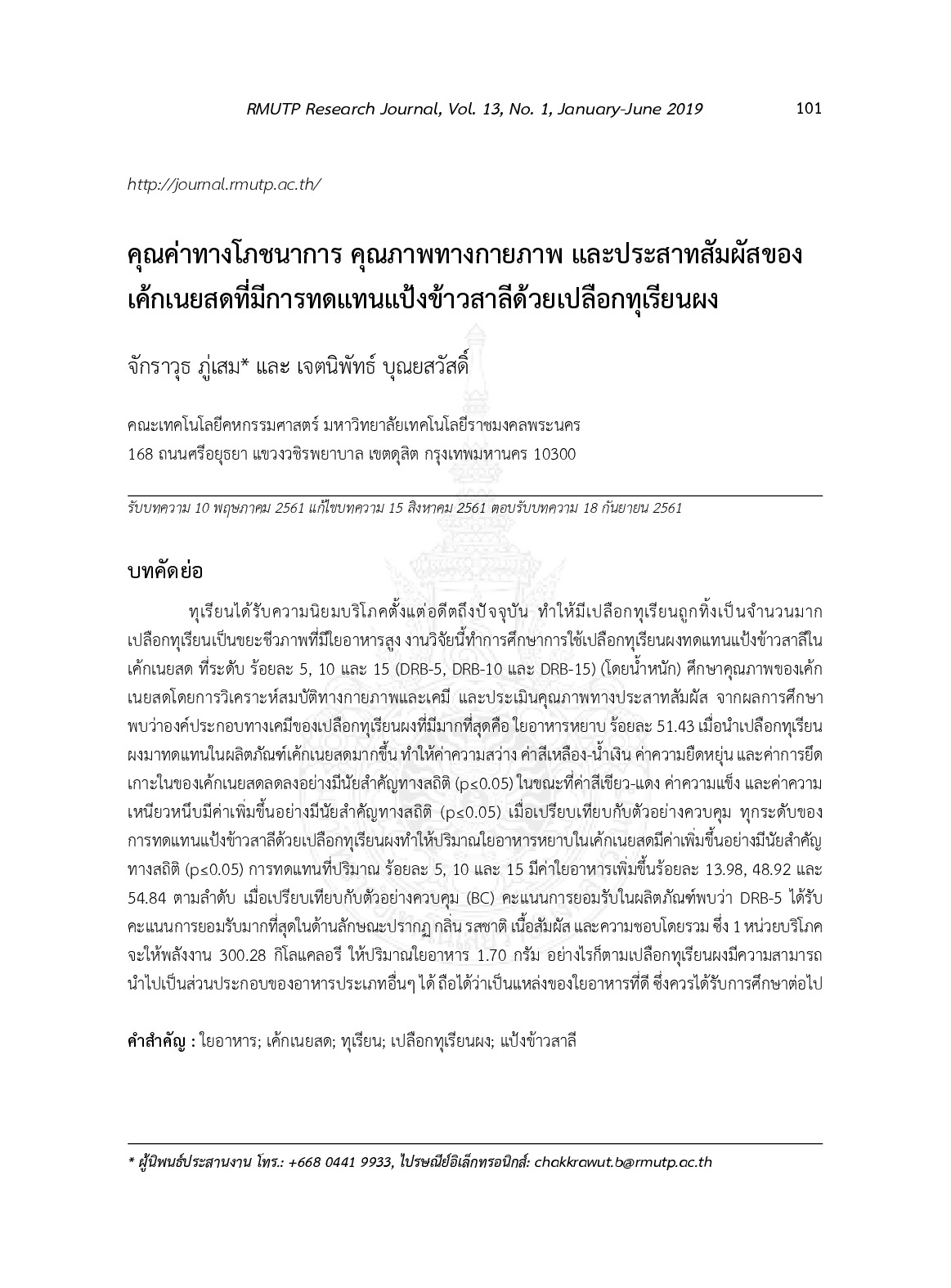
คุณค่าทางโภชนาการ คุณภาพทางกายภาย และประสาทสัมผัสของเค้กเนยสดที่มีการทดแทนแป้งข้าวสาลีด้วยเปลือกทุเรียนผง
Durian has been very popular not only local people but also tourists. As a result there are many durian peels wasted so this research is explored the utilization of durian peels. Durian rind is a biological waste but contains high amount of crude fiber. This research aims to study using durian rind powder to replace wheat flour in butter cakes at 5 10 and 15 % (w/w) (DRB-5 DRB-10 and DRB-15). Physical properties chemical composition and sensory evaluation of the butter cakes were analyzed. The results showed that durian rind powder contained 51.43 % of crude fiber. Increasing of durian rind powder in butter cakes showed significant decreasing of lightness (L*) blue–yellow component (b*) springiness and cohesiveness values while green–red component (a*) hardness and gumminess values were significantly higher than the control sample (BC) (p≤0.05). Dietary fiber content of the products shown significantly increased by 13.98% for DRB-5 48.92 % for DRB-10 and 54.84% for DRB-15 as compared with BC (p≤0.05). The acceptance scores of DRB-5 including appearance odor taste texture and overall liking scores were highest. There are 300.28 kcal for 1 serving of butter cake which contain 1.70 gram of dietary fiber. However durian rind powder can be used as a food ingredient and source of dietary fiber in other food recipes for further studies.
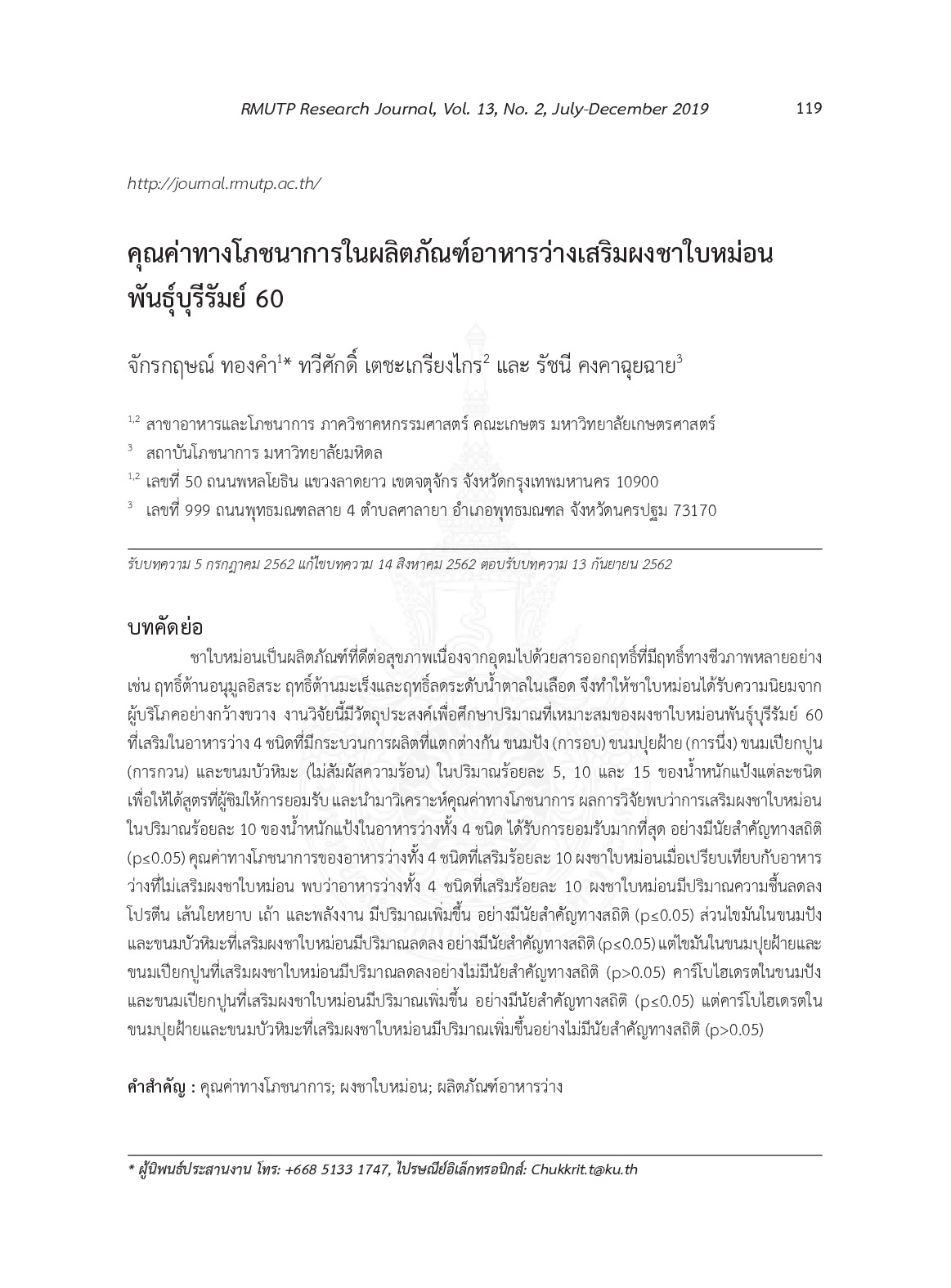
คุณค่าทางโภชนาการในผลิตภัณฑ์อาหารว่างเสริมผงชาใบหม่อนพันธุ์บุรีรัมย์ 60
The potential health benefits attributed to mulberry leaf tea and its bioactive compounds such as antioxidant effects cancer chemoprevention and lower blood sugar levels have led to a huge increase of mulberry leaf tea products in the food market. The objectives of this research were to determine the appropriate amount of mulberry leaf tea powder Buri Rum 60 added in 4 snack products which were cook by 4 different process i.e. bread (baked) puifai (steam) peakpoon (stir) and snow lotus (no heat treatment). The Mulberry leaf tea powder was used in the ingredients for 3 levels i.e. 5 10 and 15%. Then the most preferred formula was analyzed for the nutritional values. The result showed that all 4 snacks added with Mulberry leaf tea powder at level of 10% were accepted the most. The nutritive value of these 4 snacks indicated that the moisture contents decreased while protein fiber ash energy increased significantly (p≤0.05). In comparison to the original formulas fat decreased significantly in bread and snow lotus added with mulberry leaf tea powder (p≤0.05) and decreased non-significantly in puifai and peakpoon added with Mulberry leaf tea powder (p>0.05). Carbohydrate increased significantly in bread and peakpoon added with mulberry leaf tea powder (p≤0.05) and increased non-significantly in puifai and snow lotus added with Mulberry leaf tea powder (p>0.05).

การให้ความรู้ด้านโภชนาการแก่ผู้มีภาวะอ้วนลงพุง กรณีศึกษา โรงพยาบาลส่งเสริมสุขภาพ ตำบลไผ่งาม อำเภอโคกสูง จังหวัดสระแก้ว
The objectives of this research are; 1) To compare the nutrition knowledge of metabolic syndrome patients before and after was educated by 3 methods as follows: Educate by nutrition manual using Educate by suggestion and Educate by telephone; 2) To compare the nutrition knowledge differences of metabolic syndrome patients classified by 3 educated methods: nutrition manual suggestion and telephone using. Nutrition manual and Questionnaires were analyzed. Statistics which was used in analysis are Frequency Percentage Mean Standard Deviation t-test F-test and Scheffe’s Method. The results show the comparison of the results of the differences in knowledge of nutrition in metabolic syndrome patients as classified by 3 educational method found that metabolic syndrome patients’ nutritional knowledge between those who were educated by nutrition manual use only those educated by suggestion and those educated by communication device differed statistically significantly at a .05 level. Using Scheffe’s Method the multiple comparison test of nutrition knowledge of metabolic syndrome patients as classified by educational method found that the metabolic syndrome patients who were educated using the nutrition manual had a greater understanding of nutrition than the metabolic syndrome patients educated by suggestion. Moreover metabolic syndrome patients who were educated using the nutrition manual had a greater knowledge of nutrition than the metabolic syndrome patients who were educated using a communications device.
การปรับปรุงคุณค่าทางโภชนาการของขนมบุหงาปูดะด้วยไข่ขาวผง
The Improvementof Nutritional Value ofKhanomBunga budaby usingEgg White Powder.The purpose To study the basic recipeof KhanomBunga buda by selecting 3 recipes to determine the acceptability of the teste. Which use Egg White Powderin 3 levels that are 4 6 and 8 percent of weight coconut. The experiment is analyzed by Randomized Complete Block Design (RCBD) to evaluate the sensory quality in appearance color flavor teste texture and overall preference. The sensory in evaluation is tasted by 9 – Point Hedonic Scale from 80 persons. The instructors and student of the Faculty of Home Economics Technology Rajamangala University of Technology Phra Nakhon. After that the analyzed by analysis of variance (ANOVA) and of Least Significant Difference (LSD) statistically significant level 0.05The research shows that 8 percent of Egg White Powder in the best substituted amount as an ingredient of KhanomBunga buda by the appearance color flavor teste texture and overall the average points are 7.86 7.84 7.797.72 7.76 and7.93respectively. The analysis of variances and Range Test are significant difference in the level ofstatistical 0.05 Study the nutritional value of Khanom Bunga Buda 100 grams is 356 calories of energy Moisture content of 20 percentCarbohydrates 62.9 percent 8.91 percent proteinFat 7.92 percent and 3.77 percent fiber.
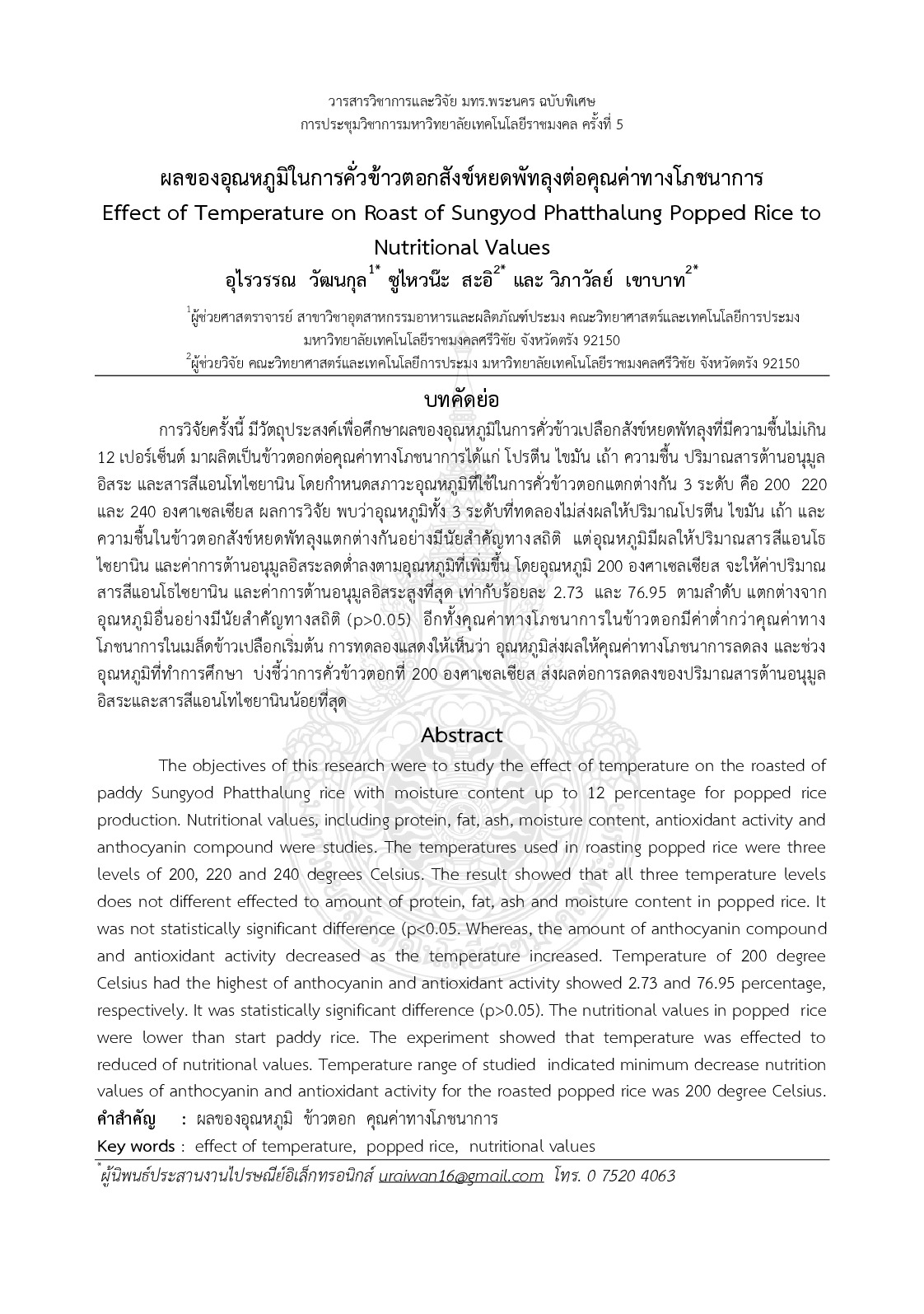
Effect of temperature on roast of sungyod phatthalung popped rice to nutritional values
The objectives of this research were to study the effect of temperature on the roasted of paddy Sungyod Phatthalung rice with moisture content up to 12 percentage for popped rice production. Nutritional values including protein fat ash moisture content antioxidant activity and anthocyanin compound were studies. The temperatures used in roasting popped rice were three levels of 200 220 and 240 degrees Celsius. The result showed that all three temperature levels does not different effected to amount of protein fat ash and moisture content in popped rice. It was not statistically significant difference (p<0.05. Whereas the amount of anthocyanin compound and antioxidant activity decreased as the temperature increased. Temperature of 200 degree Celsius had the highest of anthocyanin and antioxidant activity showed 2.73 and 76.95 percentage respectively. It was statistically significant difference (p>0.05). The nutritional values in popped rice were lower than start paddy rice. The experiment showed that temperature was effected to reduced of nutritional values. Temperature range of studied indicated minimum decrease nutrition values of anthocyanin and antioxidant activity for the roasted popped rice was 200 degree Celsius.